
What is an Attachment-Type Elevating Scaffold? A Comprehensive Analysis of Types, Applications, and Selection
In high-rise construction and exterior wall operations, safety, efficiency, and cost control remain core objectives of project management. Within the booming construction industry of high-rise and super-high-rise buildings, attachment-type elevating scaffolds (commonly known as climbing scaffolds) have become essential core equipment for ensuring safety in exterior facade work and enhancing construction efficiency in modern projects.
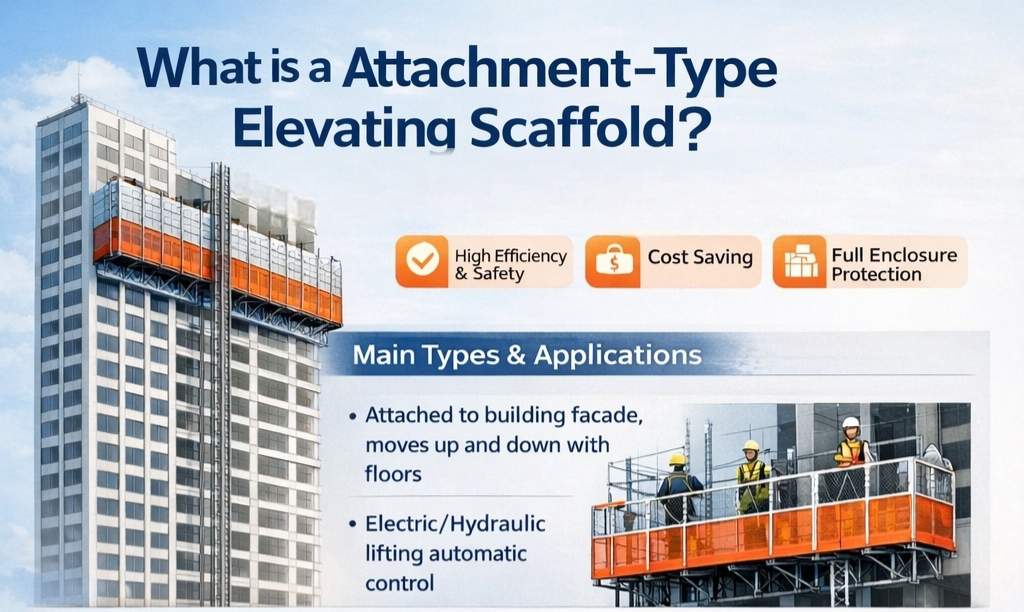
Attachment-Type Elevating Scaffold
1.What is an attached climbing scaffold?
An attached climbing scaffold, abbreviated as “climbing scaffold,” is a new type of construction scaffolding equipment that attaches to the main structure of a building. Utilizing electric or hydraulic lifting systems, it achieves synchronized lifting and lowering of the entire structure. During construction, it remains fixed to the building’s exterior facade, ascending or descending floor by floor as construction progresses. This eliminates the need for repeated disassembly and reassembly, consistently providing workers with a stable and secure operating platform.
Core Features
Compared to traditional ground-based or cantilevered scaffolding, attached climbing scaffolding offers distinct advantages:
– Ground-free installation minimizes site footprint
– Full-unit lifting enables high reuse rates
– High automation ensures safer operation
– Fully enclosed protection promotes civilized construction practices
– Ideal for high-rise and super-high-rise building projects
2.Main Types & Applications of Attached Climbing Scaffolding
A.Classification by Primary Material (Mainstream Categories)
All-Steel Integrated Attachment-Type Elevating Scaffolding
This is the most widely used mainstream type in high-rise construction. Core components—including the main frame, scaffolding boards, and safety nets—are steel structures, making it the industry’s preferred choice.
Core Advantages: Exceptional overall rigidity and frame stability; outstanding wind load resistance, fireproofing, wear resistance, and corrosion resistance; high load-bearing capacity accommodating heavy construction equipment and material storage; standardized modular production enables easy assembly and multiple reuses, resulting in low overall operating costs.
Suitable Scenarios: Super high-rise concrete structures like residential buildings and commercial office towers; large public buildings with regular facade designs; construction projects demanding strict scaffolding stability and fire resistance; standardized reusable equipment for construction companies.
Aluminum-Steel Composite Climbing Scaffolding
A lightweight climbing scaffold featuring an aluminum alloy core frame with steel reinforcements at critical load-bearing points, balancing lightness and load capacity.
Core Advantages: – Lightweight frame significantly reduces wall-mounted loads on the building structure; – Effortless assembly and lifting operations enhance construction efficiency; – Aluminum alloy surface resists oxidation for a clean appearance, suitable for high-quality facade construction; – High flexibility allows adjustable mounting points to adapt to complex shapes.
Suitable Scenarios:
– High-rise steel-framed structures with limited wall-bearing capacity
– Projects requiring flexible scaffolding adjustments for varied facade designs
– Exterior decoration of mid-to-high-rise residential/commercial buildings
– Temporary, short-term projects demanding high turnover efficiency
Steel Pipe Coupler-Type Climbing Scaffolding
An early climbing scaffold type primarily assembled with steel pipes and couplers. It offers lower costs but relatively lower safety and standardization levels.
B.Classification by Lifting Power/Control Method
Electric Hoist-Type Climbing Scaffolding
Utilizes electric hoists for lifting power, currently the most widely adopted type. Synchronized control devices enable simultaneous lifting across all positions, offering simple operation, easy maintenance, stable power, and suitability for most high-rise construction scenarios.
Hydraulic Attachment Hoist Scaffolding
Utilizes hydraulic cylinders for lifting power, offering smoother movement, flexible speed adjustment, and minimal impact on the scaffold structure. Ideal for complex facade designs and super-high-rise buildings demanding exceptional lifting stability. However, it involves higher equipment costs, maintenance expenses, and stricter technical requirements.
Manual Climbing Scaffolding
Powered by manually operated chain hoists, this type is only suitable for small-scale projects with low lifting heights and light construction loads. Due to its low efficiency and high labor costs, it is rarely used in medium-to-large high-rise or super-tall projects.
3.How to Select an Anchored Elevating Scaffolding System?
As the construction industry advances toward taller structures, standardized processes, and intelligent solutions, anchored elevating scaffolding systems have emerged as essential equipment for high-rise construction due to their high safety standards, rapid construction efficiency, and low overall costs. However, given the varying conditions of different projects, scientifically selecting the appropriate anchored elevating scaffolding system is crucial for ensuring construction safety and progress.
A.Thoroughly understand the project’s fundamentals.
This includes building height, structural form, exterior facade design, construction timeline, and environmental factors. Generally, high-rise and super-high-rise buildings demand greater stability and synchronization from scaffolding systems, making rail-guided or intelligent control systems the preferred choice. Mid-rise buildings may opt for cost-effective guide-seat systems based on budget constraints. Only by clarifying project requirements can one avoid over-speculation or under-speculation.
B.Focus on the type of lifting system.
The market primarily offers two common lifting methods: electric hoist-type and hydraulic-type. Electric hoist systems feature mature technology, easy maintenance, and moderate costs, making them suitable for most conventional projects. Hydraulic systems deliver powerful performance and smooth operation, ideal for heavy-load or super-tall projects, though they involve higher investment and maintenance costs. Companies should select based on project scale and budget constraints.
C.Safety performance is the paramount factor in selection.
High-quality attached lifting scaffolding must incorporate comprehensive fall arrest devices, overload protection systems, synchronized control mechanisms, and reliable attachment structures. Additionally, products certified by national testing authorities should be selected to ensure compliance with current safety standards. Never compromise safety configurations for cost savings, as this may create significant hazards.
D.Balance construction efficiency with management requirements.
Modern projects demand accelerated schedules. Opt for systems featuring rapid installation, user-friendly operation, and high automation levels. Intelligent systems with remote monitoring, fault alerts, and data logging capabilities enhance on-site management and reduce human operational risks.
E.Supplier technical expertise and service capacity are equally critical.
Reputable manufacturers typically offer comprehensive services—from design solutions and on-site guidance to installation training and after-sales maintenance—ensuring prompt issue resolution during construction and smooth project progression.
Anchored climbing scaffolding is not merely construction equipment but a modern solution integrating safety, efficiency, and energy conservation. Through scientific selection and standardized management, it significantly enhances construction quality, reduces overall costs, and effectively safeguards worker safety. As the construction industry advances toward intelligent and standardized practices, anchored climbing scaffolding will continue playing a vital role as indispensable core equipment for high-rise construction.
If you are seeking a reliable attached climbing scaffold solution, please feel free to contact us.