
Tinplate Manufacturer & Supplier – Sino East Steel Group
Sino East Steel Group is a professional tinplate manufacturer and supplier based in Tianjin, China, producing electrolytic tinplate (ETP), tin free steel (TFS/ECCS) and single- or double-side coated tinplate since 2008. Certified to ISO 9001:2015, our factory supplies electrolytic tinplate wholesale programs to can makers and packaging producers in more than 80 countries. As a factory-direct tinplate coil factory, we sell at mill-level pricing with a minimum order of 5 tons for stock sizes and 20 tons for custom specifications. Production and delivery run 15–30 days, and all cargo ships from Tianjin Xingang Port under FOB, CIF, CFR or DDP terms.
Our electrolytic timing lines produce tinplate from 0.15 mm to 0.50 mm in thickness and 700 mm to 1100 mm in width, with tin coating from 1.1 to 11.2 g/m² per side in equal or differential coating configurations. Hardness grades from T1 to T5 and DR7 to DR10 cover the full range of can-making requirements, from easy-open food can ends to structural beverage can bodies. Products comply with ASTM A623, JIS G3303 or GB/T 2520, and every shipment can include a full mill test certificate plus third-party inspection by SGS, BV or TÜV.
Why Choose Sino East Steel Group as Your Tinplate Supplier?
Tinplate is used for food contact and high-speed can-making lines, where hygiene, coating uniformity, hardness control and surface quality are non-negotiable. A tinplate supplier that cannot control these parameters costs you rejects, line stoppages and, worse, customer complaints. Sino East Steel Group has refined its tinplate production discipline over more than 30 years, and can makers in Asia, the Middle East, Africa, Europe and the Americas rely on our consistency.
1. Factory-Direct Manufacturing, No Middlemen
We are the tinplate manufacturer behind the brand. Our integrated operation covers substrate supply, cold rolling, annealing, temper rolling, electrolytic tinning and shearing, so coating weight and hardness are controlled on our own lines rather than bought in. Buying directly from the tinplate coil factory removes trader markups, shortens lead times, and gives can makers direct access to the production engineers who control the process.
2. Full International Standards Compliance
Our electrolytic tinplate wholesale orders are produced to ASTM A623 for North American can makers, JIS G3303 for Japanese specifications and GB/T 2520 for Chinese and Asian markets. Tin coating weight, hardness grade, temper and surface finish are verified per coil and reported in the mill test certificate, and every coil number is traceable through the production record.
3. Stable Quality with Multi-Step Inspection
Quality control covers every stage: substrate chemistry and hardness are verified after annealing, in-line gauges monitor thickness continuously, and tin coating weight is checked by the coulometric method on both surfaces of the strip. Surface inspection covers oil film, passivation film and visual defects such as scratches, pinholes and stains. A final random re-test is performed before packing, so your tinplate arrives ready for the press.
4. Flexible Supply for All Project Scales
Whether you need 5 tons of stock tinplate for a trial run or 500 tons of a dedicated coating and hardness specification for a national can program, we match your schedule. We supply coils, sheets and scroll-cut blanks, can mix coating weights and hardness grades in one container, and keep buffer stock of the most requested specifications for urgent dispatch.
Tinplate Product Range
As a full-range tinplate supplier, we cover the three product families used by can makers and packaging producers. All are available in coil, sheet or cut-to-size form.
Electrolytic Tinplate Coil (ETP)
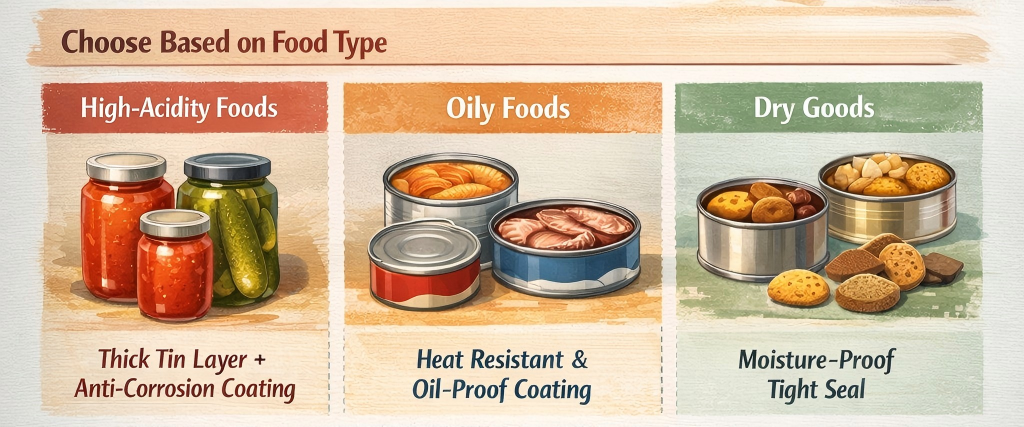
Electrolytic tinplate is low-carbon steel strip coated with pure tin by an electrolytic process, offering excellent corrosion resistance, solderability and a food-safe surface. It is the standard material for food cans, beverage cans, aerosol cans, crown caps and closures. We supply equal coating (2.8/2.8, 5.6/5.6 g/m²) and differential coating configurations in hardness grades T1–T5 and DR7–DR10.
Tin Free Steel (TFS / ECCS)
Tin free steel, also called ECCS (electrolytic chromium coated steel), is coated with a thin layer of metallic chromium and chromium oxide instead of tin. It offers excellent paint adhesion and lacquer adhesion at lower cost, making it a popular choice for food can ends, easy-open ends, crown caps and battery shells, where the interior is lacquered and the tin layer is not required.
Single-Side & Double-Side Coated Tinplate
We supply tinplate with single-side or double-side tin coating to match your can design. Double-side coated product is standard for cans exposed to product on both faces, while single-side coated tinplate is used where one surface is lacquered or painted, saving tin cost. Differential coating — for example 2.8/5.6 g/m² — is available for specialized applications such as easy-open ends.
Tinplate Specifications
The table below shows our standard production range. Please confirm thickness, width, tin coating, hardness grade and surface finish when requesting a quotation.
| Parameter | Available Range |
|---|---|
| Thickness | 0.15 – 0.50 mm |
| Width | 700 – 1100 mm (slitting available) |
| Tin Coating | 1.1 – 11.2 g/m² per side (equal or differential) |
| Hardness Grade | T1 – T5 (batch annealed), DR7 – DR10 (double reduced) |
| Standard | ASTM A623, JIS G3303, GB/T 2520 |
| Surface Finish | Bright (B), Stone (R), Silver (S), Matte (M) |
| Passivation | Chromium passivation (311), low-chromium or chromate-free on request |
| Form | Coil, sheet, scroll-cut blanks |
Reference Weight per Meter (Width 1000 mm)
Theoretical weight in kg per meter of strip, calculated at a density of 7.85 g/cm³. Tin coating adds approximately 0.1% – 0.3% to the base weight.
| Thickness (mm) | Weight (kg/m) |
|---|---|
| 0.15 | 1.18 |
| 0.18 | 1.41 |
| 0.20 | 1.57 |
| 0.23 | 1.81 |
| 0.25 | 1.96 |
| 0.30 | 2.36 |
| 0.35 | 2.75 |
| 0.40 | 3.14 |
| 0.50 | 3.93 |
Typical Applications of Tinplate
- Food cans: vegetables, fruit, fish, meat, soups and pet food
- Beverage cans and aerosol cans for pressurized products
- Crown caps, twist-off caps and closures for bottles and jars
- Easy-open can ends and full aperture ends
- Battery shells and dry cell containers
- Paint, chemical and lubricant containers and drums
- Electronic shielding, toys, gift boxes and specialty packaging
Why Tin Coating and Hardness Control Matter in Packaging
Tinplate performs two jobs at once: it protects food from the metal beneath it, and it must form reliably at the speed of modern can lines. The tin coating provides corrosion resistance, a safe food-contact surface and good solderability, while its thickness — measured in grams per square meter on each side — directly controls pack performance and cost. Under-coating risks corrosion and metal pickup; over-coating wastes tin. Hardness control is equally critical: T1–T5 grades, produced by batch annealing, are soft enough for deep drawing of can bodies and easy-open ends, while DR7–DR10 double-reduced grades are stiff and strong for structural beverage bodies and ends that must resist internal pressure. Because these parameters interact with every press tool and every product packed, our mill test certificate reports both tin coating and hardness for every coil, and our engineers work with can makers to match the specification to the actual line.
How We Ensure Reliable Export Service
Tinplate is a surface-critical product: scratches, dents or rust stains can make a coil unusable for can making. Our export department applies the strictest handling and packing discipline for every shipment to more than 80 countries.
Export Experience Across 80+ Countries
From food can plants in the Middle East and Africa to beverage can lines in Southeast Asia and South America, our tinplate runs on high-speed presses worldwide. We understand how different regions load and store coils, and we plan container packing, edge protection and moisture control with that reality in mind, supported by long-term freight partnerships in Tianjin.
Professional Export Documentation
Each shipment includes commercial invoice, packing list, bill of lading, mill test certificate and certificate of origin, plus destination-specific documents such as food-contact compliance statements, Form A or GSP certificates, fumigation certificates and third-party inspection reports. Our documentation team handles the paperwork so your tinplate clears customs without delay.
Flexible Payment and Incoterms
We support T/T with 30% deposit and 70% balance before shipment, and L/C at sight for qualified buyers. FOB Tianjin is standard, with CFR, CIF and DDP available for key markets. Buyer-nominated inspection before loading is welcome, so you verify tin coating, hardness and surface quality before the vessel sails.
Pricing, MOQ & Delivery
- Price: USD 850 – 1400 per ton FOB Tianjin, depending on thickness, tin coating weight, hardness grade, surface finish and quantity.
- MOQ: 5 tons for stock specifications; 20 tons for custom coating, hardness or dimensions.
- Payment: T/T, 30% deposit and 70% before shipment, or L/C at sight.
- Delivery: 15 – 30 days after confirmation of deposit, depending on specifications and quantity.
- Packing: Coils on steel cradles or pallets with moisture-proof wrapping, rust-preventive paper and edge protection; sheets packed flat with protective interleaving and steel straps, sea-worthy for container shipping.
- Port of Loading: Tianjin Xingang Port, China.
Buyer’s Guide: How to Choose a Reliable Tinplate Supplier
First, specify the application precisely: food can bodies and ends need different hardness and coating than crown caps or battery shells, so tell your supplier what your line produces. Second, define the tin coating: equal coating like 2.8/2.8 g/m² is standard for most food cans, while differential coatings suit easy-open ends and specialized packs, and TFS suits lacquered ends. Third, verify the supplier is a genuine tinplate manufacturer: request the business license, timing line information and a traceable mill test certificate showing coating weight and hardness per coil. Fourth, confirm food-contact compliance documents and the passivation type if you ship to a regulated market. Fifth, check packing and moisture protection, because surface damage in transit is the most common cause of tinplate claims. Finally, start with a trial order of a few tons, validate the material on your line, and scale up once the results confirm.
How to Get a Quotation
Send us your thickness, width, tin coating requirement (equal or differential), hardness grade, quantity and destination port, and our export engineers will confirm availability and pricing within 12–24 hours. We will recommend the most economical specification for your can-making application, quote packing and freight, and confirm the production window. Use the website form, email or WhatsApp — every inquiry is answered by a tinplate export specialist.
Frequently Asked Questions (FAQ)
Q1: What is the difference between ETP (electrolytic tinplate) and TFS (tin free steel)?
ETP is steel strip electroplated with pure tin, offering corrosion resistance, solderability and a food-safe surface; it is used for food and beverage cans, closures and battery shells. TFS, also called ECCS, is coated with metallic chromium and chromium oxide instead of tin; it has excellent lacquer and paint adhesion at lower cost and is typically used for lacquered can ends, crown caps and battery parts where soldering is not required.
Q2: What do tin coating weights like 2.8/2.8 g/m² mean?
The numbers state the tin mass on each face in grams per square meter: 2.8/2.8 means 2.8 g/m² on both sides (equal coating), while 5.6/2.8 means 5.6 on one side and 2.8 on the other (differential coating). Higher coating weights give better corrosion resistance and solderability but cost more, so the choice depends on the product packed and the can design.
Q3: Which hardness grades (T1–T5, DR7–DR10) fit different applications?
Softer T1–T3 grades are best for deep drawing, such as food can bodies and easy-open ends. T4–T5 offer a balance of strength and formability for general can making, crowns and closures. DR7–DR10 double-reduced grades are stiff and strong, used for beverage can bodies and ends that must withstand internal pressure with less material.
Q4: Is tinplate food-contact safe?
Yes. Tinplate is one of the most established food-contact packaging materials in the world. Our tinplate is produced from food-grade substrate, and each shipment can include a declaration of food-contact compliance; product is free of harmful substances per applicable regulations, and passivation can be supplied low-chromium or chromate-free on request for regulated markets.
Q5: Can you supply tinplate in sheets as well as coils?
Yes. We supply tinplate in coils, sheets and scroll-cut blanks. Common sheet sizes such as 712 × 508 mm and 762 × 508 mm (30 × 20 inches) are available from stock, and custom sheet dimensions can be produced for large orders with shearing tolerances agreed in advance.
Q6: How is tinplate packed to avoid surface damage during shipping?
Tinplate coils are packed on steel cradles or pallets with moisture-proof wrapping, rust-preventive paper and edge protection; sheets are packed flat with protective interleaving and steel straps. Container loading follows a verified diagram with dunnage, and moisture-absorbing measures are used for high-humidity routes to prevent rust and staining in transit.
Contact Sino East Steel Group today – send your tinplate specifications and receive a factory-direct quotation, a mill test certificate sample and a delivery schedule within 24 hours. Partner with a tinplate manufacturer that has served can makers in 80+ countries since 2008.
Browse our tinplate coil & sheet products with specifications, sizes and indicative FOB pricing.