
Steel Plates: Classification, Structure, and Application Analysis
Steel plates rank among the most fundamental and critical iron and steel products in industrial manufacturing and engineering construction. Their performance, strength, surface quality, and service life are directly influenced by production processes, material composition, and surface treatment techniques.
1.Structural Composition of Steel Plates
The “structure” of steel plates does not refer to their internal composition but is determined by several key factors:
A.Production Processes
Hot-Rolled Steel Plate
Manufactured through high-temperature rolling, it offers high strength and good plasticity, suitable for load-bearing and structural components.
Cold-Rolled Steel Plate
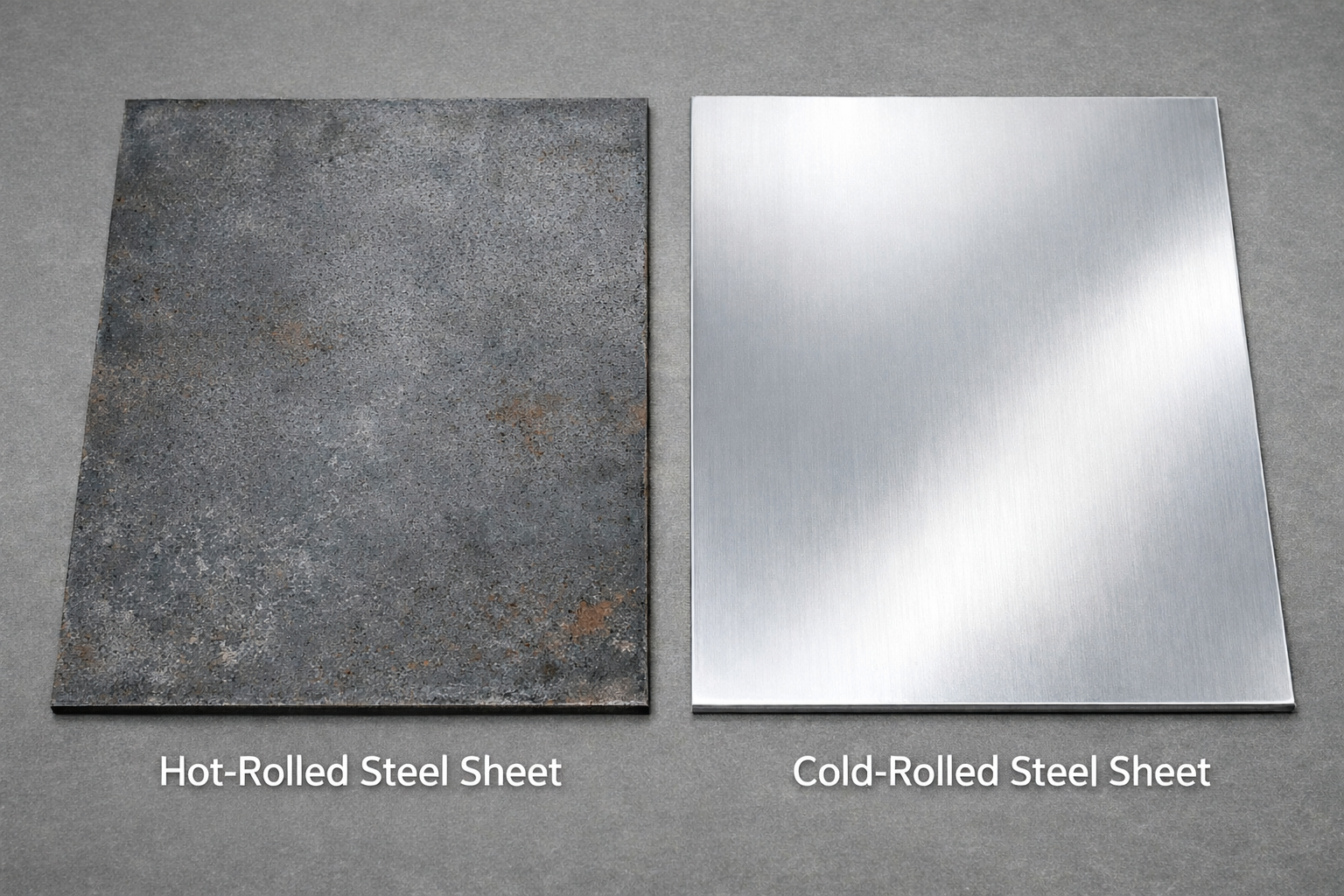
hot-rolled steel sheet&cold-rolled steel sheet
Produced by cold-working hot-rolled coils, it features high surface finish and excellent dimensional accuracy, widely used in applications demanding superior surface quality and precision.
B.Material Composition
Carbon steel plate
Alloy steel plate
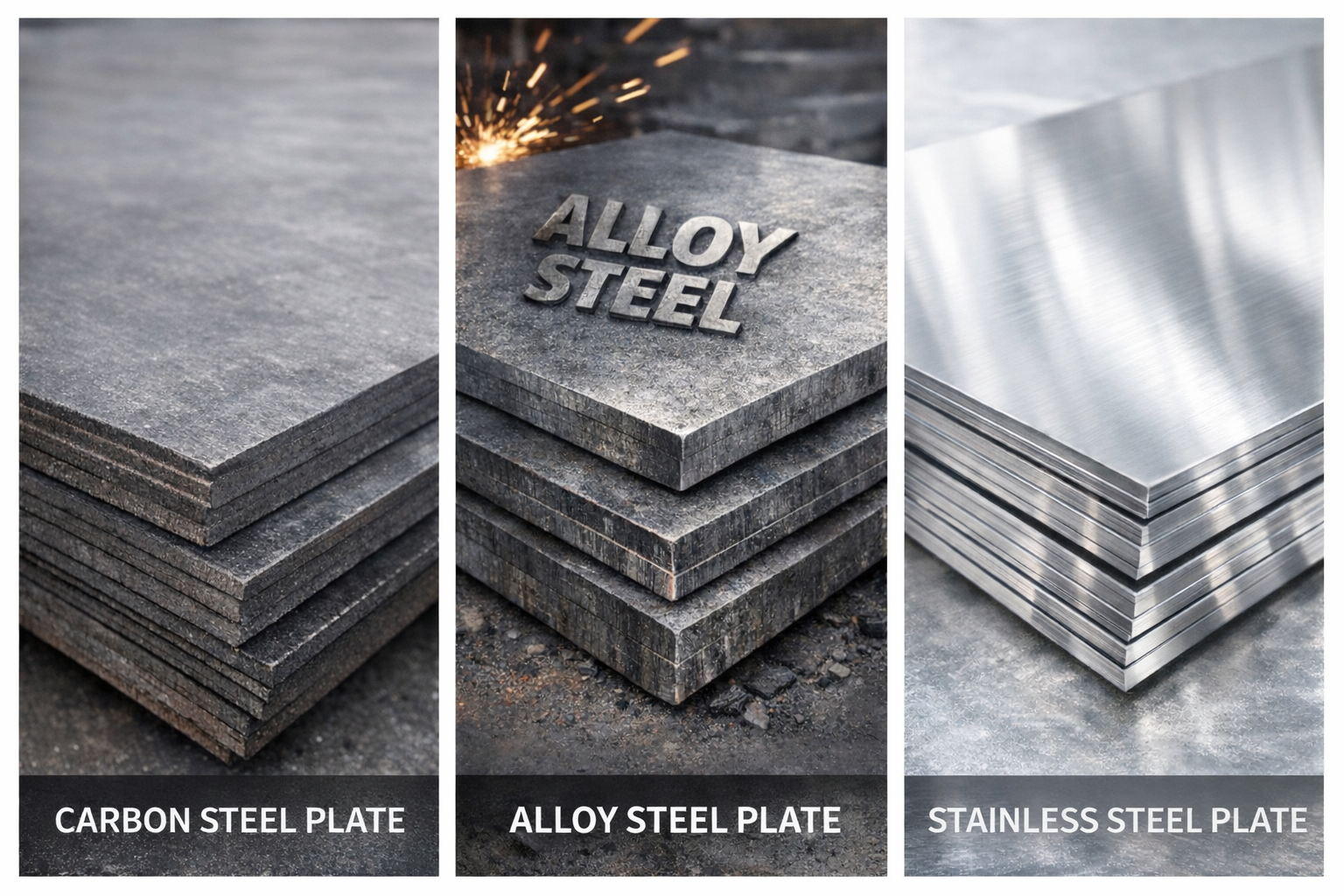
Steel sheet of different materials
Stainless steel plate
C.Surface Condition
Hot-rolled raw plate (black skin)
Pickled plate
Galvanized / Galvalume steel plate
Coated / Color-coated steel plate
These factors collectively determine the mechanical properties, corrosion resistance, and application scope of steel plates.
2.Key Differences Between Hot-Rolled and Cold-Rolled Steel Sheets
The primary distinctions between hot-rolled and cold-rolled steel sheets in practical applications are reflected in the following aspects:
| Aspect | Hot-Rolled Steel (HR) | Cold-Rolled Steel Plate (CR) |
| Strength and Surface Quality | Rougher surface, high strength, suitable for structural components | Smooth surface, excellent appearance, suitable for precision machining |
| Dimensional Accuracy | Larger thickness and width tolerances | Uniform thickness, high flatness, superior dimensional accuracy |
| Processing Performance | Suitable for welding, cutting, and heavy-duty structural fabrication | Suitable for stamping, bending, and deep processing |
| Cost | Lower cost | Relatively higher cost due to secondary processing |
3.Common Steel Plate Types and Application Scenarios
As an enterprise with years of steel supply experience, below are common steel plate types and their typical applications in the market:
| Steel Plate Type | Common Materials / Standards | Application Scenarios |
| Hot-rolled Steel Plate | Q235 / A36 / S235 | Building structures, bridges, machinery bases |
| Cold-Rolled Steel Plate | SPCC / DC01 | Appliance housings, automotive components |
| Galvanized Steel Plate | DX51D / SGCC | Roofing panels, ventilation systems, automotive body panels |
| Alloy Steel Plate | Q345 / S355 | Heavy machinery, engineering structures |
| Stainless Steel Plate | 304 / 316 | Food processing equipment, chemical vessels |
4.Primary Application Fields of Steel Plates
Steel plates are extensively used in the following industries:
Construction and Infrastructure Engineering
Shipbuilding and Offshore Equipment
Automotive and Construction Machinery
Pressure Vessels and Boilers
Industrial Equipment and Machinery Manufacturing
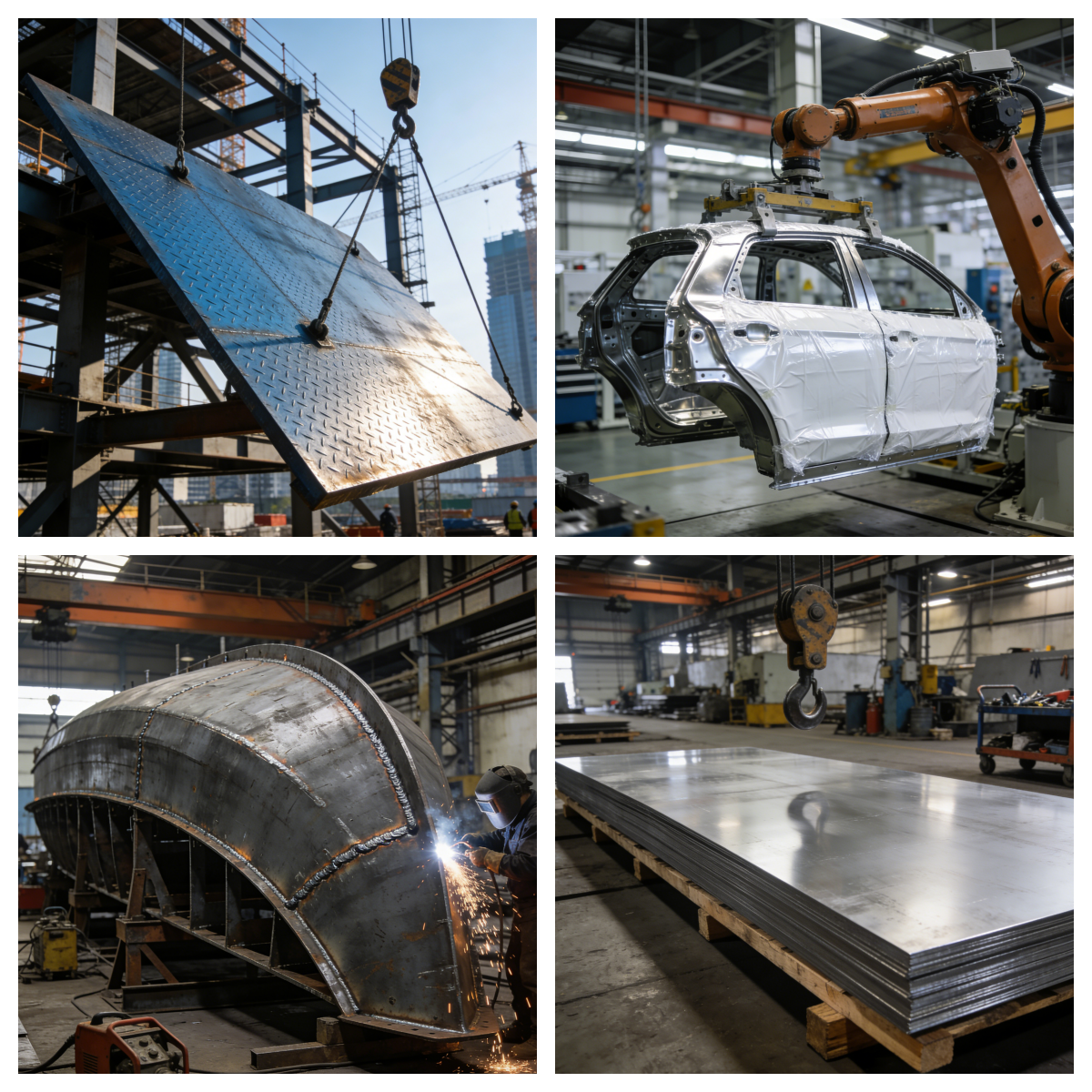
Application scenarios of steel plates
Steel plates play a vital role in modern industry. Gaining a thorough understanding of the classification, properties, and applicable scenarios of different steel plates helps achieve the best cost-performance ratio while ensuring safety and reliability.