
Steel Plate: The Ultimate Guide to Selection, Applications, and Quality Standards
In metal fabrication, construction, and industrial manufacturing, selecting the right steel plate is a critical step in ensuring project durability, safety, and cost-effectiveness. As a versatile heavy-duty component, steel plate forms the core foundation of countless structures and products.
Steel plate
1. Understanding Steel Plates: Definition and Core Characteristics
Steel plates are essentially flat, rigid steel products manufactured to specific thicknesses, widths, and lengths. They possess the following key structural features:
Uniform surface thickness ensures consistent strength and performance under stress
Customizable dimensions covering critical parameters like thickness, width, and length
Diverse edge finishing processes, including straight edges, chamfers, or bevels as required
Core characteristics include:
Material diversity: Primarily carbon structural steel and low-alloy high-strength steel, with options like stainless steel and weathering steel
Form flexibility: Categorized into hot-rolled and cold-rolled types to meet varying precision and surface quality requirements
Controllable properties: Customizable strength, corrosion resistance, and wear resistance through heat treatment and surface finishing processes
Safety and reliability: Manufactured to stringent strength standards with safety factors typically no less than 3:1, capable of withstanding heavy loads, impacts, and complex operating conditions
The core function of steel plates is to bear heavy loads, resist external forces, and form stable structures.
2. Core Application Scenarios for Steel Plates
Leveraging superior mechanical properties and processing adaptability, steel plates play irreplaceable roles across multiple industries:
Construction Engineering: Used in manufacturing beams and columns for steel structures, load-bearing plates for bridges, and shear walls/core walls for high-rise buildings, ensuring overall structural stability
Machinery Manufacturing: Processed into machine tool beds, construction machinery chassis, and heavy equipment frames to withstand operational vibrations and loads
Shipbuilding & Marine: Fabricated into hull shells, decks, and compartment bulkheads to resist seawater corrosion and complex marine stresses
Pressure Vessels: Serves as the primary component for storage tanks, boilers, pipelines, and other equipment, meeting safety requirements for high-temperature and high-pressure operations
Automotive Manufacturing: Used in critical areas such as vehicle frames, chassis armor, and cargo bed floors, enhancing load-bearing capacity and collision resistance
Warehousing & Logistics: Fabricated into shelf beams, pallets, and container bodies, designed for high-frequency loading, unloading, and transshipment operations
3. Common Types of Steel Plates: Selecting the Right Grade Ensures Efficiency
Steel plates come in diverse varieties tailored to specific applications, primarily categorized as follows:
By Rolling Process
Hot-rolled steel plates: High production efficiency and lower cost, featuring surface scale suitable for structural components with less stringent precision requirements
Cold-Rolled Steel Plates: High dimensional accuracy, smooth and flat surface, slightly higher strength than hot-rolled plates. Primarily used for automotive panels and precision mechanical components.
By Material Properties
Carbon Steel Plates: Affordable pricing and excellent work-ability. Widely used in general construction and mechanical parts.
Alloy Steel Plates: Incorporate alloying elements like manganese, chromium, and nickel for enhanced strength and corrosion resistance. Suitable for construction machinery and high-end equipment.
Stainless Steel Plate: Exceptional corrosion resistance, commonly used in chemical equipment, food processing machinery, and decorative applications
Weathering Steel Plate: Features a built-in rust-resistant layer, suitable for direct exposure to natural environments, ideal for outdoor architecture and landscape structures
Selecting the appropriate steel plate type prevents material waste, ensures project quality, and maximizes usage efficiency.
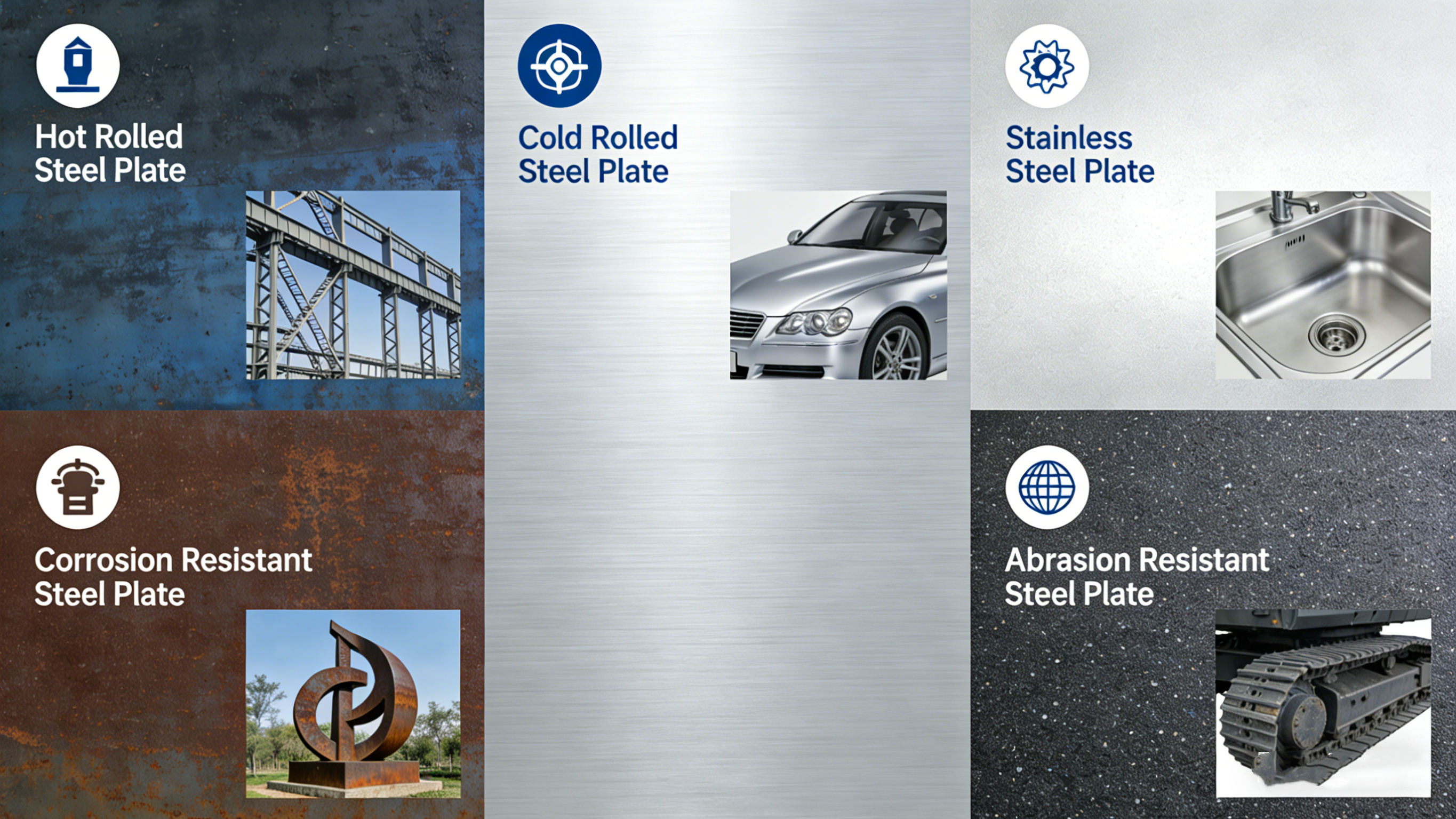
Different types of steel plates
4. Steel Plate Processing and Application Workflow: Key Steps
Cutting and Blanking: Cut steel plates to required dimensions using flame cutting, plasma cutting, or laser cutting per design drawings. Maintain precision to prevent edge deformation.
Forming and Processing: Shape steel plates into target forms through bending, stamping, welding, etc. Select compatible filler metals for welding to ensure seam strength.
Surface Treatment: Apply coatings like painting, galvanizing, or passivization based on the usage environment to enhance corrosion resistance and aesthetics.
Installation and Use: Assemble and secure fabricated steel components according to the design plan. Ensure precise positioning and uniform stress distribution during installation.
Maintenance: Conduct regular inspections of surface coatings and structural integrity. Address issues like corrosion or deformation promptly to extend service life.

Steel plate processing and usage process