
Scaffolding Rental vs. Purchase: Which Is More Cost-Effective?
In construction projects, renovation work, and various temporary operations, scaffolding is indispensable construction equipment. However, for businesses or individual projects, choosing between renting or purchasing scaffolding equipment is often an unavoidable dilemma.
1.What Are Scaffolding Rental and Purchase?
Scaffolding Rental
Scaffolding rental involves businesses or individuals leasing equipment from rental companies on a daily/weekly/monthly basis according to project timelines. Services typically include installation, transportation, and replacement as needed.
Scaffolding Purchase
Scaffolding purchase entails a one-time acquisition of equipment for self-ownership and management, suitable for scenarios requiring long-term, repeated use.
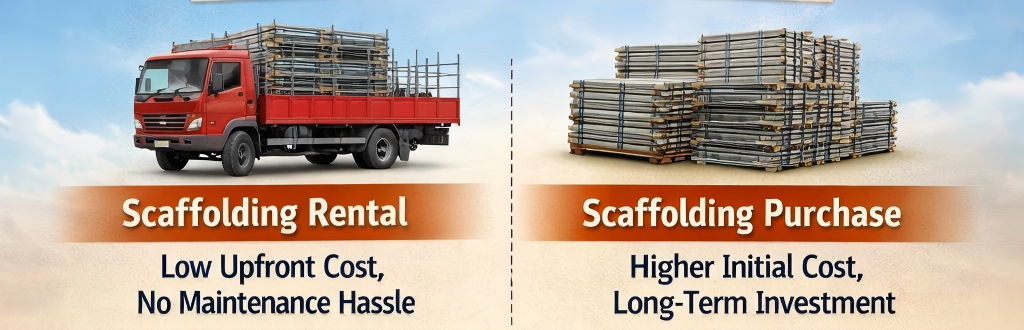
Scaffolding Rental VS Scaffolding Purchase
2.Cost Comparison Between Scaffolding Rental and Purchase
Before making a decision, the most critical step is cost calculation. Key cost items for comparison include:
| Cost Item | Rental | Purchase |
| Initial Expenditure | Low | High |
| Capital Pressure | Minimal | Significant |
| Maintenance & Repairs | Typically included | Self-responsibility |
| Idle Costs | None | Exists (waste from unused equipment) |
| Depreciation Costs | None | Exists |
| Tax Treatment | Rental fees are tax-deductible | Asset Depreciation |
A.Initial Investment & Capital Pressure
Rental: Requires no large upfront investment; only periodic rental payments are needed, making it particularly favorable for companies with tight cash flow.
Purchase: Involves a significant one-time cash outlay, posing a major challenge to cash flow.
Conclusion: From a capital pressure perspective, rental is more favorable.
B.Maintenance, Storage, and Depreciation Costs
Rented equipment is typically maintained and managed for wear and tear by the rental company.
Owning equipment requires self-maintenance, storage, and accounting for depreciation.
This means while purchase involves a large upfront cost, long-term use gradually reduces the unit cost over time.
C.Idle Time & Utilization Rate
Scaffolding usage frequency varies. Many projects involve significant idle periods:
→ If projects are concentrated and long-term → Purchase may be more cost-effective
If projects are sporadic and highly temporary → Leasing is more economical and offers greater flexibility
3.Scaffolding Rental vs. Purchase Comparison
A.When is Leasing More Suitable?
Suitable for the following scenarios:
Multiple overlapping projects with short individual project cycles
Limited budget or significant cash flow pressure
Desire for hassle-free maintenance and installation services
Varied and inconsistent demand for multiple types of scaffolding equipment
Summary of Advantages:
Low initial cost
Minimal maintenance risk
Flexible and scalable
No storage space required
B.When is purchasing more suitable?
Suitable for:
Companies with long-term, frequent construction needs
Standardized, predictable scaffolding usage
In-house teams capable of maintenance and management
Long-term cost savings as the goal
Key Advantages:
Lower unit usage cost (long-term)
Greater autonomy
Can be recorded as company assets
4.Rental vs. Purchase: Which is More Cost-Effective?
| Decision Factors | Recommended Solution |
| Tight budget | Scaffolding rental |
| Long-term, high-frequency usage | Scaffolding purchase |
| Requires flexible scheduling and service | Scaffolding rental |
| Focuses on long-term cost optimization | Scaffolding purchase |
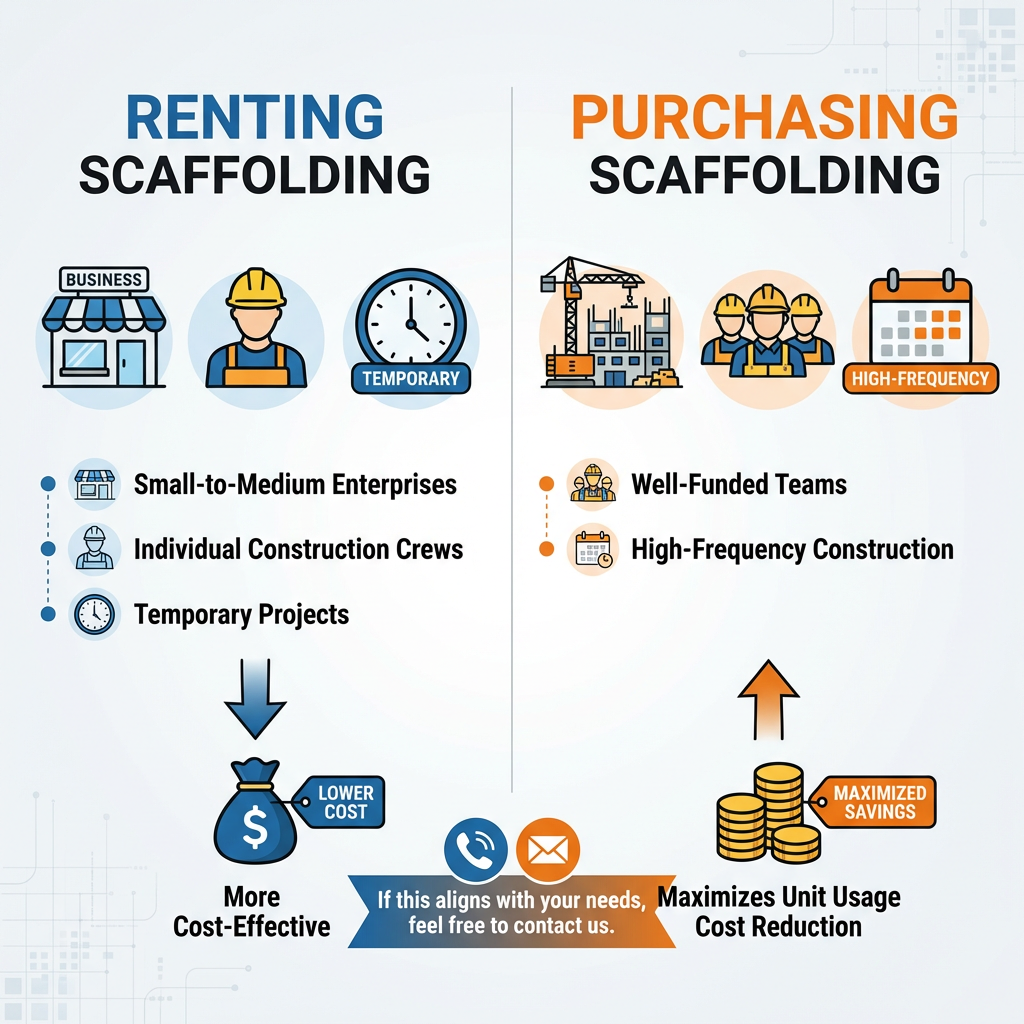
Scaffolding Rental VS Scaffolding Purchase
For most small-to-medium enterprises, individual construction crews, and temporary projects, renting scaffolding is typically more cost-effective. For well-funded, high-frequency construction teams, purchasing scaffolding maximizes reduction in unit usage costs. If this aligns with your needs, feel free to contact us.