
Detailed Comparison of Hot-Rolled Steel Plates, Cold-Rolled Steel Plates, and Galvanized Steel Plates: How to Choose the Most Suitable Steel for Your Needs?
Introduction
In steel procurement and engineering applications, hot-rolled steel plates, cold-rolled steel plates, and galvanized steel plates are the three most common yet easily confused types of steel plates. Due to their distinct production processes, these materials exhibit significant differences in surface quality, mechanical properties, corrosion resistance, and suitable applications. Improper selection not only increases project costs but may also directly impact the service life of structural components. This article provides a comparative analysis across three dimensions—performance characteristics, application domains, and selection criteria—empowering you to swiftly identify the steel best suited to your specific requirements.

Different types of steel plates
Table of Contents
1.What is Hot Rolled Steel Sheet?
2.What is Cold Rolled Steel Sheet?
3.What is Galvanized Steel Sheet?
4.Core Comparison Table of Hot-Rolled, Cold-Rolled, and Galvanized Steel Sheets
5.How to Select the Right Steel Sheet?
6.Conclusion
1.What is Hot Rolled Steel Sheet?
A.Production Process
Hot rolled steel sheets are formed by rolling steel billets at temperatures above the steel’s recrystallization point (approximately 1000°C). During production, the billet is heated to high temperatures and directly fed into rolling mills. After forming, it undergoes natural cooling.
B.Core Characteristics
Surface Condition: Relatively rough, often bearing a layer of iron oxide scale
Dimensional Accuracy: Larger thickness tolerances, generally moderate overall dimensional precision
Mechanical Properties: High strength, stable mechanical performance
Cost Advantage: Relatively simple production process, the most cost-effective category among the three steel sheet types
C.Primary Applications
Hot-rolled steel sheets, valued for their cost-effectiveness and excellent load-bearing capacity, are widely used in structural components where appearance and precision requirements are not stringent, such as:
– Building structural components, bridges, and various steel structure projects
– Basic components for construction machinery and shipbuilding
– Load-bearing parts like automotive chassis
2.What is Cold Rolled Steel Sheet?
A.Production Process
Cold-rolled steel sheets are manufactured from hot-rolled steel sheets through multiple precision processing steps at ambient temperatures. The core process involves acid pickling for rust removal, cold rolling for shaping, annealing for softening, and flattening/straightening. This process is significantly more complex than that for hot-rolled steel sheets.
B.Key Characteristics
Surface Condition: Smooth and flat with a refined texture, meeting aesthetic requirements without additional polishing
Dimensional Accuracy: Tight thickness tolerances, high dimensional precision, and strong specification consistency
Mechanical Properties: Uniform and stable mechanical performance with excellent ductility
Processability: Easily accommodates deep-drawing operations like stamping, bending, and stretching
Cost Level: Higher than hot-rolled steel sheets due to intricate manufacturing processes
C.Primary Applications
Cold-rolled steel sheets meet high aesthetic and precision requirements, making them ideal for manufacturing precision components. Common uses include:
– Outer casings and inner liners for home appliances like refrigerators and washing machines
– Automotive interior/exterior trim parts and precision components like instrument panels
– Precision mechanical parts, office furniture, and electronic product housings
3.What is Galvanized Steel Sheet?
A.Production Process
Galvanized steel sheets are not a standalone rolled product category. Instead, they are produced by applying a uniform zinc coating to the surface of hot-rolled or cold-rolled steel sheets through either hot-dip galvanizing or electrogalvanizing processes. This coating imparts special anti-corrosion and rust-proof properties to the steel.
B.Core Characteristics
Corrosion Resistance: The zinc coating effectively isolates air and moisture, offering superior rust and corrosion protection that significantly extends the steel’s service life.
Surface Finish: Depending on the galvanizing process, the surface exhibits either a zinc bloom pattern or a bright, smooth appearance.
Cost Level: Due to the additional galvanizing step, the cost is higher than that of standard hot-rolled or cold-rolled steel sheets.
C.Primary Applications
The core advantage of galvanized steel lies in its weather resistance, making it suitable for outdoor or humid corrosive environments. Typical applications include:
– Building roofs and wall cladding
– HVAC and plumbing systems (e.g., ventilation ducts, fire sprinkler pipes)
– Outdoor structures (e.g., electrical equipment enclosures, agricultural greenhouse frames)
– Steel components exposed to prolonged moisture
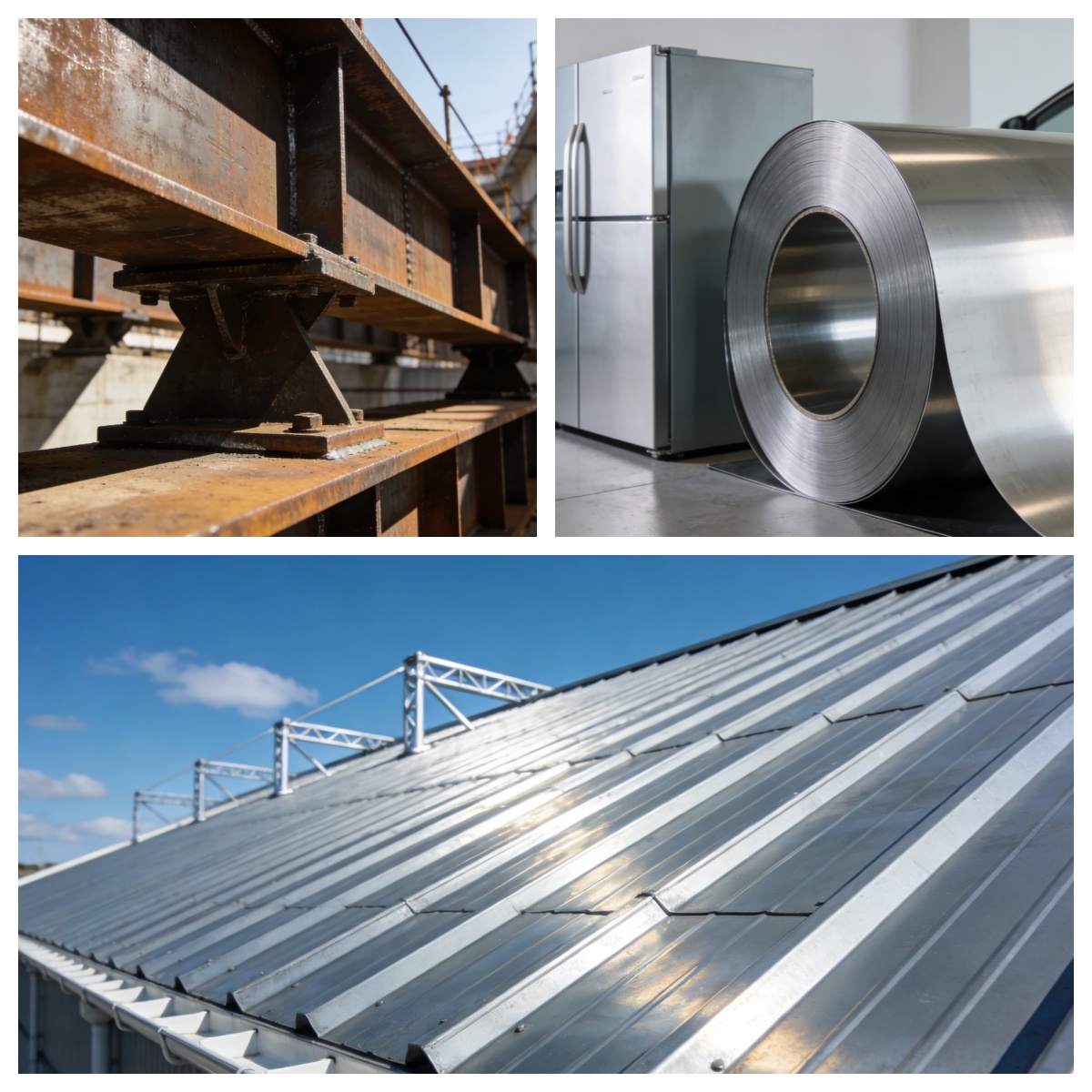
Different application scenarios of steel plates
4.Core Comparison Table of Hot-Rolled, Cold-Rolled, and Galvanized Steel Sheets
| Comparison Item | Hot-Rolled Steel | Cold-Rolled Steel | Galvanized Steel |
| Production Temperature | High-temperature rolling (approx. 1000°C) | Room-temperature rolling | Cold-rolled / Hot-rolled followed by galvanizing |
| Surface Quality | Rough, with scale | Smooth, flat, fine texture | Bright or zinc bloom finish |
| Dimensional Accuracy | Average | High | High |
| Corrosion Resistance | Poor | Poor | Excellent |
| Cost Level | Lowest | Moderate | Higher |
| Applications | Structural components, load-bearing parts | Precision machining, high-aesthetic requirements | Outdoor, humid/corrosive environments |
5.How to Select the Right Steel Sheet?
Select steel plates based on three core factors: usage environment, budget constraints, and processing requirements. Specific recommendations are as follows:
A.Selection by Usage Environment
Indoor structural applications with no aesthetic requirements: Prioritize hot-rolled steel plates
Indoor precision components with high aesthetic demands: Prioritize cold-rolled steel plates
Outdoor exposed environments or humid/corrosive scenarios: Prioritize galvanized steel plates
B.Budget-Based Selection
Cost control as primary objective: Select hot-rolled steel plates for highest cost-effectiveness
Balancing appearance and cost while pursuing value: Select cold-rolled steel plates
Prioritizing long-term use and reducing maintenance costs: Select galvanized steel plates, whose corrosion resistance and durability minimize replacement frequency
C.Selection by Processing Method
Primarily welding or cutting: Select hot-rolled steel plate for stable weld-ability
Requiring deep processing like stamping, bending, or stretching: Select cold-rolled steel plate for superior plasticity and form-ability
No complex processing needed, long-term exposure to natural environments: Select galvanized steel plate for strong weather resistance
6.Conclusion
Hot-rolled, cold-rolled, and galvanized steel sheets each possess distinct advantages. There is no universally “best” category; only the choice that best aligns with specific requirements. Accurately understanding the process differences and performance characteristics of these three steel sheet types, and scientifically selecting based on actual application scenarios, not only ensures engineering and product quality but also achieves the optimal balance between procurement and maintenance costs.