
Cold-Rolled Steel Sheet Selection Guide: Choosing the Ideal Solution for Precision Industrial Applications
In modern manufacturing, precision and efficiency have become core competitive advantages, and the appropriate selection of materials directly impacts product quality, processing stability, and overall production costs. Whether for automotive components, appliance housings, electrical equipment, metal furniture, or precision structural parts(such as gears), cold-rolled steel sheets have become the material of choice in numerous high-end industrial sectors due to their outstanding dimensional accuracy, surface quality, and consistent performance. Understanding the characteristics of cold-rolled steel sheets and mastering the correct selection approach are key to achieving high-quality manufacturing.

1. What is Cold-Rolled Steel Sheet?
Cold-rolled steel sheet is produced by further rolling hot-rolled steel sheet at room temperature after acid pickling to remove surface scale. Compared to hot-rolled steel sheets, cold-rolled sheets offer significant advantages in thickness control, flatness, and surface finish. Additionally, work hardening during processing enhances their strength.
Consequently, cold-rolled steel sheets are particularly suitable for manufacturing processes demanding high performance and appearance, such as precision stamping, bending, welding, and surface treatment.

2. Key Factors for Cold-Rolled Steel Plate Selection
Selecting cold-rolled steel plates requires evaluating specific operating conditions and considering the following core indicators:
A. Steel Grade and Mechanical Properties
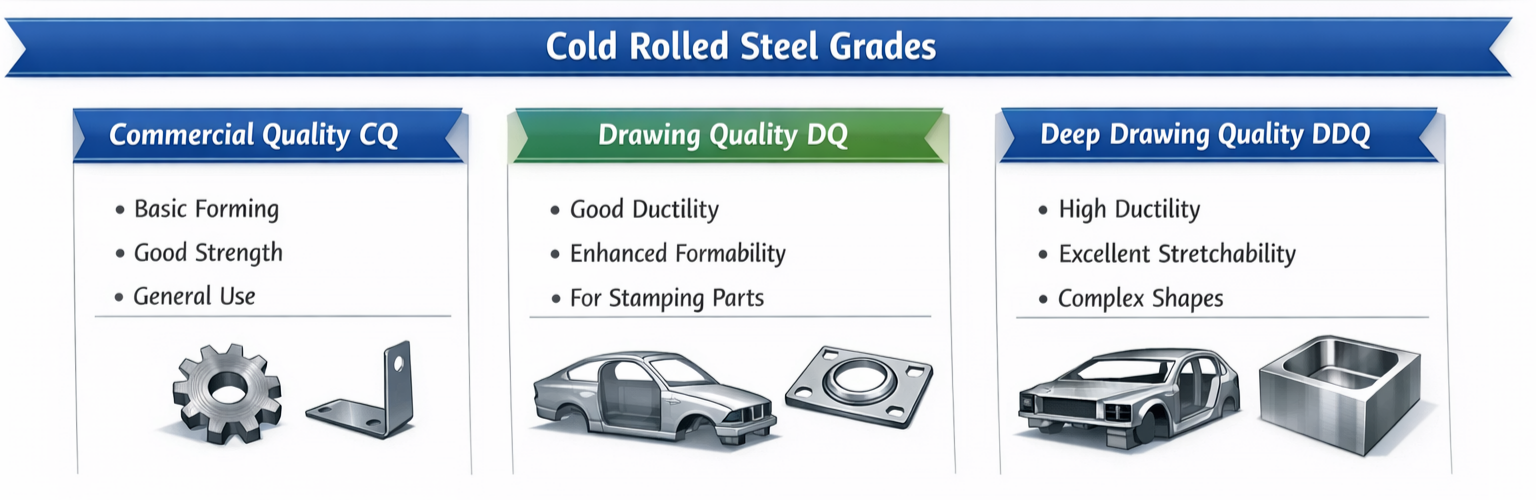
Different steel grades exhibit significant variations in strength, elongation, and form-ability. Common grades and their applications include:
Commercial Quality (CQ): Suitable for simple bending and general structural components, offering good strength and cost-effectiveness;
Stamping Grade (DQ): Suitable for moderately complex stamped parts, offering excellent work-ability and superior ductility;
Deep Drawing Grade (DDQ): Features exceptional ductility and elongation, ideal for complex deep-drawn forming operations.
Properly matching steel grades to processing complexity effectively reduces risks of part cracking and deformation while improving manufacturing yield.
B. Thickness Precision and Flatness Control
Precision industries demand exceptional dimensional consistency in materials. Cold-rolled steel sheets typically range from 0.3–3.0 mm in thickness, with far tighter thickness tolerances than hot-rolled sheets.
Superior flatness and surface quality not only facilitate automated processing but also reduce tool wear, enhance part assembly accuracy, and consequently lower scrap rates and rework costs.
C. Surface Quality and Aesthetic Requirements
Cold-rolled steel sheets feature smooth, clean surfaces ideal for direct subsequent surface treatments like spraying, electroplating, and film coating. For exposed or decorative components, consistent surface quality is critical for ensuring coating adhesion and finished product aesthetics.
When selecting materials, clearly define the product’s aesthetic positioning to match the required surface condition and processing needs.

D. Forming Performance and Processing Adaptability
Cold-rolled steel sheets are commonly used in multi-process operations like stamping, bending, and welding. Material property stability directly impacts cracking, spring-back, and weld quality during forming.
For complex shapes or high-precision components, select cold-rolled steel sheets with high elongation and consistent batch performance. Consider annealed products when necessary to enhance processing reliability.
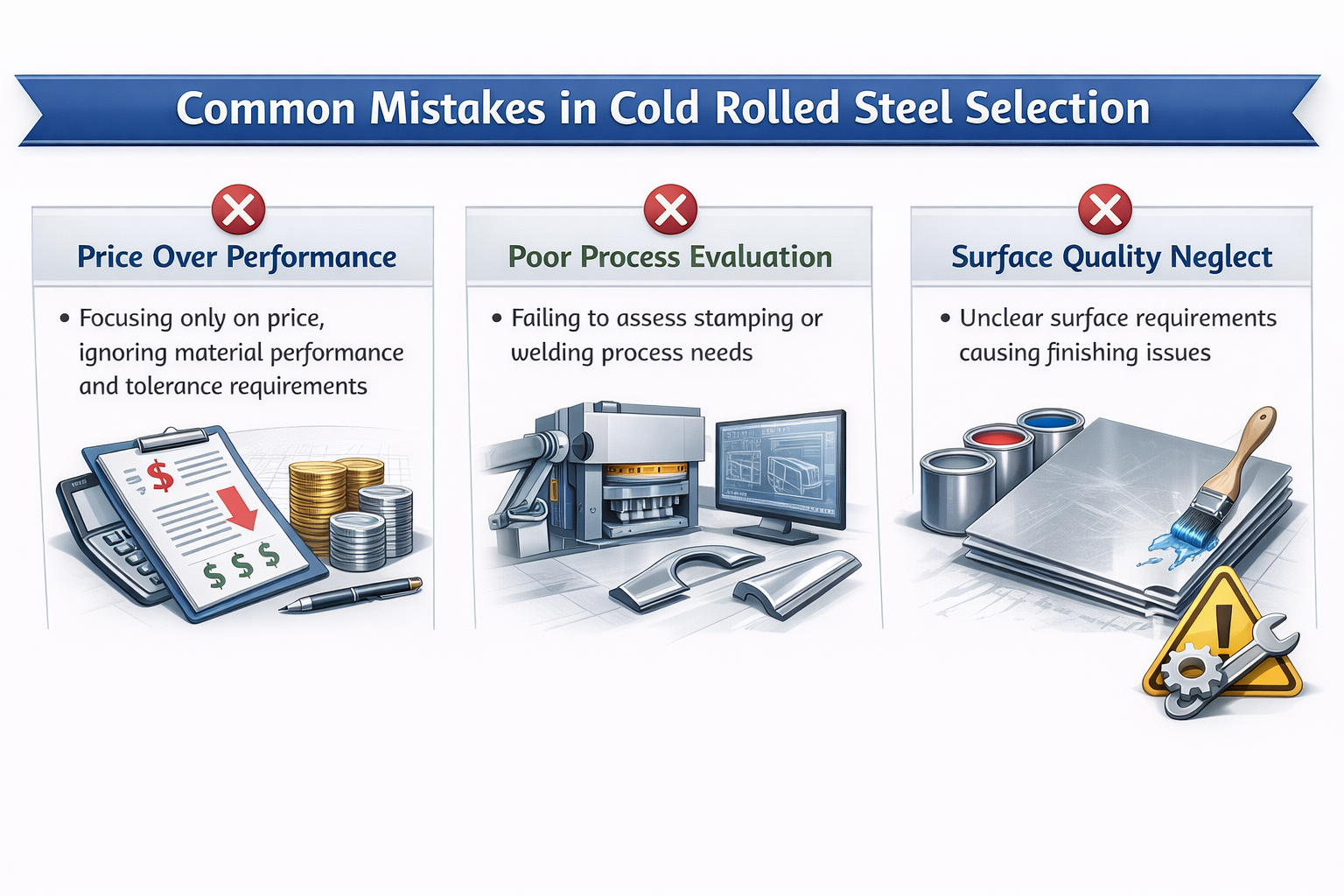
3. Common Misconceptions in Cold-Rolled Steel Plate Selection
In practical applications, frequent selection errors include:
Focusing solely on price while neglecting material processing performance and tolerance requirements;
Failing to fully evaluate specific demands of stamping or welding processes;
Lacking clear surface quality specifications, leading to subsequent treatment difficulties or sub-optimal finished product appearance.
Avoiding these pitfalls is key to enhancing production efficiency and finished product quality
Scientific Selection: Empowering Precision Manufacturing
The core of cold-rolled steel plate selection lies in achieving a balanced trade-off between performance, dimensional accuracy, surface quality, and processing stability. By thoroughly understanding steel grade characteristics, precisely controlling thickness and flatness, and selecting reliable suppliers, enterprises can significantly boost production efficiency and reduce overall costs.
If you’re seeking suitable cold-rolled steel plate solutions for precision industrial applications, feel free to contact us.