
A Step-by-Step Guide to Cold-Rolled Steel Sheet Selection and Procurement
In numerous industrial sectors such as machinery manufacturing, automotive stamping, appliance housings, and precision hardware, cold-rolled steel sheets have become an indispensable core material due to their advantages, including smooth and clean surface, high dimensional accuracy, and stable and controllable mechanical properties.
However, cold-rolled steel sheets come in a wide variety of types, subdivided into dozens of specifications based on grade, thickness, and surface treatment processes. Different applications also have significantly different requirements for strength, ductility, and corrosion resistance. Faced with such a diverse range of choices, how should we select?
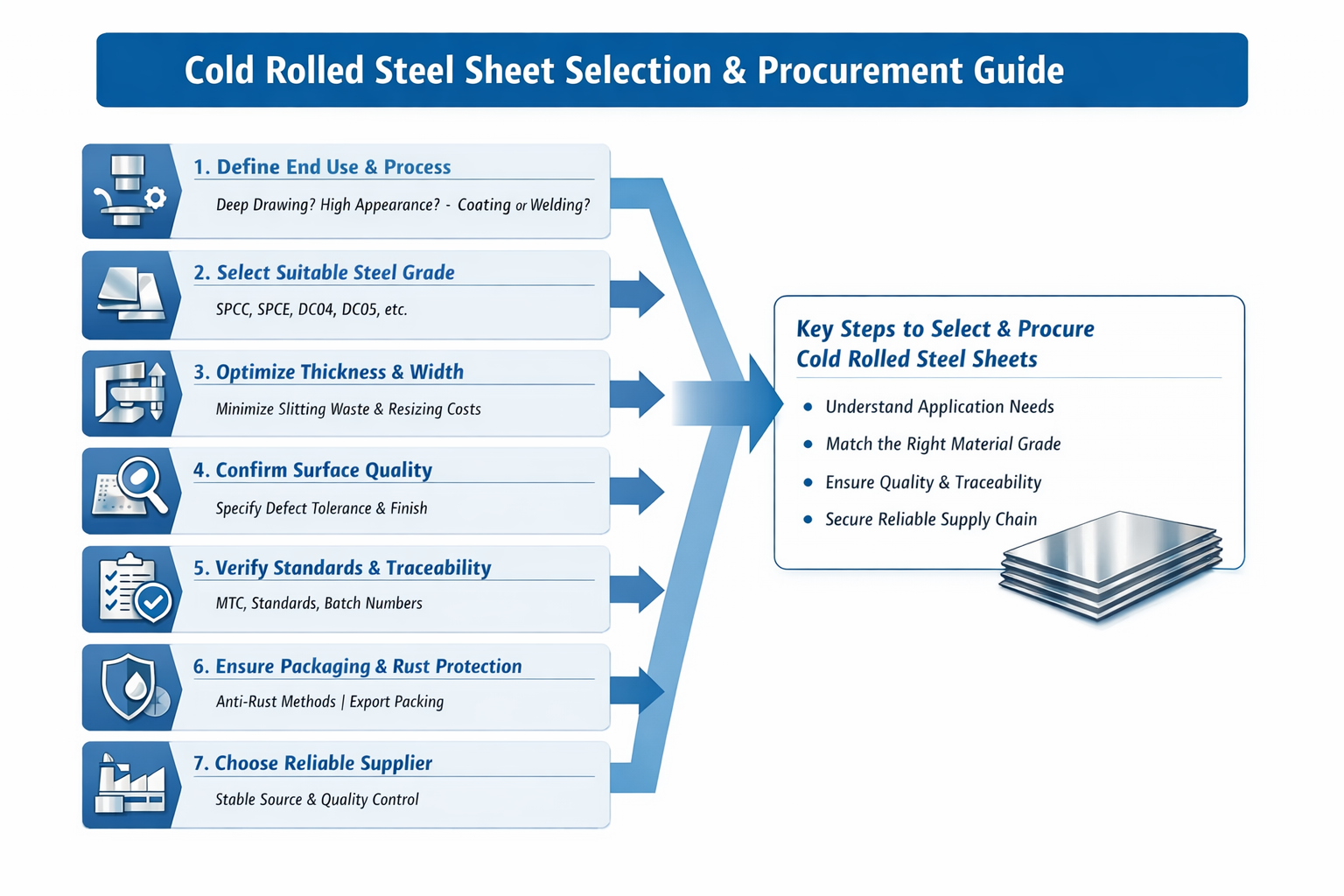
cold rolled steel sheet selection&procurement guide
1.Clarify the Application Scenarios and Core Performance Requirements
Different applications have vastly different performance requirements for cold-rolled steel sheets, which is the core basis for selection:
For automotive stamping parts (such as doors and chassis parts), the focus should be on stamping performance (elongation, yield strength) and surface quality (free from scratches and impurities).
For appliance housings (such as refrigerator and washing machine panels), in addition to surface smoothness, subsequent coating and electroplating performance should also be considered. It is recommended to choose cold-rolled steel sheets with higher surface grades.
For structural support components (such as shelves and machine supports), prioritize tensile strength and hardness, and select ordinary grade cold-rolled steel sheets.
For high-precision electronic components or medical equipment, strictly control thickness tolerance and dimensional accuracy, and select cold-rolled steel sheets with higher tolerance grades.
2.Appropriate Material Grade Matching
Selecting the appropriate material grade based on processing difficulty and performance requirements is crucial. For deep-drawing or complex forming parts, it is recommended to use deep-drawing grade materials such as SPCE, DC04, and DC05; for ordinary stamping parts, conventional grades such as SPCC and DC01 can be selected; for structural components, focus on yield strength and tensile strength, rather than simply pursuing high elongation. The core of reasonable selection is to avoid processing failure due to insufficient performance or unnecessary cost increases due to excessive performance.
3.Optimize Thickness and Width Specifications
While meeting design and strength requirements, reasonably optimizing thickness and width specifications can significantly reduce overall costs. By customizing appropriate widths and thicknesses, slitting losses can be effectively reduced, the number of inventory SKUs can be decreased, and secondary cutting and processing steps can be reduced, thereby improving overall production efficiency.
4.Confirm Surface Grade and Allowable Defects
The surface quality of cold-rolled steel sheets directly affects the yield rate of finished parts and the effectiveness of subsequent processing. Before procurement, surface grade requirements and acceptable defect ranges should be clearly defined, such as whether minor rolling marks, indentations, or color differences are permissible. Early communication and consensus help avoid unnecessary quality disputes during delivery and acceptance.
5.Emphasize Standards, Testing, and Traceability
Strict adherence to standards and a comprehensive testing system are crucial for ensuring material consistency and stability. Reliable suppliers typically provide complete Material Certificates (MTCs), clear explanations of applicable standards, and clear batch or furnace number information, ensuring good material traceability for quality management and problem tracking.
6.Focus on Packaging and Rust Prevention Solutions
Packaging and rust prevention measures are often overlooked, but they significantly impact material quality, especially for export orders. It is essential to confirm rust prevention methods, moisture protection measures, pallet structure, and reinforcement methods to ensure that cold-rolled steel sheets are protected from moisture, rust, and deformation during transportation and storage.
7.Select Stable and Reliable Cold-Rolled Steel Sheet Suppliers
The comprehensive capabilities of a supplier determine the stability of long-term cooperation. High-quality cold-rolled steel sheet suppliers typically possess stable raw material channels, mature quality control systems, extensive experience in customization and export, as well as rapid response and problem-solving capabilities, enabling them to provide continuous support to customers in all aspects of material selection, delivery, and after-sales service.