
Is Your Scaffolding Really Installed Correctly? 6 Types of Scaffolding Installation Pitfalls to Avoid
During construction, whether scaffolding is installed according to specifications directly impacts project safety, construction efficiency, and overall costs. Different types of scaffolding structures vary significantly, and their installation requirements differ accordingly.
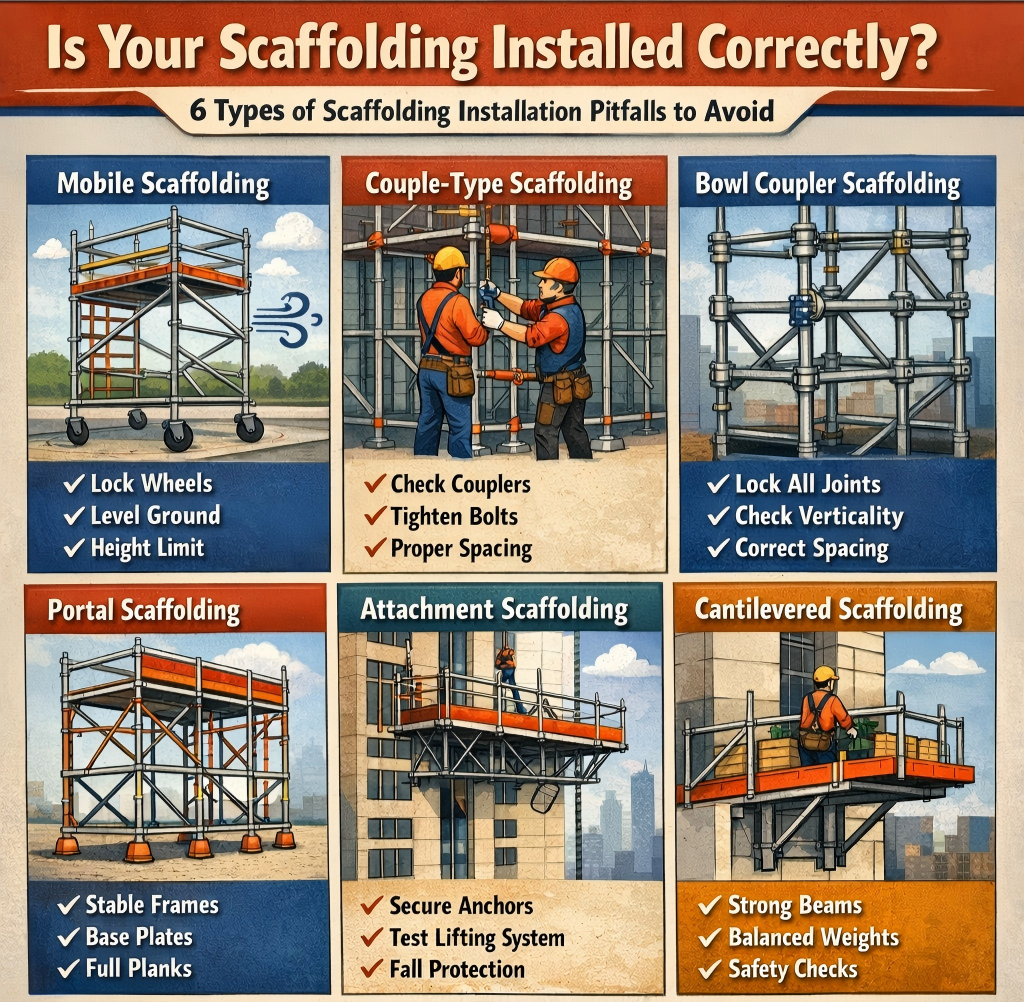
6 types scaffolding
1.Mobile Scaffolding Installation Precautions
Applicable Scenarios
Suitable for short-term work environments such as interior renovations, equipment maintenance, and high-altitude repairs.
Installation Essentials
A.Ground Must Be Level and Solid
Never install directly on soft or sloped surfaces.
Use base plates when necessary.
B.Casters Must Be Locked
Engage all brakes before work begins.
Never move scaffolding with personnel on it.
C.Strictly Control Usage Height
Adhere to maximum height limits per product specifications.
Install wall ties for heights exceeding limits.
D.Wind Protection Measures
Consider wind impact during outdoor use.
Prohibit operation during high winds.
Common Errors
Unlocked casters, exceeding height limits, unauthorized climbing.
2.Installation Precautions for Couple-TypeScaffolding
Applicable Scenarios
Traditional construction projects, high-rise construction, complex structural projects.
Installation Key Points
A.CoupleQuality Inspection
Prohibit use of cracked, rusted, or deformed couples.
Bolts must be intact.
B.Connection Tightening Requirements
Torque must meet specification requirements
Prevent loosening or detachment.
C.Vertical Pole Spacing Control
Arrange per design plan.
Strictly prohibit arbitrary spacing increases.
D.Diagonal Braces and Wall Ties Installation
Must be installed according to specifications.
Do not arbitrarily reduce quantities.
Common Errors
Unsecured couples, missing wall ties, structural deformation.
3.Bowl CoupleScaffolding Installation Precautions
Applicable Scenarios
Bridge engineering, large-scale factories, form-work support systems.
Installation Essentials
A.Fully lock all joints
Ensure upper and lower bowl couplings are fully engaged
Tap firmly after plugs are seated
B. Verticality correction for upright poles
Conduct real-time checks during installation
Prevent cumulative errors
C. Standardized horizontal bar spacing
Arrange per system specifications
Prohibit unauthorized structural modifications
D. Load-bearing design compliance
Erect according to calculated loads
Formwork support requires dedicated design
Common Errors
Unlocked joints, misaligned horizontal bars, overload usage.
4.Installation Precautions for Portal Scaffolding
Applicable Scenarios
Renovation projects, interior construction, small-to-medium projects.
Installation Essentials
A.High foundation leveling requirements
Uneven ground causes overall tilt
Base plates must be used for adjustment
B.Stable frame connections
Secure fixation between portal frames
All diagonal braces must be present
C.Strict Floor Limit Management
Elevate only to manufacturer-specified heights
Prohibit unlimited height increases
D.Complete Scaffold Board Laying
No gaps allowed
Prevent footing accidents
Common Errors
Uneven ground leveling, missing diagonal braces, unauthorized height increases.
5.Installation Precautions for Attachment-Type Elevating Scaffolding
Applicable Scenarios
High-rise exterior wall construction, super-high-rise projects.
Installation Key Points (Critical Controls)
A.Mandatory Specialized Design
Includes calculation reports and construction plans
Implementation requires approval
B.Attachment Support Installation Standards
Accurate anchor point positioning
Fixed strength must meet standards
C.Lifting System Commissioning
Electric/hydraulic systems must be tested
Ensure synchronized lifting
D.Complete Fall and Tilt Prevention Devices
Multi-layered safety systems
Regular inspection and maintenance
Common Errors
Unauthorized plan modifications, failed anchors, system malfunctions.
6.Installation Precautions for Cantilevered Scaffolding
Applicable Scenarios
High-rise exterior construction, urban renewal projects.
Installation Key Points (High-Risk Type)
A.Cantilever Beam Structural Calculations
Load-bearing verification mandatory
No reliance on experience-based erection
B.Reliable Anchoring System
Embedded parts meet strength requirements
Prevent pull-out failure
C.Balanced Counterweight Configuration
Configure per design
No arbitrary replacement
D.Segmented Acceptance System
Construction proceeds only after each phase passes inspection
Completion in a single operation is strictly prohibited
Common Errors
Insufficient anchoring, substandard counterweights, unauthorized platform extensions.
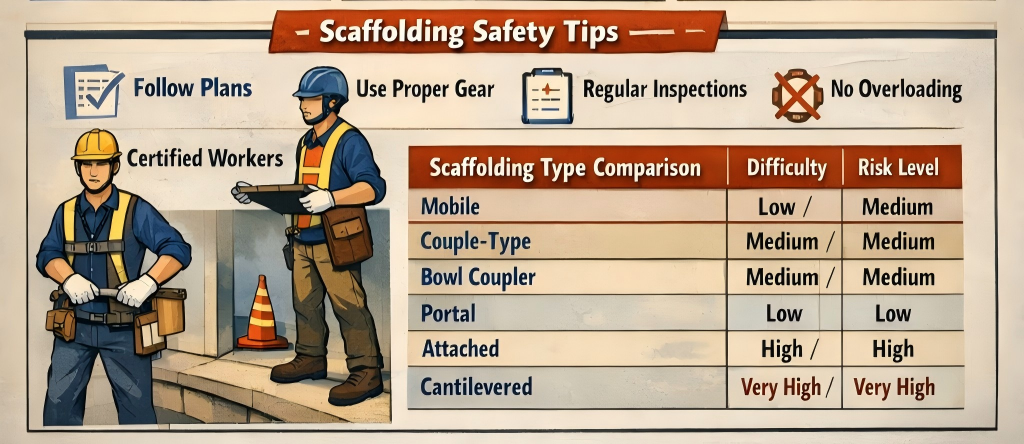
Scaffolding Safety
7.Comparison Table of Installation Precautions for Different Scaffolding Types
| Type | Installation Difficulty | Risk Level | Key Control Points |
| Mobile | Low | Medium | Lock wheels, wind protection |
| Couple-type | Medium | Medium | Secure fittings |
| Bowl-couple | Medium | Medium | Node locking |
| Gate | Low | Low | Foundation leveling |
| Attached | High | High | Anchoring system |
| Cantilevered | Extremely high | Extremely high | Load-bearing calculations |
8.General Safety Recommendations for Scaffolding Installation
Regardless of scaffolding type, adhere to these principles:
Strictly follow the construction plan
Use complete accessories
Conduct regular safety inspections
Prohibit overloading
Operate only with certified personnel
Establishing standardized construction procedures is the core measure to reduce accident rates.