
Scaffolding Maintenance Analysis Guide
With the rapid development of the construction industry, scaffolding serves as critical auxiliary equipment at construction sites. Its safety and service life directly impact project quality and construction efficiency. Scientific and reasonable maintenance management not only extends the lifespan of scaffolding but also effectively reduces the risk of safety incidents.
1.Key Maintenance Points for Mobile Scaffolding
Mobile scaffolding features high mobility and flexibility, with convenient assembly and disassembly, making it commonly used in interior decoration and equipment installation projects.
Maintenance Focus:
Regularly inspect caster flexibility to prevent jamming and rust
Ensure brake mechanisms remain fully functional
Check vertical and horizontal poles for deformation
Avoid overloading
Maintenance Recommendations:
Promptly clean dust and cement residue after use. Store in a dry, well-ventilated environment to effectively extend service life.
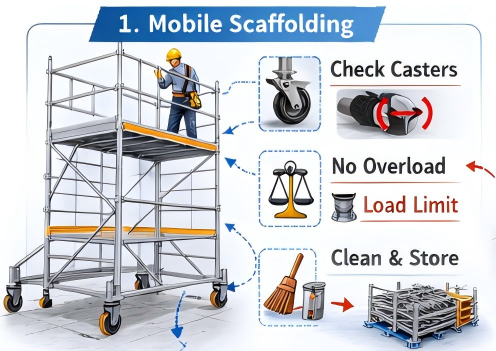
Mobile Scaffolding
2.Maintenance Analysis for Couple-TypeScaffolding
Couple-type scaffolding is the most widely used, primarily composed of steel tubes and couples, suitable for diverse construction scenarios.
Maintenance Focus:
Inspect couple bolts for looseness
Prevent steel tube corrosion and rust
Regularly replace aged couples
Avoid impact-induced deformation
Maintenance Recommendations:
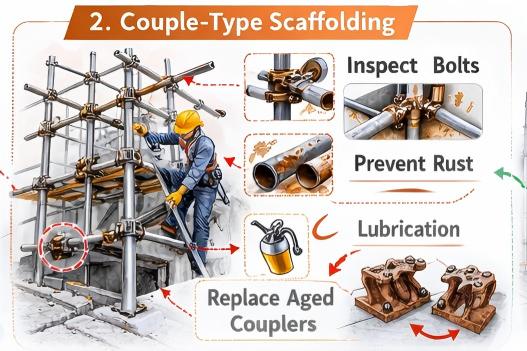
Couple-Type Scaffolding
Apply rust-proof coatings to steel tubes and regularly lubricate joints to enhance connection stability.
3.Maintenance Management Points for Bowl-CoupleScaffolding
Bowl-couple scaffolding features structural stability and high load-bearing capacity, widely used in high-rise construction projects.
Maintenance Focus:
Inspect upper and lower bowl couples for deformation
Ensure locking mechanisms operate smoothly and reliably
Prevent mortar buildup from affecting engagement
Monitor wear at connection points
Maintenance Recommendations:
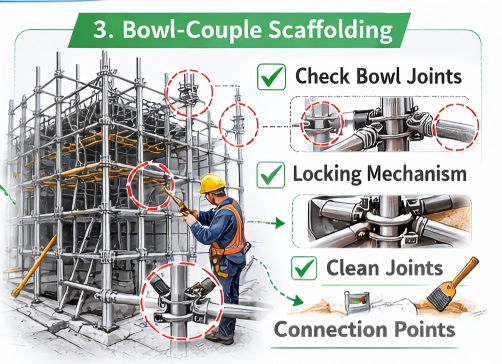
Bowl-Couple Scaffolding
Clean connection points promptly after use to avoid debris accumulation affecting joint performance.
4.Maintenance Standards for Portal Scaffolding
Portal scaffolding is widely used in residential and renovation projects due to its high standardization and ease of installation.
Maintenance Focus:
Check verticality of portal columns
Monitor welded joints for cracks
Prevent loosening of scaffold boards
Inspect integrity of locking pins
Maintenance Recommendations:
Conduct regular non-destructive testing on welded joints to prevent fatigue fracture risks.
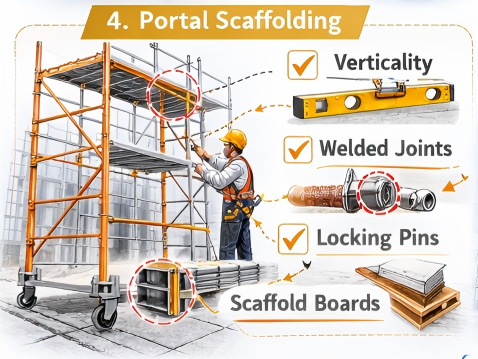
Portal Scaffolding
5.Maintenance Analysis for Attachable Elevating Scaffolding
Attachable elevating scaffolding is high-risk, high-tech equipment demanding stringent maintenance.
Maintenance Focus:
Check electrical control system stability
Periodically test fall arrest devices
Ensure guide rails and wall attachments are secure
Investigate hydraulic system leaks
Maintenance Recommendations:
Implement dedicated personnel management, conduct regular professional inspections and adjustments, and strictly prohibit operation with defects.
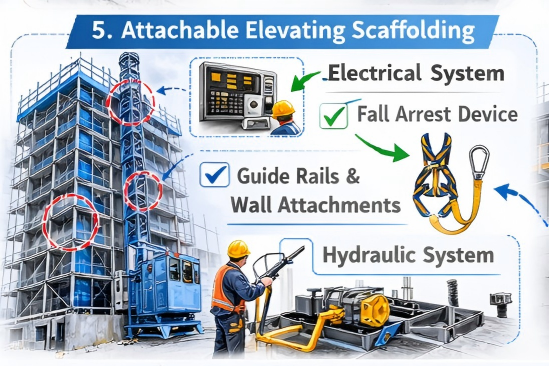
Attachable Elevating Scaffolding
6.Maintenance Management Essentials for Cantilevered Scaffolding
Cantilevered scaffolding is primarily used for exterior construction on high-rise buildings, heavily reliant on structural integrity.
Maintenance Focus:
Inspect anchorage status of cantilever beams
Prevent structural steel fatigue
Ensure stability of tie-in systems
Monitor overall displacement
Maintenance Recommendations:
Conduct structural calculations before and after construction. Enhance monitoring during construction and prohibit unauthorized structural modifications.
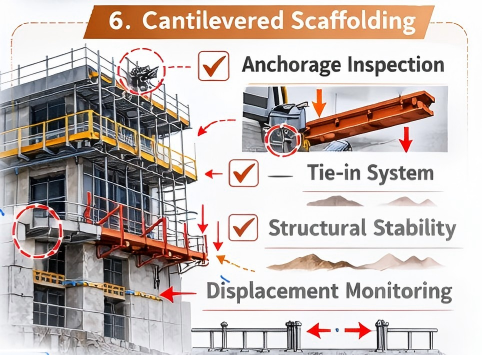
Cantilevered Scaffolding
7.Comprehensive Scaffolding Maintenance Strategy
To enhance overall operational safety, companies should establish a systematic maintenance framework:
A.Implement Regular Inspection Protocols
Daily: Pre-use on-site checks
Weekly: Structural stability assessments
Monthly: Comprehensive safety evaluations
B.Standardize Storage Management
Categorized stacking
Moisture and corrosion prevention
Avoid prolonged outdoor storage
C.Enhance Personnel Training
Strengthen safety awareness
Standardize operational procedures
Improve maintenance skills
D.Implement an Archival Management System
Record usage frequency
Maintenance schedules
Scrap cycles

Comprehensive Maintenance Strategy
Scientific Maintenance to Enhance Scaffolding Value
Whether for mobile scaffolding or attached climbing scaffolding, scientifically standardized maintenance management is crucial for ensuring construction safety and maximizing equipment value. Establishing a comprehensive maintenance system not only reduces accident rates but also lowers equipment replacement costs, thereby improving overall project efficiency.