
Avoid Damage and Rework: Essential Tips for Scaffolding Transportation
In the construction and equipment rental industries, the transportation of scaffolding is often overlooked. However, improper handling during transport can lead to component damage, deformation, and rust. These issues not only increase repair costs but may also cause delays due to rework, impact project timelines, and even damage a company’s reputation. For scaffolding suppliers, rental companies, and construction firms, effective transportation management is crucial for reducing costs and enhancing service quality.
1.Why Does Scaffolding Transportation Lead to Damage?
In practical operations, scaffold transportation damage primarily stems from four key factors:
Improper loading methods: Mixing components or haphazard stacking can cause deformation from excessive pressure, uneven stress distribution leading to bending, and compromise structural integrity.
Inadequate securing measures: Loose strapping allows components to shift during transit. Sudden braking may cause sliding, collisions, and secondary damage.
Insufficient protective measures: Lack of rainproofing/moisture protection and cushioning materials leads to severe surface scratches and even rust/corrosion;
Rough handling during loading/unloading: Manual tossing, forceful moving, or improper machinery use directly damages components, increasing loss risks.
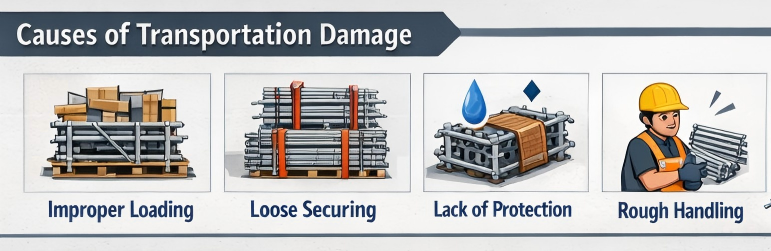
Causes of Transportation Damage
2.Scientific Loading: The First Step to Reducing Losses
A.Categorized and Layered Loading
Before loading, sort scaffolding components: stack vertical poles, horizontal beams, and diagonal braces separately. Bundle small accessories together and package different specifications individually. This prevents mutual compression and improves loading efficiency.
B.Optimize Cargo Space Planning
Follow the “heavy-bottom, light-top, stable-and-level” principle: position heavy components on the bottom layer, lighter ones on upper layers, and insert wooden spacers or anti-slip mats between layers. This ensures stability and minimizes movement during transit.
C.Control Loading Weight
Strictly prohibit overloading: prevent vehicle deformation, reduce accident risks, and avoid prolonged pressure on components. Proper loading is fundamental to safe transportation.
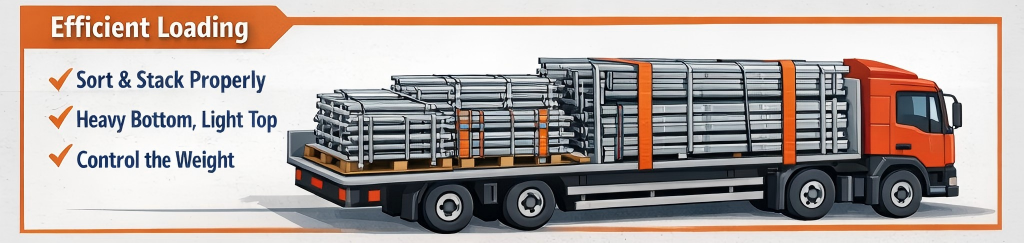
Efficient Loading
3.Secure Fastening: Key to Preventing Damage During Transit
A.Use Professional Lashing Tools
Recommended: High-strength lashing straps, steel wire ropes, and anti-slip rope nets. Avoid using aged or damaged materials.
B.Multi-Point Fastening Principle
Do not secure at only one location. Ensure: front-to-back fastening, left-to-right reinforcement, and mid-section reinforcement to form an integrated stable structure.
C.Regular In-Transit Inspections
For long-distance transport:
– Stop every 2–3 hours to inspect and tighten loose fastenings.
– During rainy weather, prioritize waterproofing checks to minimize unexpected risks.
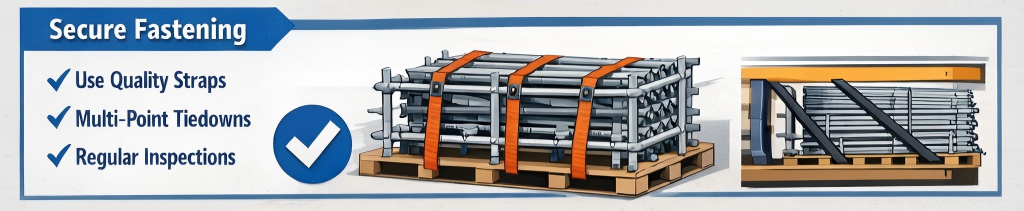
Secure Fastening
4.Protective Packaging: Extending Scaffolding Lifespan
A.Surface Protection Treatment
For galvanized or coated scaffolding:
– Apply protective film.
– Use foam padding.
– Lay scratch-resistant fabric to prevent cosmetic damage affecting future use or resale.
B.Rain and Moisture Protection Measures
Especially during rainy season transport: Cover with waterproof tarps, seal critical joints, and promptly air-dry upon arrival to prevent rust and corrosion.
C.Palletized Packaging for Transport
Utilize palletized packaging: Enhances loading/unloading efficiency, reduces labor damage, and facilitates warehouse management—ideal for large-scale operations.
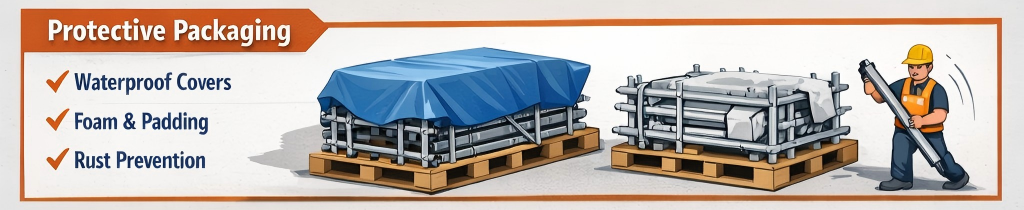
Protective Packaging
5.Standardized Loading/Unloading: Minimizing Human Damage Risks
Loading/unloading is a high-risk damage zone requiring strict management.
A.Strictly Prohibit Rough Handling
Establish clear regulations: components must not be thrown, dragged, or friction-abraded; standing on deform able parts is prohibited. Implement a responsibility system.
B.Proper Use of Mechanical Equipment
Recommended tools: forklifts, hoisting equipment, and lifting platforms. This reduces risks from manual misoperation.
C.Enhanced Personnel Training
Regular training covers: standard loading/unloading procedures, safety protocols, and emergency response. Skilled personnel are crucial for minimizing losses.
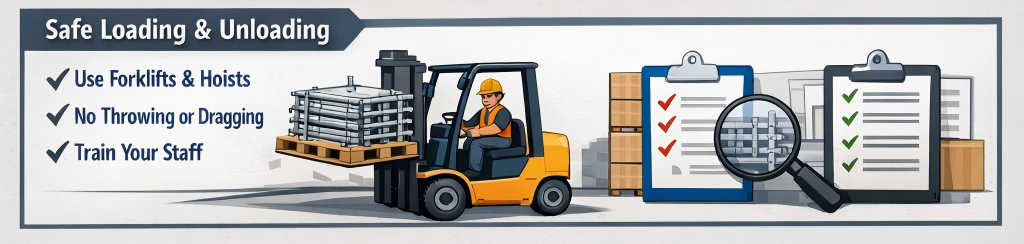
Safe Loading & Unloadinc
6.Pre- and Post-Transportation Inspections: The Core Step to Avoid Rework
A.Pre-Shipment Inspection
Before dispatch: Verify quantity, conduct visual inspection, confirm functionality, and document with photos to prevent mis-shipments or omissions.
B.On-Site Receiving Process
Upon arrival: Cross-check against the packing list, inspect for deformation or rust, and report issues immediately to avoid construction defects leading to rework.
C.Establish Transportation Records
Companies should maintain: transportation logs, damage statistics, and customer feedback archives to provide data for future optimization.
Scaffolding transportation, though seemingly straightforward, directly impacts product quality, project timelines, and corporate reputation. By implementing scientific loading, secure fastening, appropriate protection, standardized handling, and rigorous inspections, damage rates can be significantly reduced, preventing unnecessary rework and disputes.