
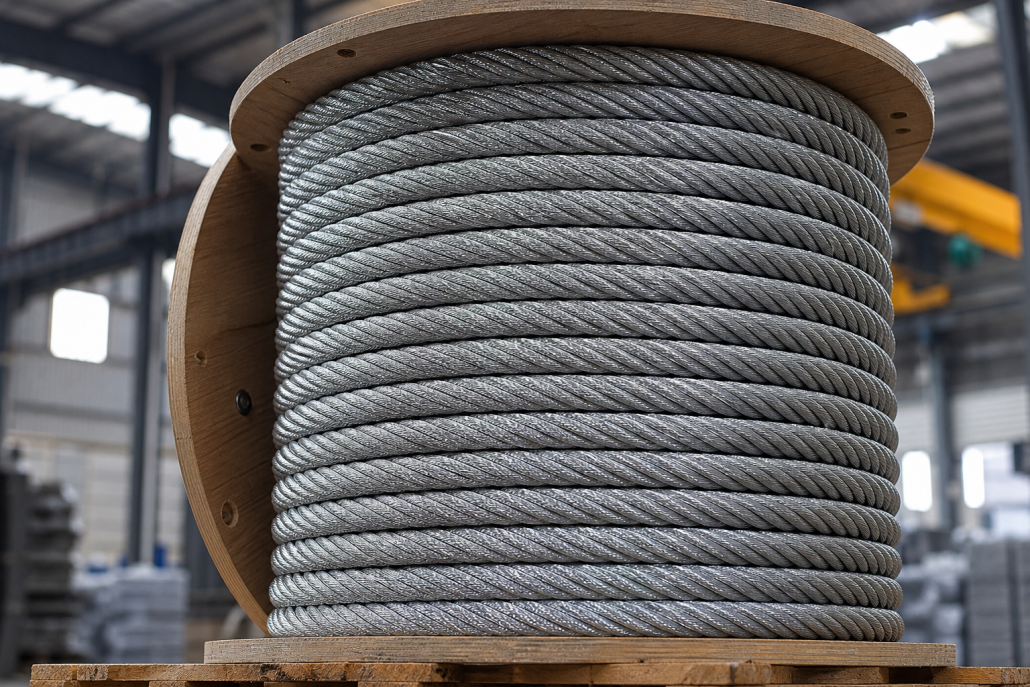
Steel Wire Rope Specifications, Breaking Strength Chart & B2B Selection Guide
Steel Wire Rope Specifications, Breaking Strength Chart & Selection Guide
Steel wire rope is a critical load-bearing component across modern civil engineering, crane lifting, maritime towing, oilfield drilling, and architectural suspension. Choosing the correct wire rope construction requires a thorough understanding of tensile grades, strand patterns, core types (IWRC vs. FC), minimum breaking load (MBL), and environmental corrosion factors.
This technical guide, compiled by the engineering team at Sino East Steel Group (Tianjin Sino East Steel Pipe Co., Ltd.), provides engineering tables, comparative construction analyses, international standard equivalents, and B2B sourcing guidelines for global procurement managers.
🏭 Direct Factory Sourcing from China
Looking for mill-direct container shipments of certified wire ropes? Explore our official Steel Wire Rope Manufacturer & Factory Portal for instant FOB/CIF quotations, custom drum lengths (500m – 2,000m), and EN 10204 3.1 Mill Test Certificates.
1. Core Anatomy of Steel Wire Rope
A steel wire rope comprises three primary mechanical components:
- Wires: Cold-drawn high-carbon steel wires (or AISI 304/316 stainless steel) providing baseline tensile strength (1570, 1770, 1960, 2160 N/mm²).
- Strands: Wires twisted helically around a central wire to form individual strands (e.g., 19 wires in 1+6+12 arrangement for 6×19).
- Core: The structural axis supporting outer strands under radial compression:
- IWRC (Independent Wire Rope Core): A miniature 7×7 wire rope core adding 7.5% breaking strength and superior resistance to crushing on multi-layer winch drums.
- FC / NFC / SFC (Fiber Core): Sisal or polypropylene synthetic fiber core storing lubricating grease for enhanced flexibility around small crane sheaves.
2. Major Wire Rope Constructions & Comparison Matrix
| Construction | Flexibility | Abrasion Resistance | Rotation Resistance | Typical Industrial Applications |
|---|---|---|---|---|
| 6×19+IWRC / FC | Medium | Very High | Low (Standard torque) | Winches, mining haulage, dredging, boom hoists, general rigging slings. |
| 6x36WS+IWRC | High | Medium-High | Low | Overhead crane hoists, port container cranes, engineering machinery sheaves. |
| 7×19 Stainless Steel | High | Medium | Low | Yacht marine rigging, architectural cable railings, food/chemical plant rigging. |
| 35Wx7 / 18×7 | Medium | High | Non-Rotating (Category 1) | Tower cranes, mobile crawler cranes, high-lift single part line hoists, deep shaft mining. |
| PVC / Nylon Coated | High | High Polymer Shield | Low | Gym fitness equipment, conveyor trip cables, marine lifelines, security cables. |
3. Minimum Breaking Load (MBL) Reference Matrix (1770 & 1960 N/mm²)
Standard minimum breaking force calculated in accordance with ISO 2408 and EN 12385-4 for galvanized steel wire ropes:
| Nominal Dia. (mm) | Nominal Dia. (Inch) | Unit Weight (kg/100m) | 6×19+IWRC MBL (kN) @ 1770 N/mm² | 6x36WS+IWRC MBL (kN) @ 1960 N/mm² | Safe Working Load (SWL / WLL 5:1) |
|---|---|---|---|---|---|
| 8.0 mm | 5/16″ | 27.4 kg | 43.8 kN | 48.5 kN | 0.89 Ton (890 kg) |
| 10.0 mm | 3/8″ | 42.8 kg | 68.4 kN | 75.7 kN | 1.39 Ton (1,390 kg) |
| 12.0 mm | 1/2″ | 61.6 kg | 98.5 kN | 109.0 kN | 2.01 Ton (2,010 kg) |
| 16.0 mm | 5/8″ | 109.5 kg | 175.1 kN | 193.9 kN | 3.57 Ton (3,570 kg) |
| 20.0 mm | 3/4″ | 171.1 kg | 273.6 kN | 303.0 kN | 5.58 Ton (5,580 kg) |
| 24.0 mm | 1″ | 246.4 kg | 394.0 kN | 436.3 kN | 8.03 Ton (8,030 kg) |
| 28.0 mm | 1-1/8″ | 335.4 kg | 536.3 kN | 593.8 kN | 10.93 Ton (10,930 kg) |
| 32.0 mm | 1-1/4″ | 438.0 kg | 701.0 kN | 776.0 kN | 14.29 Ton (14,290 kg) |
4. Global Standard Equivalents & Testing Specifications
When procuring steel wire ropes across international borders, standard compatibility is critical:
- ISO 2408: International standard for steel wire ropes for general purposes.
- EN 12385 (Parts 1-4): European specification for general lifting, cranes, and rope slings.
- ASTM A1023 / A1023M: Standard specification for stranded carbon steel wire ropes.
- DIN 3055 / DIN 3060: German industry standard for 6×19 and 6×36 flexible steel wire ropes.
- Federal Specification RR-W-410: US federal specification for wire rope and cable.
5. B2B Sourcing Checklist for Importers & Contractors
To avoid supply chain bottlenecks and guarantee on-site safety, international buyers should verify:
- Lay Direction: Right Regular Lay (RHRL) is standard for winches; Lang Lay (RHLL) is preferred for multi-layer crane drums with severe abrasion.
- Lubrication Specification: Specify dry/ungalvanized, light rust preventative oil, or heavy synthetic lubricant (Elaskon/Nyrosten).
- Packaging Integrity: Fumigated solid wooden reels or steel reels with cardboard outer lagging to prevent transit crushing.
- Mill Certification: Mandatory EN 10204 3.1 MTC detailing chemical analysis, tensile test curves, and individual wire torsion/bending test results.
6. Frequently Asked Questions (FAQ)
How do I calculate the Safe Working Load (SWL) from Minimum Breaking Load (MBL)?
Apply the appropriate safety factor (SF). For general lifting and rigging slings, SF is typically 5:1 (SWL = MBL / 5). For passenger elevators or critical cranes, SF can range between 6:1 and 10:1 depending on local safety codes.
What is the advantage of IWRC over Fiber Core (FC)?
IWRC provides approximately 7.5% higher breaking load, maintains rope diameter under high radial pressure, and resists drum crushing. Fiber core is lighter and more flexible but can flatten under heavy tension on drums.
Can Sino East Steel Group provide customized wire rope slings with thimbles and master links?
Yes. We supply 1-leg, 2-leg, 3-leg, and 4-leg pressed steel wire rope slings with aluminum ferrule or Flemish eye terminations, heavy-duty thimbles, and safety hooks proof-tested and certified before export.
{“@context”:”https://schema.org”,”@type”:”Article”,”headline”:”Steel Wire Rope Specifications, Breaking Strength Chart & Selection Guide”,”publisher”:{“@type”:”Organization”,”name”:”Sino East Steel Group”,”logo”:{“@type”:”ImageObject”,”url”:”https://sesteelpipe.com/wp-content/uploads/2018/12/logo2.png”}},”mainEntityOfPage”:”https://sesteelpipe.com/steel-wire-rope-specifications-breaking-strength-chart-selection-guide/”,”author”:{“@type”:”Person”,”name”:”Sino East Steel Group Engineering Team”}}
{“@context”:”https://schema.org”,”@type”:”FAQPage”,”mainEntity”:[{“@type”:”Question”,”name”:”How do I calculate the Safe Working Load (SWL) from Minimum Breaking Load (MBL)?”,”acceptedAnswer”:{“@type”:”Answer”,”text”:”Apply the appropriate safety factor (SF). For general lifting and rigging slings, SF is typically 5:1 (SWL = MBL / 5). For passenger elevators or critical cranes, SF can range between 6:1 and 10:1 depending on local safety codes.”}},{“@type”:”Question”,”name”:”What is the advantage of IWRC over Fiber Core (FC)?”,”acceptedAnswer”:{“@type”:”Answer”,”text”:”IWRC provides approximately 7.5% higher breaking load, maintains rope diameter under high radial pressure, and resists drum crushing. Fiber core is lighter and more flexible but can flatten under heavy tension on drums.”}},{“@type”:”Question”,”name”:”Can Sino East Steel Group provide customized wire rope slings with thimbles and master links?”,”acceptedAnswer”:{“@type”:”Answer”,”text”:”Yes. We supply 1-leg, 2-leg, 3-leg, and 4-leg pressed steel wire rope slings with aluminum ferrule or Flemish eye terminations, heavy-duty thimbles, and safety hooks proof-tested and certified before export.”}}]}
⚡ Quick RFQ & Instant CIF Quotation
Inquiring about Steel Wire Rope Specifications Breaking Strength Chart amp B2B Selection Guide? Contact our export engineering team for 2026 FOB/CIF pricing, MTC 3.1 certificates, and 20GP container loading calculations.