
Square Steel Tube vs Rectangular Steel Tube: Which One Is Better for Your Project?
 When choosing structural steel tubing for construction, manufacturing, or fabrication, one of the most common questions buyers ask is: Square steel tube vs rectangular steel tube—which is the better choice?
Although both belong to Hollow Structural Sections (HSS) and offer excellent strength, durability, and versatility, they serve different purposes depending on the application. Understanding their differences can help engineers, contractors, distributors, and manufacturers make cost-effective decisions while improving structural performance.
In this guide, we’ll compare square and rectangular steel tubes in terms of strength, load capacity, applications, cost, and design flexibility to help you determine the best option for your project.
What Is a Square Steel Tube?
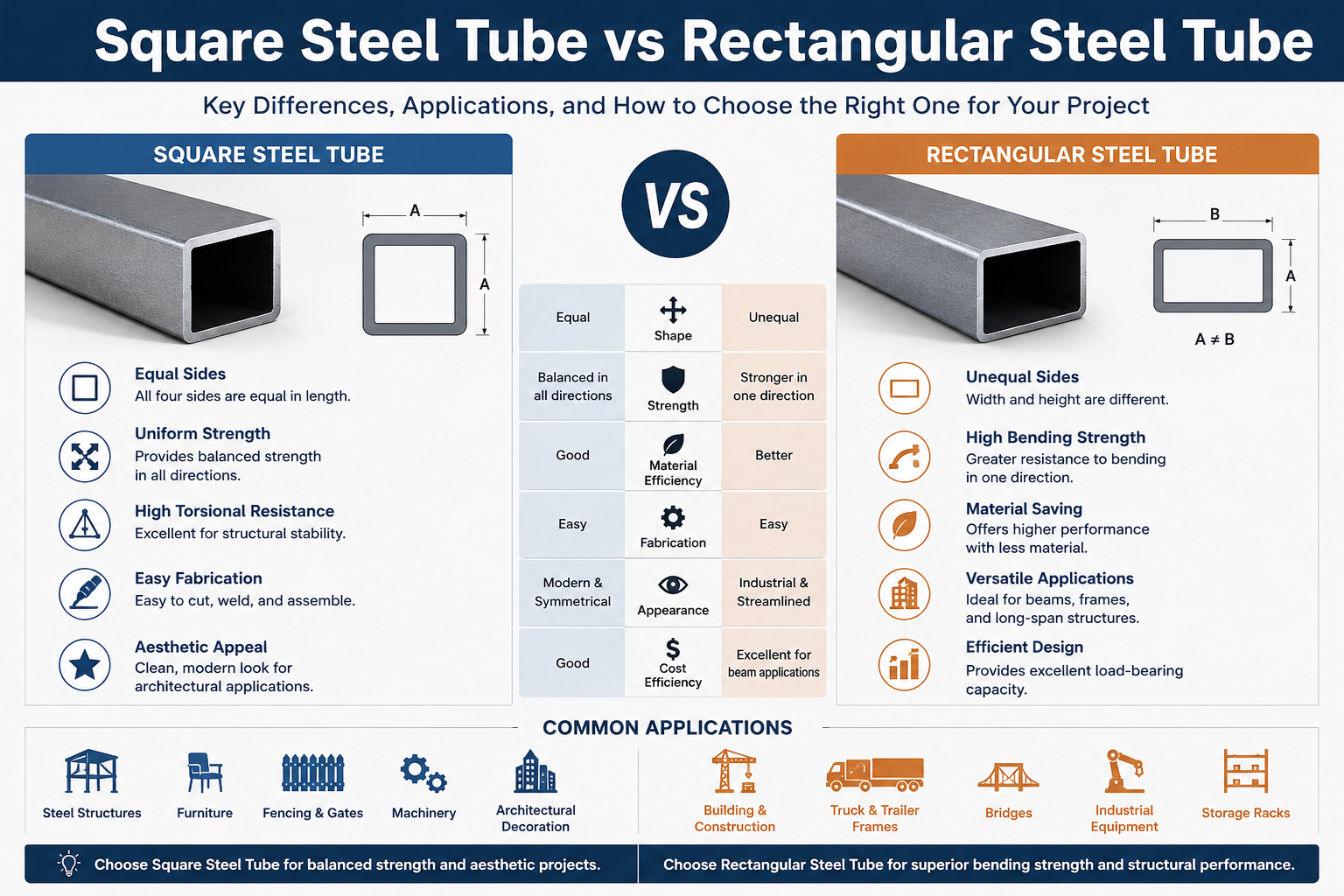
A square steel tube is a hollow steel section with four equal sides and 90-degree corners. It is manufactured through cold-forming or hot-forming processes and is widely used in structural and decorative applications.
Square steel tubes are available in carbon steel, galvanized steel, stainless steel, and alloy steel, with various wall thicknesses and dimensions.
Key Features
- Equal width and height
- Uniform load distribution
- High torsional resistance
- Easy welding and fabrication
- Attractive appearance for architectural projects
What Is a Rectangular Steel Tube?
A rectangular steel tube has unequal width and height while maintaining a hollow cross-section. Its elongated shape provides greater flexibility for projects requiring directional strength.
Rectangular tubes are commonly used in bridges, trailers, vehicle frames, heavy equipment, shelving systems, and building structures.
Key Features
- Higher bending strength in one direction
- Efficient material usage
- Larger surface area
- Ideal for long-span structures
- Excellent load-bearing performance
Square Steel Tube vs Rectangular Steel Tube: Key Differences
1. Shape and Structural Design
The most obvious difference is geometry.
Square tubing has equal dimensions on all four sides, making it symmetrical and suitable for applications where loads come from multiple directions.
Rectangular tubing has unequal sides, allowing designers to orient the stronger axis toward the primary load direction.
Winner
- Multi-directional loads: Square tube
- Directional loads: Rectangular tube
2. Strength Comparison
Many buyers assume square tubing is stronger because of its balanced shape. However, strength depends on how the load is applied.
Square Steel Tube
Provides nearly equal strength in both axes, making it suitable for columns, supports, and frames subjected to loads from different directions.
Rectangular Steel Tube
Offers greater resistance to bending along its major axis. When properly positioned, it can support heavier loads using less material.
Winner
- Compression: Square tube
- Beam applications: Rectangular tube
3. Weight and Material Efficiency
For the same wall thickness, rectangular tubing often delivers higher bending performance without significantly increasing weight.
This allows engineers to reduce steel consumption while maintaining structural integrity.
Square tubing may require larger sizes to achieve the same bending capacity.
Winner: Rectangular steel tube
4. Fabrication and Welding
Both square and rectangular tubes are easy to fabricate.
Common processing methods include:
- Laser cutting
- Plasma cutting
- CNC machining
- Welding
- Drilling
- Powder coating
- Galvanizing
Because square tubing has identical sides, layout and installation are often quicker, especially for repetitive fabrication.
Rectangular tubing requires attention to orientation during assembly.
Winner: Square steel tube
5. Appearance
Architects often choose square tubing because of its clean, symmetrical appearance.
It is widely used in:
- Furniture
- Railings
- Gates
- Handrails
- Decorative fencing
- Modern buildings
Rectangular tubing creates a more streamlined look and is commonly used in large commercial structures and industrial equipment.
Winner
Depends on design preference.
6. Cost Comparison
Pricing depends on:
- Steel grade
- Tube size
- Wall thickness
- Surface treatment
- Order quantity
- Market steel prices
Generally speaking, there is little difference in price between square and rectangular steel tubing of similar weight.
However, rectangular tubing can sometimes reduce overall project costs because fewer materials are needed to achieve the required structural performance.
Applications of Square Steel Tubes
Square steel tubes are commonly used for:
- Steel buildings
- Structural columns
- Agricultural equipment
- Machine frames
- Fencing
- Gates
- Furniture
- Sign posts
- Architectural decoration
- Solar mounting systems
Their balanced shape makes them ideal for vertical support structures.
Applications of Rectangular Steel Tubes
Rectangular tubing excels in applications requiring greater bending resistance.
Typical industries include:
- Construction
- Transportation
- Truck chassis
- Trailer manufacturing
- Bridges
- Warehouses
- Industrial platforms
- Conveyor systems
- Storage racks
- Heavy machinery
Its larger moment of inertia allows longer spans without excessive deflection.
Square Steel Tube vs Rectangular Steel Tube: Pros and Cons
| Feature | Square Steel Tube | Rectangular Steel Tube |
|---|---|---|
| Symmetry | Excellent | Good |
| Bending Strength | Moderate | Excellent |
| Compression Strength | Excellent | Very Good |
| Fabrication | Easy | Easy |
| Appearance | Modern and balanced | Industrial and streamlined |
| Weight Efficiency | Good | Better |
| Structural Flexibility | Moderate | Excellent |
| Cost Efficiency | Good | Excellent for beam applications |
Which One Should You Choose?
Choose Square Steel Tube if you need:
- Uniform strength
- Architectural aesthetics
- Columns and supports
- Furniture manufacturing
- Decorative applications
- Easy fabrication
Choose Rectangular Steel Tube if you need:
- Better bending performance
- Long-span beams
- Vehicle frames
- Industrial structures
- Material savings
- Directional load capacity
Ultimately, the best choice depends on your project’s structural requirements rather than the tube’s shape alone.
How to Select the Right Steel Tube Supplier
Whether purchasing square or rectangular steel tubing, selecting a reliable supplier is just as important as choosing the right profile.
Look for suppliers that provide:
- ASTM, EN, JIS, or GB standard products
- Multiple steel grades
- Custom sizes and lengths
- Galvanized and coated options
- Mill test certificates (MTC)
- Fast delivery
- Competitive pricing
- OEM and fabrication services
Working with an experienced manufacturer ensures consistent quality and reliable supply.
Frequently Asked Questions
Is square steel tubing stronger than rectangular tubing?
Not necessarily. Square tubing provides balanced strength in all directions, while rectangular tubing is stronger in its major axis and performs better as a beam.
Which steel tube is better for construction?
For columns, square tubing is often preferred. For beams and horizontal structural members, rectangular tubing is usually the better choice.
Is rectangular tubing cheaper?
The price per ton is generally similar. However, rectangular tubing can reduce total project costs because of its higher structural efficiency.
Which tube is easier to weld?
Both are easy to weld. Square tubing is slightly easier to align because all four sides are identical.
Can both tubes be galvanized?
Yes. Square and rectangular steel tubes are available in hot-dip galvanized, pre-galvanized, painted, powder-coated, and black steel finishes.
Conclusion
When comparing Square Steel Tube vs Rectangular Steel Tube, there is no universal winner. Square steel tubing offers balanced strength, attractive aesthetics, and ease of fabrication, making it ideal for architectural and structural columns. Rectangular steel tubing, on the other hand, delivers superior bending resistance, greater material efficiency, and outstanding performance in beams, frames, and heavy-duty applications.
By understanding the differences in strength, design, and intended use, you can select the steel tube that best matches your project’s technical requirements and budget.
If you’re looking for high-quality square or rectangular steel tubes in custom sizes, partnering with a trusted steel manufacturer can help ensure reliable quality, competitive pricing, and on-time delivery for projects worldwide.
Need Square or Rectangular Steel Tube Pricing?
Send your specification, quantity and destination port — our export team replies within 10 business hours with a factory-direct quotation.
Or email [email protected] — every inquiry is answered by a steel export specialist.