
Vietnam Welded Steel Pipe Market Analysis: Supplier Guide, Specifications, and Procurement Insights
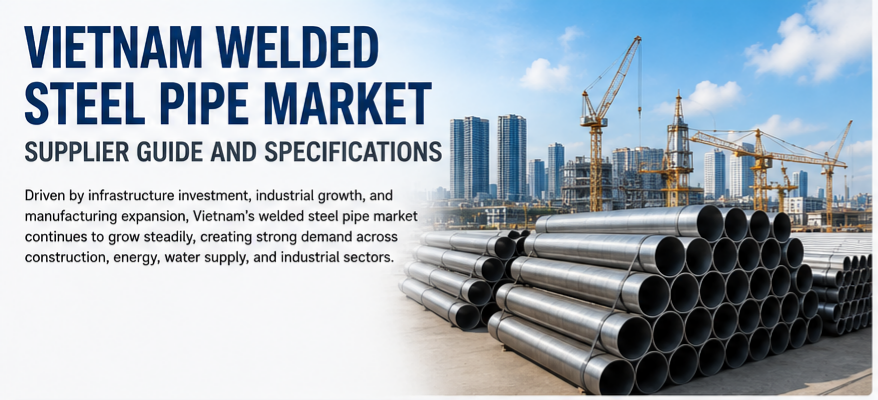
Overview of Vietnam’s Welded Steel Pipe Market
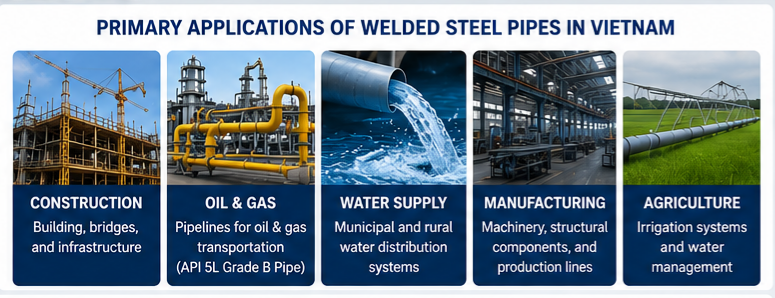
In recent years, Vietnam’s welded steel pipe market has maintained steady growth, driven primarily by infrastructure development, industrial expansion, and the relocation of global manufacturing capacity into Southeast Asia. As Vietnam accelerates its industrialization process, demand for steel pipes continues to increase across construction, oil & gas transmission, water supply systems, power projects, industrial facilities, and machinery manufacturing.
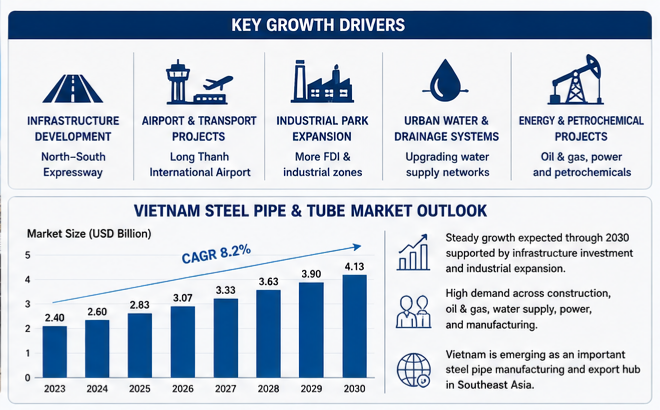
Major infrastructure and industrial projects contributing to market growth include:
- North–South Expressway
- Long Thanh International Airport
- Expansion of industrial parks
- Urban water supply and drainage upgrades
- Energy and petrochemical projects
According to industry research, Vietnam’s steel pipe and tube market is expected to continue growing in the coming years, with infrastructure investment and manufacturing expansion remaining the primary growth drivers.
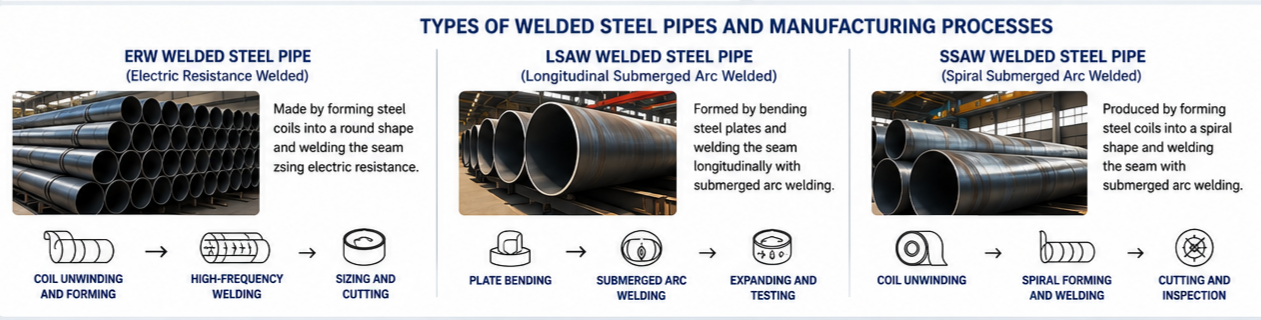
Main Types of Welded Steel Pipes in Vietnam
The Vietnamese market mainly consists of the following welded steel pipe categories:
1. ERW Steel Pipe (Electric Resistance Welded Pipe)
ERW steel pipe is one of the most widely used welded pipe products in Vietnam.
Manufacturing Process
Steel coils are cold-formed into round shapes, and the seam is welded using high-frequency electrical resistance welding technology.
Key Features
- Lower production cost
- High manufacturing efficiency
- Stable dimensional accuracy
- Suitable for small and medium diameters
Applications
- Structural construction
- Scaffolding
- Fire protection systems
- Water supply pipelines
- HVAC systems
Common Specifications
- Outer Diameter: 21.3mm – 660mm
- Wall Thickness: 1.2mm – 16mm
2. LSAW Steel Pipe (Longitudinal Submerged Arc Welded Pipe)
LSAW steel pipes are mainly used for high-pressure and large-diameter transmission systems.
Features
- High weld quality
- Excellent pressure resistance
- Ideal for oil and gas transportation
Applications
- API pipeline systems
- Natural gas transmission
- Offshore engineering
- Large bridge structures
Common Specifications
- Outer Diameter: 406mm – 1422mm
3. SSAW Steel Pipe (Spiral Submerged Arc Welded Pipe)
SSAW spiral welded pipes are widely used in Vietnam’s water infrastructure and large-scale engineering projects.
Advantages
- Capable of producing extra-large diameters
- Lower production cost compared to LSAW
- Suitable for long-distance transmission
Applications
- Municipal water transmission
- Offshore engineering
- Oil and gas transportation
Common Specifications
- Outer Diameter: 219mm – 3000mm
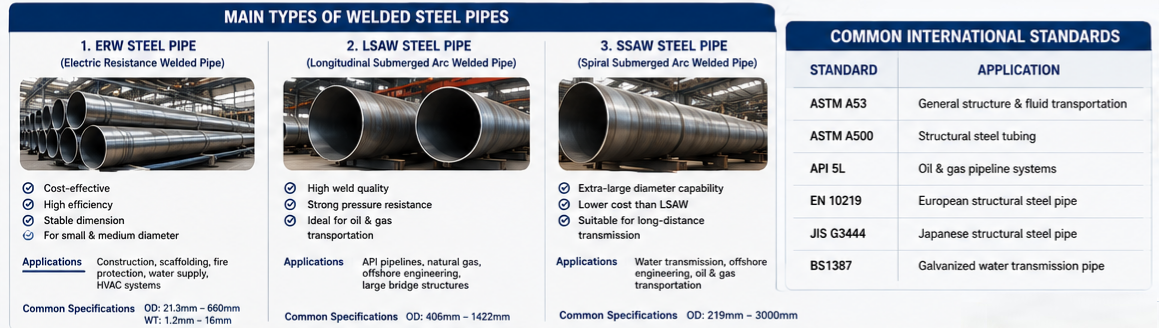
Main Standards for Welded Steel Pipes in Vietnam
Welded steel pipes in Vietnam are generally manufactured according to international standards, especially products intended for export to Europe, the Middle East, and North America.
Common International Standards
| Standard | Application |
|---|---|
| ASTM A53 | General structure and fluid transportation |
| ASTM A500 | Structural steel tubing |
| API 5L | Oil and gas pipeline systems |
| EN 10219 | European structural steel pipe |
| JIS G3444 | Japanese structural steel pipe |
| BS1387 | Galvanized water transmission pipe |
Rising Demand for Hot Dip Galvanized Steel Pipes in Vietnam
As Vietnam continues to expand coastal industrial zones and projects in humid tropical environments, demand for hot dip galvanized steel pipes has increased significantly.
Key Reasons Include:
- Improved corrosion resistance
- Longer service life
- Lower maintenance costs
- Better suitability for outdoor and underground projects
Hot dip galvanized welded pipes are widely used in:
- Fire protection systems
- Agricultural irrigation
- Water supply engineering
- Electrical conduit systems
- Solar mounting structures
Vietnam’s Welded Steel Pipe Import Market
Although Vietnam’s domestic steel pipe manufacturing capacity continues to improve, certain high-specification products still rely on imports, particularly:
- API line pipes
- High-grade oil & gas pipes
- Ultra-large diameter steel pipes
- Special alloy steel pipes
Main Import Sources
- China
- South Korea
- Japan
In recent years, steel trade between China and Vietnam has remained active, with China continuing to be one of Vietnam’s major steel supply sources.
How to Choose High-Quality Welded Steel Pipes
For international buyers, selecting the right Vietnamese steel pipe supplier is essential.
Key Factors to Consider
1. Certification System
Priority should be given to manufacturers certified by:
- ISO 9001
- API
- CE
- SGS
2. Raw Material Quality
Stable and reliable steel coil sourcing directly affects pipe quality and consistency.
3. Weld Inspection Capability
Important inspection methods include:
- Ultrasonic Testing (UT)
- Hydrostatic Testing
- X-Ray Inspection
4. Galvanizing Quality
Buyers should pay attention to:
- Zinc coating thickness
- Coating adhesion
- Salt spray resistance testing
Future Trends in Vietnam’s Welded Steel Pipe Market
Vietnam’s welded steel pipe industry is expected to maintain strong growth momentum in the coming years due to several factors:
- Manufacturing relocation into Southeast Asia
- Continuous infrastructure investment
- Expansion of industrial zones
- Growth in energy projects
- Recovery of the real estate sector
At the same time, green manufacturing and high-end steel pipe products are becoming increasingly important competitive factors.
The industry is expected to move toward:
- Higher value-added products
- Stricter international certifications
- Larger diameter steel pipes
- Export-oriented production
Conclusion
Vietnam’s welded steel pipe market is developing rapidly and is gradually becoming an important manufacturing and export hub in Southeast Asia. For international buyers, understanding different welded pipe types, technical standards, supplier capabilities, and market trends can help reduce procurement risks and improve project competitiveness.
As Vietnam continues its industrialization process, demand for welded steel pipes in construction, energy, water infrastructure, and manufacturing sectors is expected to remain strong, creating new opportunities within the global steel supply chain.
