
ERW Pipe vs Seamless Pipe – Different Application Domains

When choosing steel pipes for industrial projects, one of the most common questions buyers ask is: Should I choose an ERW pipe or a seamless pipe?
Although both products are designed to transport fluids or provide structural support, they are manufactured differently and perform best in different environments. Modern ERW (Electric Resistance Welded) pipes have achieved excellent quality and are widely used in many industries, while seamless pipes remain the preferred option for high-pressure and critical applications.
In this guide, we’ll compare ERW pipe vs seamless pipe, focusing on their application domains, advantages, limitations, and how to select the right solution for your project.
What Is an ERW Pipe?
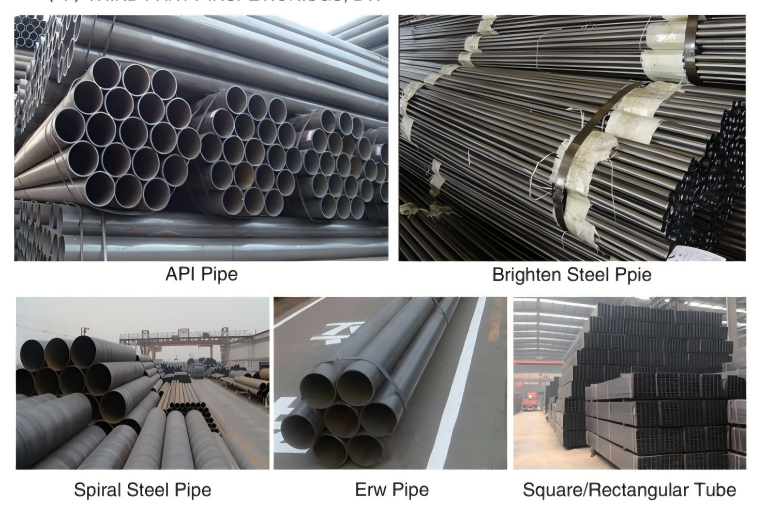
ERW pipe (Electric Resistance Welded Pipe) is manufactured by rolling steel coils into a cylindrical shape and welding the edges together using high-frequency electrical resistance. Unlike traditional welded pipes, ERW welding requires no filler material, resulting in a clean and strong longitudinal weld.
Advantages of ERW Pipe
- Excellent dimensional accuracy
- Smooth inner and outer surfaces
- Lower manufacturing cost
- High production efficiency
- Consistent wall thickness
- Available in large quantities and standard sizes
Because of these advantages, ERW pipes are often the first choice for projects where cost efficiency and dimensional consistency are important.
What Is a Seamless Pipe?
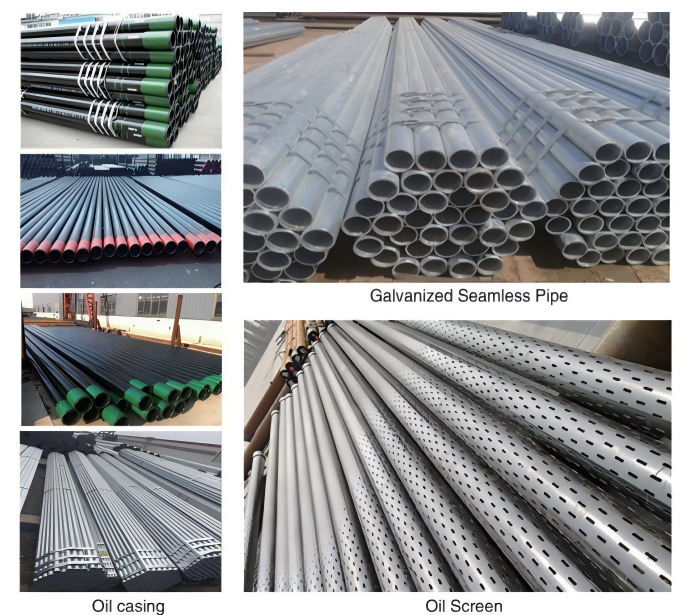
A seamless pipe is produced from a solid steel billet that is pierced and rolled into a hollow tube without any welded seam. Since there is no weld line, the pipe has a uniform structure throughout its cross-section.
Advantages of Seamless Pipe
- No welded seam
- Higher pressure resistance
- Better performance under extreme temperatures
- Greater structural integrity
- Excellent fatigue resistance
- Suitable for demanding industrial environments
Although seamless pipes are generally more expensive, they provide greater reliability under severe operating conditions.
ERW Pipe vs Seamless Pipe: Key Differences
| Feature | ERW Pipe | Seamless Pipe |
|---|---|---|
| Manufacturing | Electric resistance welding | Hot rolling or cold drawing from billet |
| Weld Seam | Yes | No |
| Pressure Capacity | Medium to High | Very High |
| Cost | Lower | Higher |
| Surface Finish | Smoother | Slightly rougher |
| Dimensional Accuracy | Excellent | Good |
| Production Efficiency | High | Lower |
| Typical Lead Time | Shorter | Longer |
The biggest difference is not simply the presence of a weld seam—it is choosing the product that matches the project’s operating pressure, temperature, applicable codes, and budget.
Different Application Domains of ERW Pipe
ERW pipes dominate many commercial and industrial sectors because they provide excellent performance at a competitive cost.
1. Oil & Gas Transmission Pipelines
Modern ERW pipes are widely used in long-distance oil and natural gas transmission systems where they comply with industry standards such as API 5L. Their excellent weld quality and dimensional consistency make them suitable for pipeline construction under many operating conditions.
2. Water Supply Systems
Municipal water pipelines, irrigation projects, and wastewater treatment facilities commonly use ERW steel pipes because they offer:
- Corrosion-resistant coatings
- High production efficiency
- Lower installation costs
- Reliable mechanical strength
3. Structural Construction
ERW pipes are extensively used for:
- Building structures
- Steel frameworks
- Bridges
- Stadiums
- Warehouses
- Scaffolding
Their uniform dimensions simplify fabrication and welding during construction.
4. Mechanical Engineering
Manufacturers use ERW pipes for:
- Machinery frames
- Automotive components
- Agricultural equipment
- Material handling systems
The precise outside diameter and wall thickness improve machining accuracy.
5. Fire Protection Systems
Fire sprinkler networks often utilize ERW pipes because they combine adequate pressure resistance with economical pricing for large-scale installations.
6. Low and Medium Pressure Fluid Transportation
Industries transporting:
- Water
- Compressed air
- Steam
- Natural gas
- Industrial fluids
frequently select ERW pipes when operating conditions do not require seamless construction.
Different Application Domains of Seamless Pipe
While ERW pipes cover many industrial needs, seamless pipes remain essential where safety margins are critical.
1. High-Pressure Oil & Gas Exploration
Drilling operations expose pipes to:
- Extremely high pressure
- Heavy mechanical loads
- Abrasion
- Corrosive environments
Seamless pipes provide superior reliability because they eliminate concerns associated with a longitudinal weld.
2. Petrochemical Industry
Chemical plants often transport:
- Corrosive chemicals
- High-temperature liquids
- Hazardous gases
Seamless pipes are widely specified for these demanding process conditions.
3. Boiler Systems
Power plants operate under extremely high steam pressure and temperature.
Boiler tubes typically require seamless construction to ensure long-term safety and durability.
4. Heat Exchangers
Heat exchanger tubes frequently experience thermal expansion and contraction.
Seamless pipes perform well under repeated thermal cycling, reducing the risk of structural failure.
5. Hydraulic Systems
Hydraulic cylinders and precision hydraulic pipelines require:
- High internal pressure resistance
- Excellent dimensional stability
- Superior fatigue performance
Seamless pipes are commonly selected for these applications.
6. Aerospace and Defense
Critical aerospace components demand materials with exceptional strength and reliability.
Because seamless pipes contain no weld seam, they are often preferred for aircraft, military equipment, and other high-performance engineering applications.
How to Choose Between ERW Pipe and Seamless Pipe
Choosing the right steel pipe depends on your project’s specific requirements rather than assuming one type is universally better.
Choose ERW Pipe if you need:
- Cost-effective solutions
- Large-volume procurement
- Structural applications
- Water or gas transportation
- Standard industrial pipelines
- Fast delivery times
Choose Seamless Pipe if your project involves:
- High-pressure systems
- High-temperature environments
- Critical process piping
- Boiler applications
- Hydraulic equipment
- Oil & gas exploration
- Safety-critical operations
Cost Considerations
Budget is often a decisive factor in pipe selection.
ERW pipes are generally more economical because they are manufactured from steel coils using efficient continuous production methods. Seamless pipes require billet piercing and rolling, resulting in higher production costs and typically longer lead times.
However, selecting a lower-cost pipe is not always the best decision. If the application involves severe pressure, temperature, or fatigue loading, investing in seamless pipe can reduce long-term operational risks and maintenance costs.
⚡ Quick RFQ & Instant CIF Quotation
Inquiring about ERW Pipe vs Seamless Pipe Different Application Domains? Contact our export engineering team for 2026 FOB/CIF pricing, MTC 3.1 certificates, and 20GP container loading calculations.
