
Difference Between Galvanized and Black Square Steel Tube
In the fields of construction, manufacturing, and infrastructure development, square steel tubes are among the most widely used structural materials. In actual procurement and engineering applications, the choice between galvanized square steel tubes and black square steel tubes directly determines a project’s construction costs, structural durability, and maintenance intervals, making it a critical decision point in the material selection process.
- What Are Galvanized Square Steel Tubes and Black Square Steel Tubes?
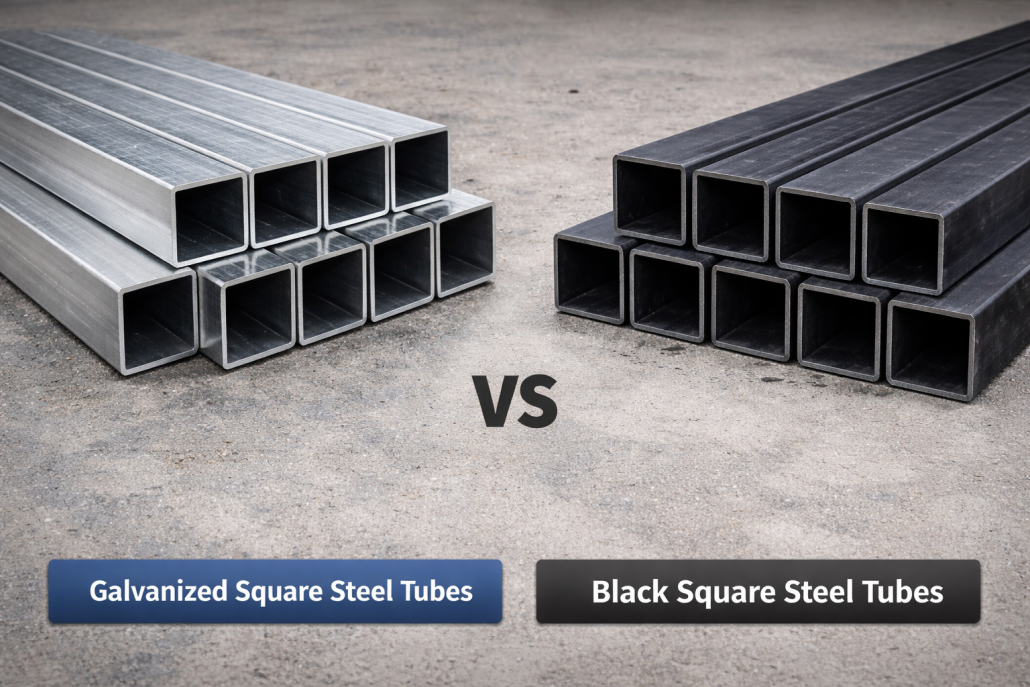
Galvanized Square Steel Tubes
Galvanized square steel tubes use ordinary carbon steel square tubes as the base material, with a uniform layer of zinc coating applied to their surface. The core manufacturing processes are primarily divided into two types: hot-dip galvanizing and electro galvanizing. Of these, hot-dip galvanizing is more widely used due to its strong adhesion and uniform coverage; cold galvanizing, on the other hand, is suitable for scenarios where corrosion protection requirements are not extremely stringent, thanks to its ease of construction and moderate cost. Its core function is to prevent steel corrosion and rust at the source by physically isolating and electro chemically protecting the steel substrate from contact with air and moisture through the zinc layer.
Black Square Steel Tubes
Black square steel tubes are ordinary carbon steel square tubes that have not undergone any surface anti-corrosion treatment. A natural black oxide scale forms on their surface, representing the basic, unprocessed form of square steel tubes. Their key features include low production costs and ease of processing, allowing for direct subsequent operations such as cutting and welding. However, due to the lack of surface protection, their corrosion resistance is weak, making them susceptible to rusting under environmental influences.
2. Comparison of Core Performance
A. Corrosion Resistance (Key Differences)
Galvanized Square Steel Tubes: The zinc coating forms a complete protective barrier, effectively isolating the steel from oxidizing agents (air, moisture, acids, and alkali). This is particularly true for hot-dip galvanized square tubes, features sufficient zinc coating thickness and strong adhesion, offering a service life of over 20 years in complex outdoor environments. Even if the zinc coating is locally damaged, the sacrificial anode effect of zinc protects the steel substrate from corrosion.
Black Square Steel Tubing: The surface scale cannot form effective protection. In humid, outdoor, or corrosive environments, it is highly susceptible to moisture and rust, with a relatively fast corrosion rate. Without additional anti-corrosion treatment, rust and damage will occur within a short period, affecting structural stability.
Ranking of Corrosion Resistance: Hot-dip galvanized square tubing > Cold-galvanized square tubing > Black square steel tubing
B. Service Life
Galvanized square steel tubes: With stable protective performance, they require infrequent anti-corrosion maintenance, have a long service life, can maintain structural integrity over the long term, and have extremely low maintenance costs.
Black square steel tubes: Service life is highly dependent on the environment and post-treatment. Without anti-corrosion treatment, they can last 3–5 years in dry indoor environments but only 1–2 years outdoors or in humid environments; If regularly painted or treated with rust-proofing, service life can be extended, but this increases maintenance costs and labor.
For long-term projects with a service life exceeding 5 years, galvanized square steel tubes offer superior overall cost-effectiveness, effectively reducing future maintenance costs and the risk of rework.
C. Cost Comparison
Black square steel tubes: Simple raw materials and manufacturing processes result in the lowest price, making them the top choice for short-term projects and low-cost applications;
Cold-galvanized square steel tubes: Incorporate a cold-galvanizing process on top of the black square tube base, offering moderate costs while balancing cost-effectiveness with basic corrosion protection needs;
Hot-dip galvanized square steel tubes: The hot-dip galvanizing process is complex and consumes more zinc, resulting in the highest cost; however, long-term use can save on maintenance costs, making them suitable for projects with high durability requirements.
D. Strength and Structural Performance
Both types of square steel tubes use ordinary carbon steel as the base material. When the base material specifications (diameter, wall thickness) are identical, differences in structural properties—such as mechanical strength, load-bearing capacity, and impact resistance—are minimal, and both can meet the structural requirements of conventional construction and manufacturing. While the zinc coating on galvanized square steel tubes does not enhance the core strength, it provides additional protection for the base material, reducing corrosion-induced loss of structural strength and ensuring greater structural stability over the long term.
E. Process-ability
Black square steel tubes: Offer the best process-ability, allowing for direct welding, cutting, bending, drilling, and other operations without additional treatment. They are suitable for applications requiring complex processing or surface coating.
Galvanized Square Steel Tubes: Processing is subject to certain limitations. Before welding, the zinc coating must be removed from the weld area (otherwise, the zinc coating will produce fumes that affect weld quality and cause defects such as porosity and cracks), which adds processing steps and increases workload. After cutting or bending, the cut edges or bent areas must be re-treated with a corrosion-resistant coating to prevent localized rusting.
3. Comparison of Application Scenarios
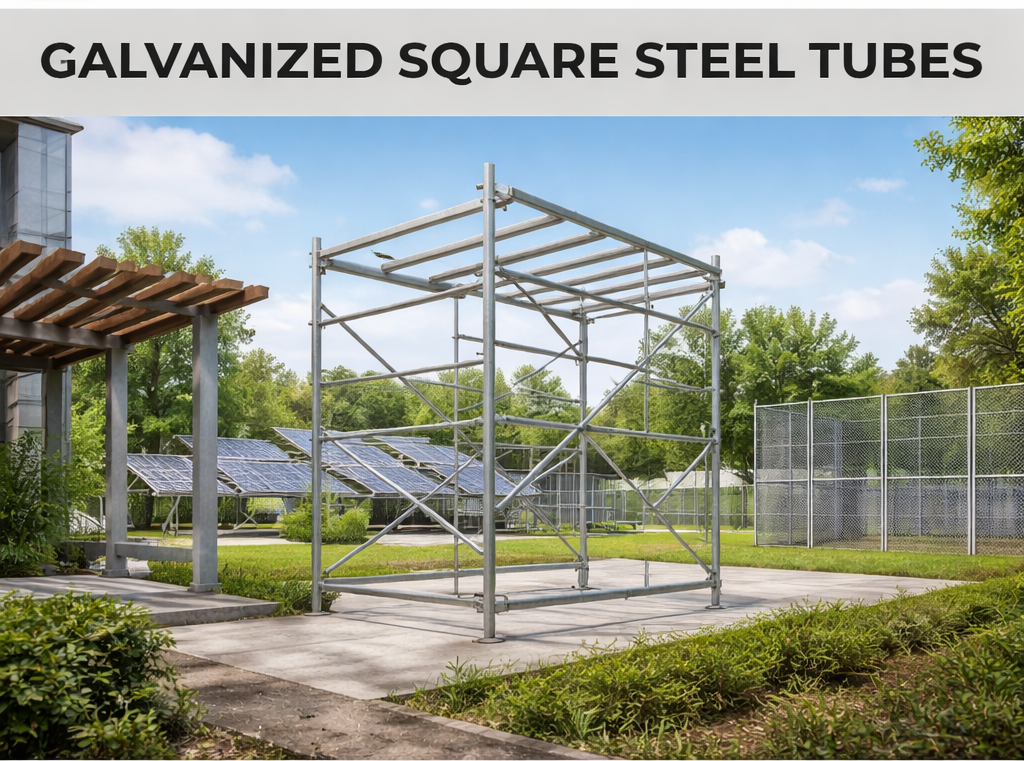
Applications for Galvanized Square Steel Tubes
Projects subject to long-term exposure to outdoor environments, humidity, acids, alkali, and other corrosive conditions that require minimal maintenance and prioritize structural durability.
Outdoor building structures: such as scaffolding, outdoor frameworks, building columns, and fence posts;
Steel structure engineering: such as steel structures for industrial buildings, auxiliary bridge structures, and steel support structures for stadiums;
Landscaping and protective facilities: such as landscape frameworks, road guardrails, residential complex fences, and wall railings;
Others: solar panel mounts, greenhouse structures, outdoor billboard frames, water supply and drainage supports, etc.
Applications for Black Square Steel Tubes
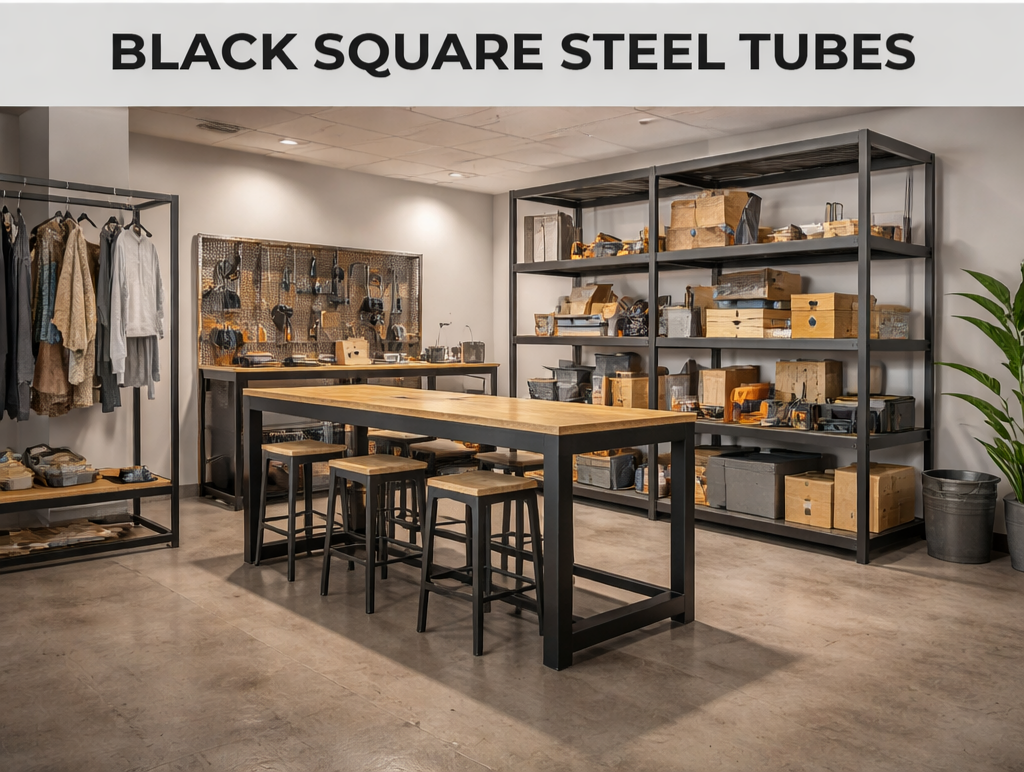
Indoor dry environments, short-term use, projects where anti-corrosion treatment can be applied later, or projects requiring complex processing, prioritizing low cost and high processing convenience.
Indoor Structures: Such as interior finishing frames, ceiling joists, indoor supports, and equipment bases;
Furniture Manufacturing: Such as metal furniture frames, shelving units, display racks, and warehouse shelving;
Temporary Projects: Such as temporary scaffolding, temporary fencing, and temporary construction shelters;
Others: Products requiring secondary corrosion protection treatments such as spraying or electroplating, or simple structural components intended for single-use.
- Hot-Dip Galvanizing vs. Electro galvanizing (Extended Comparison)
| Comparison Item | Hot-Dip Galvanizing | Electro galvanizing |
| Zinc Coating Thickness | Thicker (typically ≥80μm), uniform coverage, strong adhesion | Thinner (typically ≤20μm), relatively uniform coverage, average adhesion |
| Corrosion Resistance | Strong; withstands complex outdoor environments and acid/alkali corrosion | Average; meets only basic corrosion protection needs; not suitable for harsh environments |
| Service Life | Long; up to 20+ years outdoors | Moderate; approximately 5–10 years outdoors, 10–15 years indoors |
| Cost | Higher, complex process, high zinc consumption | Lower, simple process, moderate cost-effectiveness |
| Applications | Long-term outdoor projects, harsh environments, projects with high corrosion resistance requirements | Indoor projects, short-term outdoor projects, basic corrosion protection needs with limited budgets |
5. Practical Selection Guide
In actual procurement, there is no need for complex analysis; you can quickly assess and precisely match requirements based on the following four core dimensions:
A. Consider the usage environment
Outdoor, humid, rainy, coastal, or acidic/alkaline environments →Prioritize galvanized square steel tubes (hot-dip galvanized is best);
Indoor, dry, non-corrosive environments → Black square steel tubes are sufficient; no need to incur additional galvanizing costs.
B. Consider the service life
Long-term projects (service life > 5 years) → Galvanized square steel tubes to reduce long-term maintenance costs;
Short-term projects (service life ≤ 3 years) or temporary installations → Black square steel tubing is more economical and offers better value for money.
C. Consider Budget Constraints
Limited budget, prioritizing low cost → Black square steel tubing (can be easily painted for corrosion protection later);
Prioritizing durability and minimizing future maintenance → Galvanized square steel tubing (choose hot-dip or electro galvanized based on budget).
D. Consider Subsequent Processing
Requires frequent welding, cutting, or bending, or will undergo subsequent spraying or electroplating → Black square steel tubes are more convenient, avoiding the galvanized coating from affecting processing quality;
No complex processing required; ready for direct installation after purchase → Galvanized square steel tubes, eliminating the need for subsequent anti-corrosion procedures.
6. Frequently Asked Questions (FAQ)
Q1: Do galvanized square steel tubes rust?
Yes, but the corrosion rate is much slower than that of black square steel tubes. Corrosion of galvanized square steel tubes only occurs when the zinc coating is damaged (e.g., by scratches or impacts) and the damaged area is exposed to air and moisture for an extended period. Furthermore, corrosion first consumes the remaining zinc coating before affecting the steel substrate, and the overall corrosion rate is less than one-tenth that of black square steel tubes.
Q2: Can black square steel tubes replace galvanized square steel tubes?
Yes, but under certain conditions: the black square steel tubes must undergo additional corrosion protection treatment (such as applying anti-rust paint or spraying a protective coating). Otherwise, their service life will be extremely short, and they are prone to rust and damage, which can compromise structural safety. They are suitable for short-term use in scenarios where regular maintenance can be performed later; however, they are not recommended as a substitute for long-term projects.
Q3: Which type of square steel pipe is more suitable for export projects?
Hot-dip galvanized square steel pipes are the preferred choice. Most international engineering standards (such as those in Europe, the Americas, and Southeast Asia) have high requirements for the corrosion resistance of structural materials. The durability and corrosion resistance of hot-dip galvanized square steel pipes better meet these international standards, effectively reducing quality risks in export projects while lowering maintenance costs for overseas projects.
Q4: How can corrosion protection be ensured after welding galvanized square steel tubes?
Before welding, the zinc coating must be removed from the weld area (using methods such as grinding or sandblasting). After welding, the weld joints and surrounding areas should be repainted using specialized galvanized touch-up paint or anti-corrosion coatings to ensure that the repainted areas form a complete protective layer with the original zinc coating, thereby preventing localized corrosion.
7. Summary
There is no definitive superior or inferior option between galvanized and black square steel tubes; the key is to match the actual project requirements, usage environment, and budget.
If corrosion resistance, long service life, and low maintenance are priorities for outdoor or long-term projects, galvanized square steel tubes should be the first choice (opt for hot-dip galvanizing if the budget allows, or cold-dip galvanizing if the budget is limited);
If you prioritize low cost and ease of fabrication for indoor, short-term projects, or scenarios requiring further processing, black square steel tubing is the appropriate choice.
From the perspective of long-term costs and project stability, although galvanized square steel tubes have a higher initial purchase cost, they significantly reduce subsequent maintenance costs and minimize the risk of rework. They offer better overall value for money and are the preferred choice for most long-term and outdoor projects.
If you are struggling with material selection for your project, or need to develop a precise selection plan for square steel tubes based on specific usage environments, budgets, and technical requirements, please feel free to contact us.
