
Steel Plates vs Steel Strips vs Structural Steel: Comparing Easily Confused Steel Categories + Guide to Selecting High-Quality Steel Plates
In steel procurement and project construction, steel plates, steel strips, and structural steel are three frequently used materials. Many people make selection errors due to unfamiliarity with their forms, properties, and applicable scenarios. This not only increases project costs but may also create safety hazards. This article provides a detailed comparison of their core differences and shares tips for selecting high-quality steel plates, helping you choose the right steel precisely.
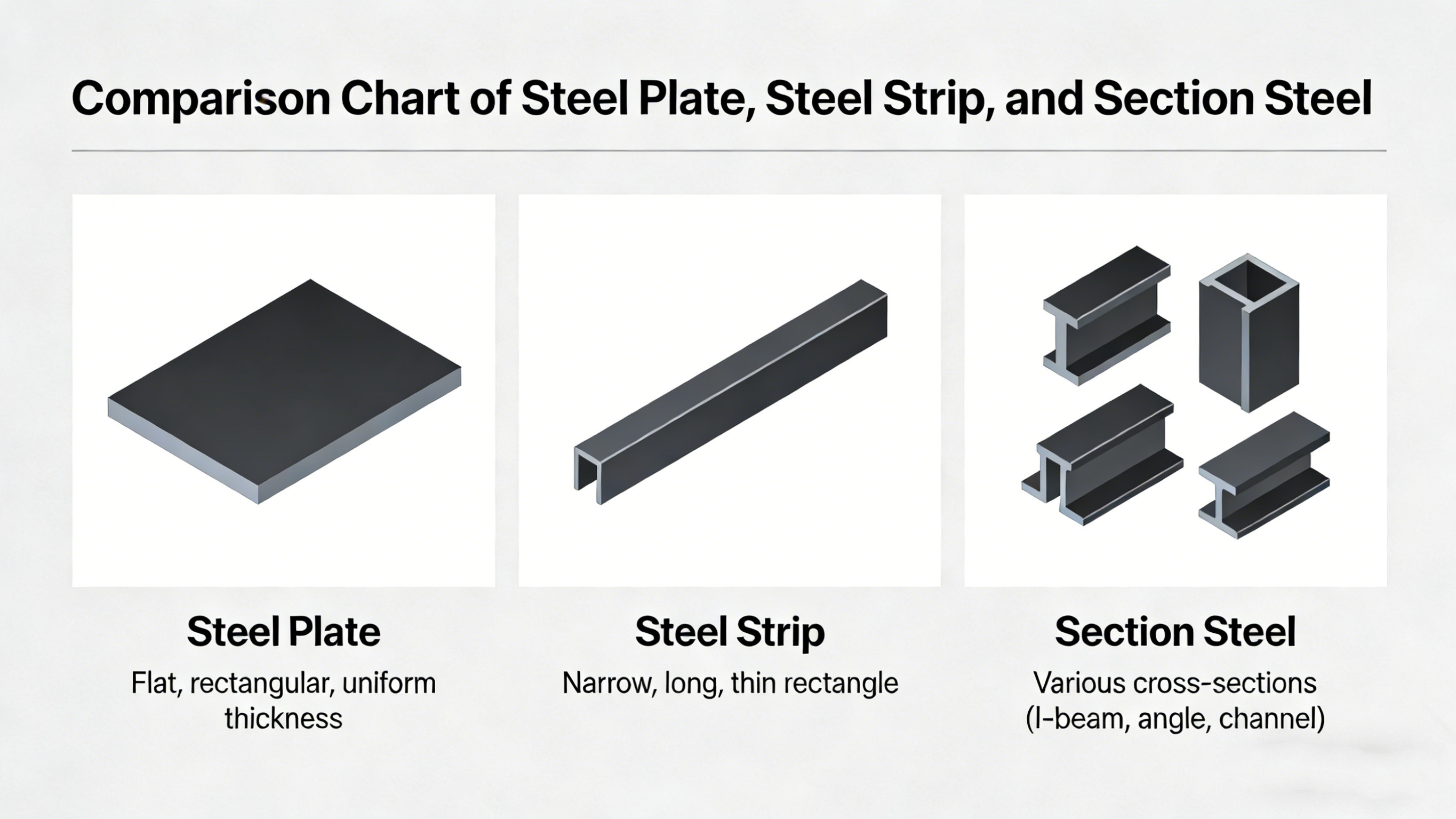
1.Core Differences Between Steel Plates, Steel Strips, and Structural Steel
Though all belong to the steel category, steel plates, steel strips, and structural steel exhibit significant distinctions in form characteristics, load-bearing methods, application scenarios, and processing difficulty, as shown in the table below:
| Comparison Dimension | Steel Plate | Steel Strip | Shaped Steel |
| Physical Form | Flat, thickness ≥6mm, flexible length/width dimensions | Thin strip, thickness <6mm, supplied in coils | Specific cross-sectional shapes (e.g., I-beams, channels, angles) |
| Load-bearing Mechanism | Primarily subjected to surface loads and compressive stress | Primarily used for rolling and stamping, withstanding localized stresses | Primarily subjected to tensile and bending stresses, with mechanical properties tailored for specific applications. |
| Application Scenarios | Manufacturing large components, equipment housings, load-bearing panels, bridge components, etc. | Processed into hardware fittings, pipes, steel boxes, automotive parts, etc. | Building beams and columns, equipment supports, mechanical frames, steel structure workshop skeletons, etc. |
| Processing Difficulty | Cutting and welding processes are mature; moderate forming difficulty | Excellent stamping performance, suitable for mass-producing small parts with high processing efficiency | Primarily standardized production; processing mainly involves cutting, drilling, and assembly with low difficulty |
Simply put, steel plates are ideal for large-area load-bearing or protective components, steel strips are best for mass-producing small hardware parts, and structural steel is the preferred material for constructing load-bearing frameworks.
2.How to choose? Select materials based on project requirements
The core principle for choosing among these three steel types is matching the project’s load characteristics, structural design, and cost budget.
Prioritize steel plates: When projects require large-area load-bearing panels or equipment housings—such as tank walls for large storage tanks or protective enclosures for machinery—steel plates provide sufficient surface load-bearing capacity.
Prioritize steel strip: For mass-producing small stamped parts or rolled pipe fittings—like hardware components or steel-banded packaging boxes—coiled steel strip offers higher processing efficiency and cost control.
Prioritize structural steel: When constructing building frames or equipment support structures, sections like I-beams and channel bars provide superior tensile and bending strength, ensuring structural stability.
3.Key Considerations for Selecting Premium Steel Plates
Selecting the right steel plate requires not only matching requirements but also ensuring quality. The following four points are essential:
Define performance requirements and match them to the usage environment. Different scenarios demand varying steel plate properties. For chemical applications involving corrosive media, prioritize stainless steel or corrosion-resistant alloy plates. For outdoor structures exposed to prolonged weathering, weathering steel is preferable as it forms a protective rust layer that prevents internal corrosion. For high-temperature operations, heat-resistant steel plates must be selected to prevent deformation from elevated temperatures.
Verify dimensional accuracy to ensure assembly integrity. Thickness tolerances and length/width deviations directly impact subsequent processing and assembly. Precision equipment manufacturing demands exceptionally high dimensional accuracy. During procurement, conduct on-site measurements or review inspection reports to confirm dimensions match design drawings, preventing assembly failures due to dimensional discrepancies.
Verify quality certificates and reject non-standard substandard products. Steel plates from reputable manufacturers come with material certificates and inspection reports. Always require suppliers to provide these documents during procurement to verify that the plate’s material composition, mechanical properties, and other indicators comply with national or industry standards. Steel plates without quality certificates are likely non-standard substandard products with unguaranteed performance and should be strictly avoided.
Evaluate processing suitability to match subsequent processes. Different subsequent processing methods for steel plates require different selections. For components requiring bending, prioritize cold-rolled steel plates, which offer better plasticity and are less prone to cracking after bending. For welded components, focus on the steel’s weld-ability and select plates with excellent weld-ability to avoid defects such as cracks and porosity after welding.
The core principle for selecting steel plates, steel strips, and structural steel is “matching to requirements.” Choosing appropriate materials based on the project’s stress characteristics, structural design, and cost budget effectively avoids safety risks and economic losses. When purchasing high-quality steel plates, strict control must be exercised across four dimensions—performance, dimensions, quality certificates, and processing compatibility—to ensure the selected products meet the requirements.