
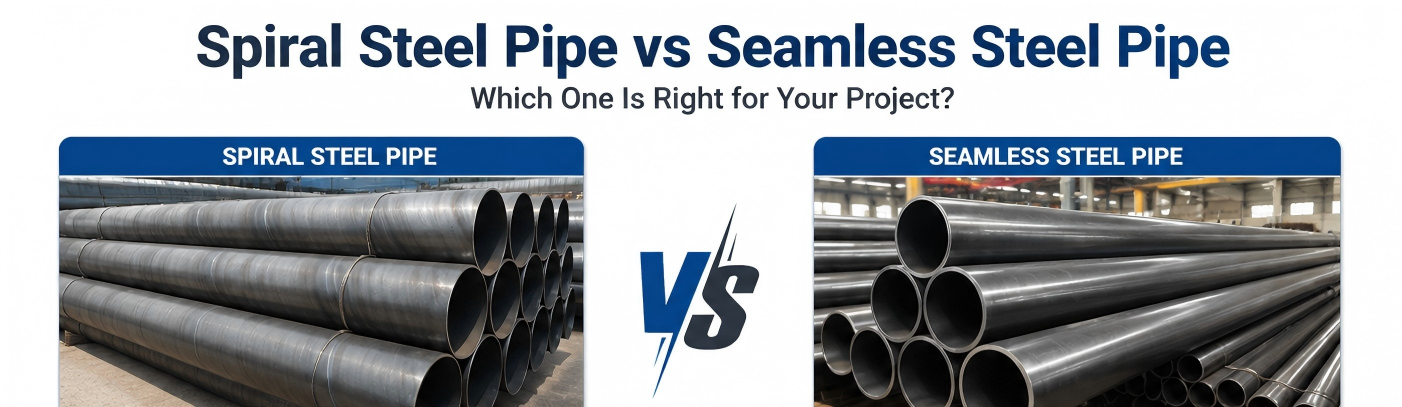
Spiral Steel Pipe vs Seamless Steel Pipe: Which One Is Right for Your Project?
Choosing the right steel pipe is one of the most important decisions in industrial projects. Whether you’re working in oil and gas, water transmission, construction, or infrastructure development, selecting the appropriate pipe type directly impacts project safety, performance, and cost.
Among the many options available, spiral steel pipe and seamless steel pipe are two of the most commonly used products. While both offer excellent durability and strength, they differ significantly in manufacturing process, mechanical properties, applications, and price.
This guide compares Spiral Steel Pipe vs Seamless Steel Pipe to help buyers, engineers, contractors, and procurement professionals make informed purchasing decisions.
What Is a Spiral Steel Pipe?
A spiral steel pipe, also known as a spiral welded steel pipe (SSAW pipe), is manufactured by rolling a steel strip into a cylindrical shape and welding it along a continuous spiral seam.
Because the weld follows a spiral path instead of a straight line, manufacturers can produce large-diameter pipes using narrower steel coils, making spiral pipes a highly economical solution for many industries.
Advantages of Spiral Steel Pipe
- Cost-effective for large-diameter projects
- Available in extra-large diameters
- High production efficiency
- Suitable for long-distance pipeline construction
- Excellent structural strength for low- and medium-pressure applications
Common Applications
Spiral steel pipes are widely used for:
- Water transmission pipelines
- Municipal water supply
- Sewage systems
- Oil and gas transportation
- Bridge piling
- Structural foundations
- Marine engineering
- Dredging projects
What Is a Seamless Steel Pipe?
Unlike welded pipes, a seamless steel pipe is manufactured from a solid round steel billet that is heated and pierced to create a hollow tube. Since there is no welded seam, seamless pipes provide superior pressure resistance and mechanical performance.
The absence of a weld makes seamless steel pipes the preferred choice for demanding industrial environments.
Advantages of Seamless Steel Pipe
- No welded seam
- Excellent pressure resistance
- High tensile strength
- Better fatigue resistance
- Reliable performance under extreme temperatures
- Longer service life in critical applications
Common Applications
Seamless steel pipes are commonly used in:
- Oil drilling
- Natural gas transportation
- Petrochemical plants
- Boilers
- Power generation
- High-pressure pipelines
- Hydraulic systems
- Mechanical manufacturing
Manufacturing Process Comparison
Understanding how each pipe is manufactured helps explain their performance differences.
Spiral Steel Pipe Manufacturing
The manufacturing process includes:
- Steel coil preparation
- Coil edge milling
- Forming into a spiral shape
- Submerged arc welding (SAW)
- Ultrasonic testing
- Hydrostatic pressure testing
- Surface treatment
- Final inspection
Modern SSAW production lines incorporate automated quality control systems to ensure consistent weld integrity.
Seamless Steel Pipe Manufacturing
The seamless manufacturing process generally includes:
- Billet heating
- Rotary piercing
- Hot rolling
- Sizing
- Heat treatment
- Straightening
- Non-destructive testing
- Final inspection
This process eliminates the need for welding and results in a uniform pipe structure.
Spiral Steel Pipe vs Seamless Steel Pipe: Key Differences
| Feature | Spiral Steel Pipe | Seamless Steel Pipe |
|---|---|---|
| Manufacturing | Spiral welded | No weld |
| Production Cost | Lower | Higher |
| Diameter Range | Very large diameters available | Usually smaller to medium diameters |
| Pressure Capacity | Medium to high | Very high |
| Mechanical Strength | Good | Excellent |
| Corrosion Resistance | Depends on coating | Excellent with proper treatment |
| Production Speed | Faster | Slower |
| Weight | Generally lighter for large diameters | Heavier wall options available |
| Price | More economical | More expensive |
| Typical Standards | API 5L, ASTM A252 | ASTM A106, ASTM A53, API 5L |
Strength Comparison
Many buyers wonder whether welded pipes are weaker than seamless pipes.
In reality, modern spiral steel pipes undergo rigorous inspections, including:
- Ultrasonic testing
- X-ray inspection
- Hydrostatic pressure testing
- Weld integrity testing
For most water transmission, structural, and low- to medium-pressure pipeline systems, spiral steel pipes provide more than sufficient strength.
However, for extremely high-pressure environments, seamless steel pipes remain the preferred option because there is no weld seam that could become a potential stress concentration point.
Pressure Performance
Pressure capability is one of the biggest differences between these two products.
Spiral Steel Pipe
Suitable for:
- Municipal water systems
- Oil transportation
- Gas distribution
- Irrigation
- Structural piling
Typically used in medium-pressure applications.
Seamless Steel Pipe
Ideal for:
- High-pressure steam systems
- Refinery pipelines
- Boiler tubes
- Chemical processing
- Hydraulic equipment
Capable of handling significantly higher operating pressures.
Diameter Availability
Diameter requirements often influence pipe selection.
Spiral Steel Pipe
One major advantage is its ability to produce very large diameters.
Typical diameter range:
- 219 mm
- 325 mm
- 508 mm
- 820 mm
- 1200 mm
- 2000 mm
- Up to 3000 mm or larger
This makes spiral pipes ideal for water transmission and infrastructure projects.
Seamless Steel Pipe
Seamless pipes are commonly available in:
- 21.3 mm
- 33.4 mm
- 60.3 mm
- 114.3 mm
- 168.3 mm
- Up to approximately 660 mm depending on manufacturing capabilities
Large-diameter seamless pipes become significantly more expensive.
Cost Comparison
Budget is often a deciding factor in procurement.
Spiral Steel Pipe
Advantages include:
- Lower raw material costs
- Higher production efficiency
- Lower manufacturing cost
- Competitive pricing for large diameters
This makes spiral steel pipe the preferred option for large-scale infrastructure projects.
Seamless Steel Pipe
Due to the complex production process, seamless pipes require:
- More energy
- Longer manufacturing time
- Higher equipment investment
- More stringent quality control
As a result, seamless steel pipes typically cost considerably more than spiral welded pipes of similar dimensions.
Corrosion Protection
Both pipe types require appropriate surface protection depending on the operating environment.
Common coating options include:
- 3LPE (Three-Layer Polyethylene)
- FBE (Fusion Bonded Epoxy)
- Coal Tar Epoxy
- Bitumen Coating
- Hot-Dip Galvanizing
- Internal Epoxy Lining
The choice of coating depends on soil conditions, transported media, temperature, and project lifespan.
Which Industries Prefer Each Pipe?
Spiral Steel Pipe
Common industries include:
- Municipal engineering
- Water treatment
- Offshore piling
- Construction
- Dredging
- Irrigation
- Bridge construction
Seamless Steel Pipe
Preferred by:
- Oil and gas
- Petrochemical
- Power plants
- Boilers
- Aerospace
- Mechanical engineering
- High-pressure industrial systems
How to Choose Between Spiral and Seamless Steel Pipe
Before placing an order, consider the following questions:
- What operating pressure will the pipe experience?
- What diameter is required?
- Is the transported medium corrosive?
- What is the project budget?
- Which industry standards apply?
- Will the pipe operate under high temperatures?
- Are there specific certification requirements?
If your project requires large diameters, cost efficiency, and reliable structural performance, spiral steel pipe is often the most practical solution.
If your application involves high pressure, extreme temperatures, or critical industrial systems, seamless steel pipe is generally the safer and more durable choice.
Final Thoughts
Both spiral steel pipe and seamless steel pipe play vital roles across modern industries, but they are designed to meet different engineering requirements.
Spiral steel pipes offer an economical solution for large-diameter pipelines, water transmission systems, structural foundations, and infrastructure projects. Their efficient manufacturing process and competitive pricing make them an excellent choice for projects where cost and scale are key considerations.
Seamless steel pipes, on the other hand, provide unmatched strength, pressure resistance, and reliability. Their seamless construction makes them ideal for demanding applications such as oil and gas, petrochemical processing, power generation, and high-pressure fluid transport.
By understanding the differences in manufacturing, performance, cost, and application, buyers can confidently select the steel pipe that best aligns with their technical requirements and budget, ensuring long-term safety, efficiency, and value.
⚡ Quick RFQ & Instant CIF Quotation
Inquiring about Spiral Steel Pipe vs Seamless Steel Pipe Which One Is Right for Your Project? Contact our export engineering team for 2026 FOB/CIF pricing, MTC 3.1 certificates, and 20GP container loading calculations.