
Understanding Tinplate in 5 Minutes
Tinplate is one of the most widely used materials in the metal packaging industry, commonly employed in food cans, beverage cans, gift tins, chemical containers, and industrial components. With its excellent corrosion resistance, good work-ability, and attractive surface finish, tinplate has become a vital material across numerous industries.
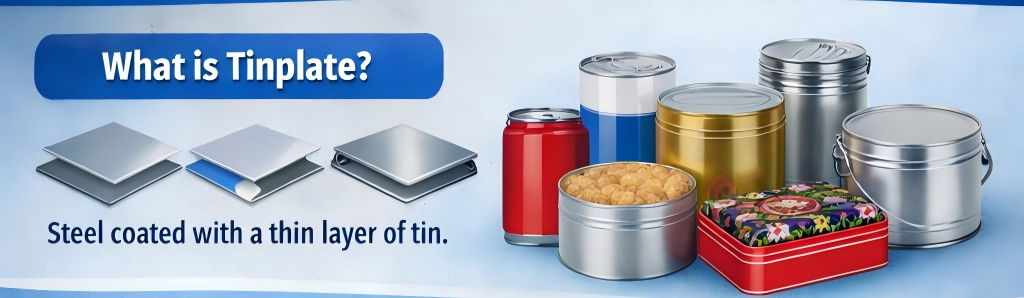
tinplate
1.What is Tinplate?
Tinplate is a composite metal material formed by electroplating a thin layer of tin onto cold-rolled low-carbon steel sheets.
This tin coating not only effectively prevents rusting but also enhances corrosion resistance while imparting a smooth, lustrous surface ideal for printing and coating applications.
Combining the strength of steel with the protective properties of tin, tinplate is extensively used in various packaging and industrial product manufacturing, such as: food packaging (canned goods, milk powder tins), beverage cans, cookie tins, tea tins, paint cans, chemical containers, and industrial and electronic components.
2.Tinplate Production Process
Tinplate production involves multiple precision manufacturing steps to ensure product quality and performance.
A.Cold Rolling
Production begins with low-carbon steel billets, which are cold-rolled into thinner steel sheets. This process enhances the sheet’s strength and produces a smoother surface.
B.Cleaning and Annealing
The cold-rolled sheets undergo cleaning to remove oils and impurities. Annealing follows to restore ductility, facilitating subsequent processing.
C.Tin Plating
An even layer of tin is deposited onto the steel surface through electroplating. This is the most critical step in tinplate production, as the tin coating significantly enhances the material’s corrosion resistance and surface quality.
D.Surface Treatment
After tin plating, the material typically undergoes additional surface treatments such as:
Passivation
Oil coating
Surface finishing
These steps enhance the tinplate’s oxidation resistance while improving print-ability and coating adhesion.
E.Cutting or Coiling
Tinplate is processed into coils or sheets according to customer specifications to facilitate various manufacturing and production processes.
3. Advantages of Tinplate
Tinplate’s widespread adoption in packaging and industrial applications stems primarily from the following strengths:
A.Superior Corrosion Resistance
The tin coating effectively shields the steel substrate from rust, making tinplate particularly suitable for food and beverage packaging.
B.Excellent Work-ability
With high ductility, tinplate readily accommodates stamping, bending, welding, and forming, making it suitable for manufacturing diverse metal containers and tins.
C.Smooth and Aesthetic Surface
Its flat, smooth surface is ideal for printing and coating applications, frequently chosen for premium packaging designs.
D.High Food Safety
Long employed in food packaging, tinplate is recognized as a safe and reliable food-grade material.
E.Environmentally Friendly and Recyclable
Tinplate is a 100% recyclable material, aligning with current green and sustainable development trends.
4.Key Characteristics of Tinplate
Compared to other metals, tinplate exhibits the following distinct features: high mechanical strength, relatively light weight, excellent sealing properties, ease of welding and processing, durability, and recyclability.
These properties enable tinplate to play a vital role in food packaging, gift packaging, and industrial manufacturing.
Tinplate is a metal material that combines strength, corrosion resistance, and aesthetic appeal, holding a vital position in modern packaging and industrial production. From food cans to exquisite gift tins, tinplate provides reliable and eco-friendly solutions for products.
If you are seeking high-quality tinplate materials, please feel free to contact us anytime.