
How to Select Tinplate for Food Canning?
In the food canning industry, packaging serves not only as the “outer garment” but also directly impacts food safety, freshness, and taste. Tinplate, with its corrosion resistance, strong sealing properties, and excellent print-ability, has become the preferred material for food canning packaging. So how should one choose?
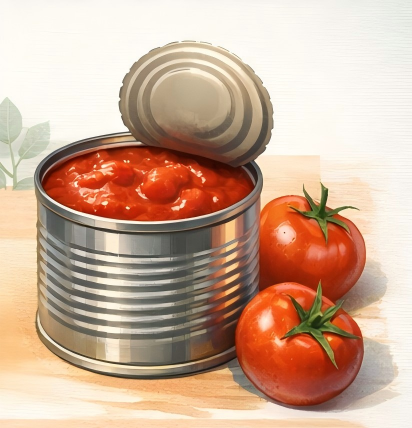
tinplate
1.Understand the Fundamental Characteristics of Tinplate
Tinplate is a metal material made by coating low-carbon steel sheet with a thin layer of tin. It offers the following advantages:
Corrosion and Rust Resistance: The tin layer blocks air and moisture, preventing rust and extending shelf life.
Excellent Sealing Properties: High-quality tinplate cans paired with premium lids ensure vacuum seals, blocking air and bacteria.
Strong Print-ability: The smooth surface allows direct printing of product information and designs, enhancing brand image.
Eco-Friendly and Recyclable: Tinplate is 100% recyclable, aligning with modern environmental values.
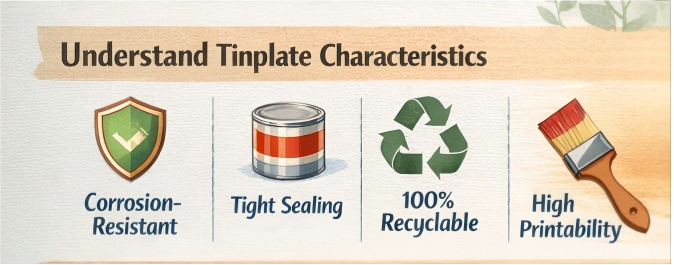
Tinplate Characteristics
2.Selecting Tinplate Cans Based on Food Type
Different foods have distinct requirements for can materials:
Proper selection not only extends shelf life but also preserves flavor and ensures safety. Detailed guidelines by food category:
A.High-Acidity Foods
Material requirements: Use tinplate cans with thicker tin layers and superior corrosion resistance to prevent direct contact between acidic liquids and metal.
Inner Coating: Preferably use food-grade epoxy or polyester coatings to enhance corrosion resistance and odor prevention.
Process Notes: Ensure vacuum-sealed closures. Acidic liquids corrode upon air exposure; poor sealing may cause can rust or food spoilage.
Additional Tip: Acidic foods may chemically react with metal. Conduct acid resistance testing before long-term storage.
B.Oily Foods
Material Requirements: Oil-resistant, high-temperature-resistant tinplate cans with moderate thickness and uniform tin coating.
Inner Coating: Requires food-grade coatings resistant to high temperatures and oil corrosion, such as epoxy or polyester coatings.
Process Notes: Oily foods typically undergo high-temperature sterilization or pasteurization. Cans must withstand high-temperature steam or hot water immersion while ensuring leak-proof sealing.
Additional Note: Selecting oil-resistant and heat-resistant materials reduces grease penetration into the tin layer, preventing metal contamination of food or off-flavors.
C.Dry Goods
Material Requirements: Primarily consider sealing and moisture resistance. Moderate tin layer thickness is acceptable, but lids must seal tightly.
Inner Coating: Dry goods generally have low chemical reaction requirements, but an inner coating can enhance moisture resistance and preserve flavor.
Process Notes: Dry goods are prone to moisture damage, so lids often incorporate rubber gaskets or vacuum sealing to prevent air and moisture ingress.
Additional Tip: Opt for square or square-rounded can shapes to enhance storage efficiency and visual appeal.
High-Acidity Foods → Thick Tin Layer + Anti-Corrosion Coating + Vacuum Seal
Oily Foods → High-Temperature Resistance + Oil-Resistant Coating + High Sealing Integrity
Dry goods → Prioritize moisture-proof sealing + Aesthetic packaging design
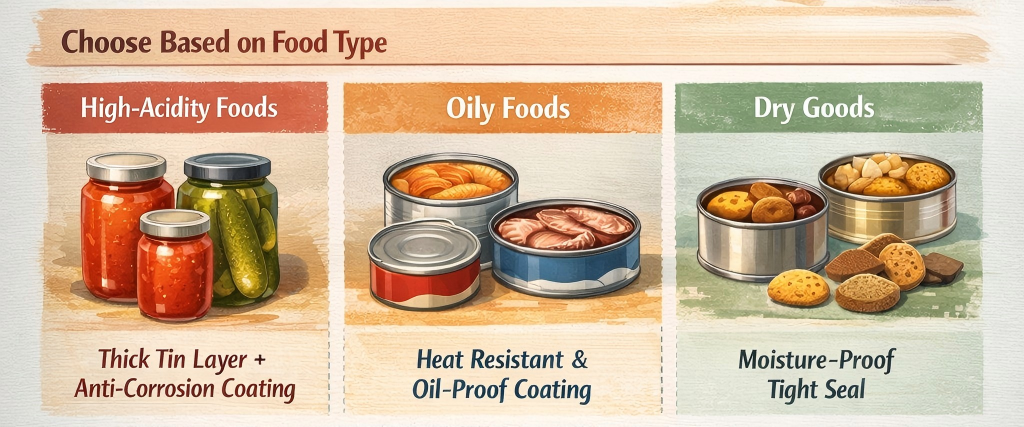
Tinplate choose
3.Focus on Tinplate Can Craftsmanship and Quality
When selecting tinplate cans, consider not only the material but also the manufacturing process and quality details. The can body thickness, lid sealing integrity, surface coating, and printing techniques directly impact food safety, freshness retention, and consumer experience.
A.Can Body Thickness
Standard Thickness: Food-grade tinplate cans typically range from 0.18–0.25mm.
Thickness Selection Principles:
Too Thin: Prone to deformation and dents from impact, compromising seal integrity and transport safety.
Too Thick: Increases cost and processing complexity.
Practical Recommendations: Select appropriate thickness based on food weight, can size, and shipping distance. For example:
– Light dry goods: 0.18–0.20mm
– Oily or high-acid canned goods: 0.22–0.25mm
Additional note: Thickness inconsistencies may cause poor lid sealing, affecting shelf life. Sample testing for thickness uniformity is recommended before purchase.
B.Lid Sealing Performance
Sealing criticality: High-quality lids paired with tinplate cans enable long-term vacuum preservation, preventing air, moisture, and microbial ingress.
Common Types: Pull-tab lids, flip-top lids, screw-on lids, or standard press-on lids. Different food types have varying sealing requirements:
High-acid or liquid foods: Lids with vacuum seals or tamper-evident seals are recommended to ensure long-term preservation.
Dry goods: Sealing rings or easy-open lids suffice, but moisture resistance must still be ensured.
Testing Methods: Conduct hydro-static pressure tests or vacuum tests before production to verify reliable lid sealing.
C.Surface Coating
Function: Internal coatings prevent direct food-metal contact, avoiding metallic off-flavors and chemical reactions while enhancing preservation.
Common coatings: Food-grade coatings like epoxy (EPOXY) or polyester (PET).
Safety standards: Must comply with FDA, EU, or domestic food contact material regulations.
Selection Tips: Different foods require varying coating resistance to acids/alkali’s and fats/oils. Acidic foods demand acid-resistant coatings, while fatty foods require oil-resistant and heat-resistant coatings.
D.Printing Process
Common Techniques: Thermal transfer, screen printing, gravure printing, etc.
Function: Beyond aesthetics, print clarity impacts brand image and consumer trust.
Recommendations:
Gravure printing is ideal for mass production, offering sharp patterns and abrasion resistance.
For small batches or customization, use thermal transfer or screen printing.
Added Value: Some printing processes can incorporate anti-counterfeiting labels, QR codes, or eco-labels to enhance value and brand professionalism.
Comprehensive Recommendations
Pr-purchase Sample Inspection: Verify uniform thickness, reliable lid sealing, intact inner coating, and clear printing.
Match Food Type: Adjust thickness, sealing, coating, and printing process based on food characteristics.
Prioritize quality details: Even identical materials may exhibit performance issues during transportation, storage, or sales due to manufacturing variations.
Conclusion: Tinplate cans require more than just “good material.” The combined quality of can body thickness, lid sealing, inner coating, and printing techniques determines food safety, freshness preservation, and consumer experience. Selecting the right manufacturing process ensures food cans are safe, durable, and visually appealing.