
Efficiency, Safety, Stability—Detailed Analysis of Bowl-Couple Scaffolding’s Technical Advantages
Bowl-couple scaffolding represents a highly advantageous standardized socket-type steel tube scaffolding system in modern construction engineering. As a core temporary support facility on construction sites, it performs critical functions such as erecting elevated work platforms, bearing heavy form-work loads, and providing construction safety protection. This directly impacts construction safety, operational efficiency, and overall project cost control. This system utilizes patented bowl-couple joints as its core connecting components, integrated with standardized vertical poles, horizontal beams, diagonal braces, and various accessories to form a complete load-bearing framework. Its features of quick assembly, structural stability, and high versatility make it the preferred support solution for building construction, municipal projects, bridges, and other engineering applications.
1. What is Bowl-Couple Scaffolding?
Bowl-couple scaffolding is a socket-type support system primarily constructed from high-frequency welded steel tubes. It utilizes integrally stamped bowl-couple joints to achieve rapid connection and fixation of vertical poles, horizontal poles, and diagonal braces without requiring additional bolts or nuts for auxiliary fastening. This modular, standardized system represents an innovative scaffolding approach.
Its core structure comprises six key components. Through various combinations, it can flexibly assemble scaffolding frameworks suitable for diverse complex construction environments. It is widely applied in multiple construction fields including building construction, municipal bridge construction, tunnel engineering, and large-scale equipment installation:
· Vertical load-bearing: Steel pipe uprights
· Horizontal load-bearing: Crossbars (horizontal members)
· Lateral stability: Diagonal braces (diagonal members)
· Core Connections: Bowl Couples (Upper Bowl Couple, Lower Bowl Couple, Stop Pin)
· Height Adjustment: Top Brackets, Bottom Brackets
· Foundation Accessories: Base Plates, Coupling Sleeves
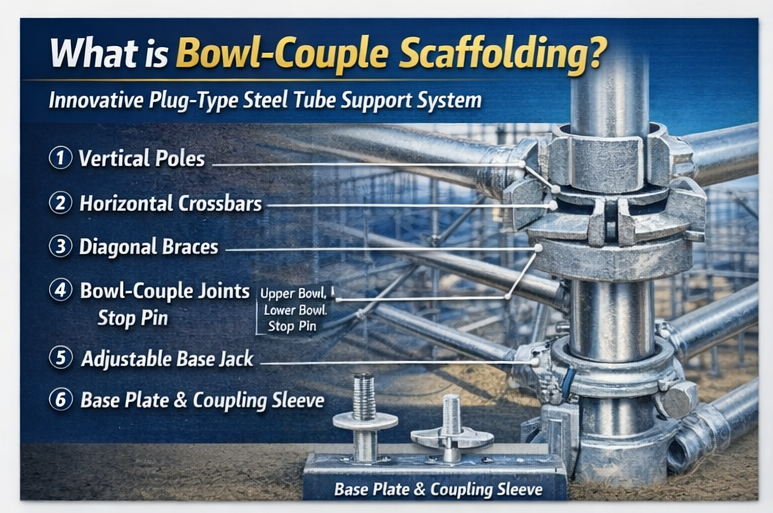
Bowl-Couple Scaffolding
2. Structural Advantages: Stability Rooted in Scientific Design
As a new generation of standardized scaffolding, bowl-couple scaffolding offers multiple significant advantages over traditional couple-type scaffolding and other types in construction efficiency, structural stability, and operational costs. It aligns with modern construction demands for high efficiency, safety, and energy conservation:
Structural Stability with High Safety Factor
Bowl-couple joints are integrally stamped and formed, featuring fully automated submerged arc welding to uprights. This ensures high weld strength without stress concentration issues. Horizontal plugs lock securely into bowl sockets with a single insertion, eliminating risks of loosening or detachment. The entire scaffold forms a spatial rigid frame structure with strong lateral force resistance and settlement resistance, effectively withstanding external loads like construction vibrations and wind forces. This significantly reduces safety hazards associated with scaffold collapse or instability.
Rapid Assembly/Disassembly Doubles Construction Efficiency
Modular design enables “one-click locking, one-pull disassembly” without tools like wrenches, accelerating erection/dismantling by 3-5 times compared to traditional coupler scaffolding. Significantly boosting single-worker productivity, it reduces on-site labor requirements, shortens erection schedules, and aligns with project phased construction rhythms.
Standardized Modularity with Exceptional Adaptability
All poles and accessories are standardized with uniform specifications and high interchangeability. They can be freely combined to easily assemble single-row, double-row working platforms, heavy-duty form-work supports, and curved/fan-shaped structures. This adaptability suits irregular building structures, complex sites, and variable conditions while maximizing space utilization.
High Re-usability, Low Overall Cost
Members are fabricated from Q235 high-quality carbon structural steel with hot-dip galvanized corrosion protection, offering superior corrosion and wear resistance. With no vulnerable consumable parts, they support multiple reuse cycles. Bowl-type couplings exhibit no loosening or deformation wear, requiring only simple inspections for maintenance—eliminating frequent component replacements and significantly reducing overall costs for equipment procurement, upkeep, and labor.
Streamlined Management, Tidy and Orderly Site
Standardized components eliminate loose bolts, nuts, and small parts, effectively preventing loss or damage during construction. The neatly arranged framework after erection facilitates on-site safety management and material storage, meeting standardized construction site management requirements.
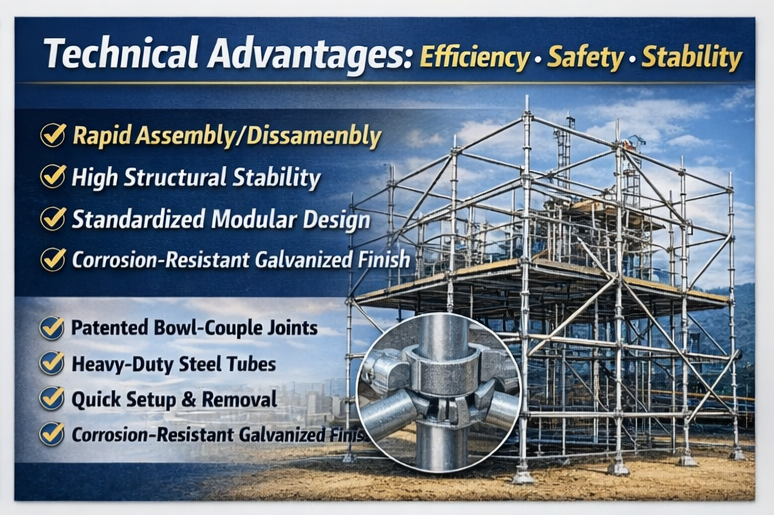
Structural Advantages
3. Efficient Construction: Significantly Accelerates Project Progress
Rapid Installation and Dismantling
The bowl-couple scaffolding features a plug-in structure requiring minimal bolts and fittings. Connections are achieved through simple hammering or rotation, drastically reducing setup and dismantling times.
Flexible Modular Configuration
Standardized system components can be freely combined based on construction height and operational requirements, making it suitable for various complex structural projects and effectively reducing on-site secondary processing.
Reduced Labor Costs
Simplified operation procedures lower technical dependency on construction personnel. Ordinary workers can be deployed after minimal training, contributing to overall labor cost savings.
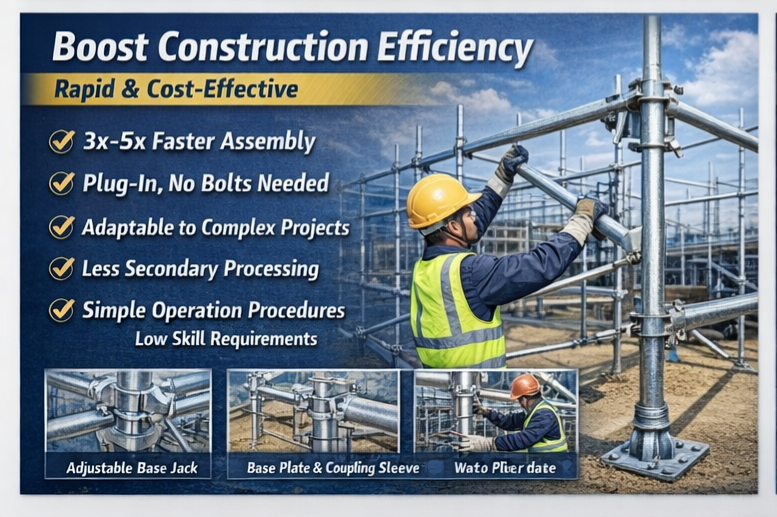
Boost Construction Efficiency
4. Key Application Scenarios Analysis
Bowl-couple scaffolding, renowned for its flexible erection, high load-bearing capacity, and easy assembly/disassembly, has become a widely adopted scaffolding type in construction. It serves multiple functions including work platform construction, heavy-load support, and safety protection, comprehensively meeting construction needs throughout the entire building process. Core application scenarios fall into four major categories:
Main Building Structure Construction
Suitable for concrete pouring, re-bar tying, masonry work, and steel structure installation in residential buildings, office towers, industrial plants, and super high-rise structures. It can form heavy-duty form-work support frames and elevated work platforms, providing stable and secure working surfaces for vertical and horizontal construction while meeting the high-load demands of tall and super high-rise buildings.
Finishing and Decoration Projects
During decorative phases like wall plastering, exterior insulation, door/window installation, curtain wall construction, and interior ceiling finishing, specialized lightweight scaffolding can be erected. Its height and spacing are flexibly adjustable to accommodate diverse building facades and interior spaces. Quick assembly/disassembly ensures no damage to the building’s main structure.
Municipal & Bridge/Tunnel Engineering
Applied to overpasses, elevated bridges, urban utility tunnels, municipal road renovations, and tunnel portal construction. Flexible configurations like curved or ladder-shaped frames accommodate specialized support requirements for bridge piers, box girders, and other complex structures. Corrosion-resistant components withstand outdoor humid and dusty conditions, with structural stability meeting municipal engineering standards.
Large-Scale Equipment Installation and Temporary Support Protection
Serves as a full-span load-bearing support scaffold for installing large industrial equipment and building mechanical/electrical systems. Also functions as safety guardrails around excavation pits, floor edges, elevator shaft openings, and material storage areas. Additionally, it acts as primary material for erecting temporary construction shelters and emergency repair support structures, providing dual roles in temporary load-bearing support and safety protection.
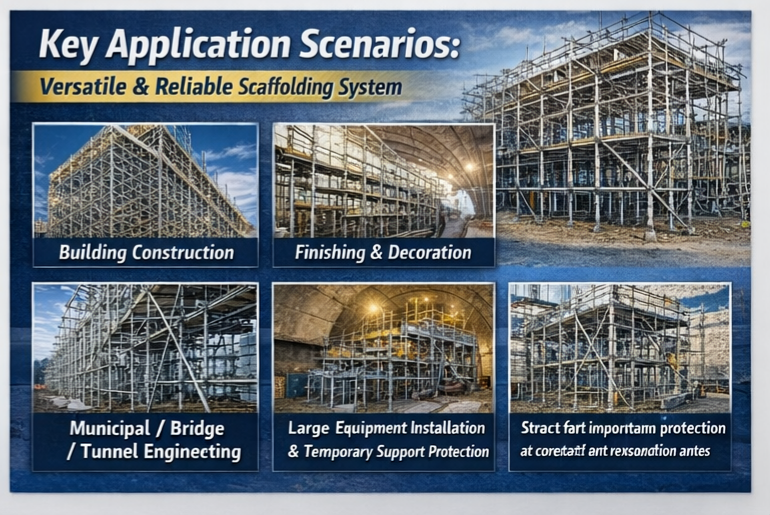
Application Areas