
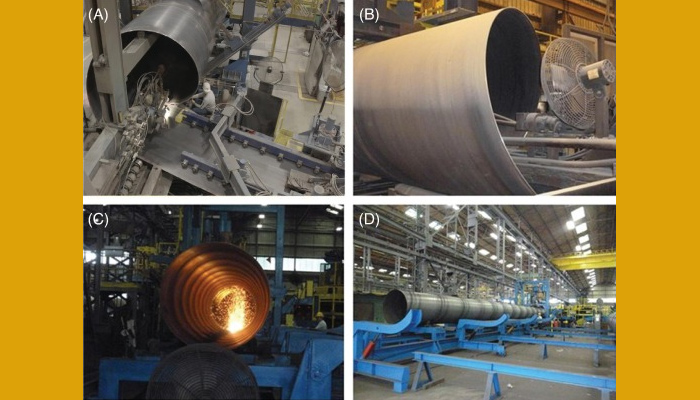
How to Select the Right Large Diameter Spiral Welded Pipe Specification
How to Select the Right Large Diameter Spiral Welded Pipe Specification
Introduction
Selecting the right large diameter spiral welded pipe specification is an important step in the design and procurement of water transmission, drainage, industrial, and infrastructure pipeline projects. The correct specification can improve pipeline safety, hydraulic performance, installation efficiency, and long-term cost control.
Choosing a pipe only by diameter or price is not enough. Factors such as wall thickness, steel grade, operating pressure, installation conditions, coating, applicable standards, and transportation requirements should all be evaluated before placing an order.
This guide explains the key factors buyers, engineers, contractors, and project owners should consider when selecting large diameter spiral welded steel pipe.
1. Determine the Required Pipe Diameter
Pipe diameter is one of the first specifications to determine because it directly affects the flow capacity of a pipeline.
The required diameter should be selected according to:
- Required flow rate
- Pipeline length
- Fluid characteristics
- Allowable pressure loss
- Pumping requirements
- Future expansion requirements
A larger diameter generally provides greater flow capacity and can reduce flow resistance. However, an oversized pipe increases material, transportation, and installation costs.
For this reason, the best diameter is not necessarily the largest available size. It should provide sufficient flow capacity while maintaining reasonable project costs.
For municipal water supply and long-distance transmission projects, hydraulic calculations should be completed before finalizing the pipe diameter.
2. Select the Correct Wall Thickness
Wall thickness is another critical specification for large diameter spiral welded pipe.
It affects:
- Pressure resistance
- Structural strength
- Pipe weight
- Material cost
- Transportation
- Installation requirements
Higher operating pressure normally requires greater wall thickness. However, excessive wall thickness can result in unnecessary steel consumption and higher project costs.
Engineers should consider design pressure, pipe diameter, steel grade, external loads, installation conditions, and applicable design standards when determining wall thickness.
For underground pipelines, external forces such as soil pressure, traffic loads, groundwater, and ground settlement should also be evaluated.
The goal is to select a wall thickness that provides sufficient safety without unnecessary over-design.
3. Choose the Appropriate Steel Grade
Steel grade has a direct influence on pipe strength and service performance.
Depending on the project, buyers may need to evaluate:
- Yield strength
- Tensile strength
- Impact toughness
- Weldability
- Chemical composition
For standard water supply and drainage systems, conventional pipeline-grade steel may provide sufficient performance.
For high-pressure industrial pipelines or demanding infrastructure projects, higher-strength steel grades may be considered.
However, higher-strength steel is not always the most economical choice. The selected material should match the actual engineering requirements rather than simply using the highest available grade.
4. Consider Operating and Design Pressure
The pipe specification must be compatible with the pressure conditions of the pipeline.
Before selecting the pipe, determine:
- Normal operating pressure
- Maximum operating pressure
- Pressure fluctuations
- Pressure surge
- Water hammer conditions
- Required safety margin
For example, water transmission pipelines may experience sudden pressure changes when pumps start or stop.
If these conditions are ignored, the pipeline may experience excessive stress.
Therefore, pipe diameter, wall thickness, steel grade, and connection method should be considered together when designing the pipeline system.
5. Evaluate the Installation Environment
The installation environment can significantly influence the required pipe specification.
Large diameter spiral welded pipes may be installed:
- Underground
- Above ground
- Underwater
- Inside tunnels
- In industrial facilities
- In coastal or corrosive environments
For buried pipelines, engineers should consider soil conditions, external loads, groundwater, ground movement, and traffic loads.
For above-ground pipelines, additional factors may include wind loads, vibration, thermal expansion, and pipe support spacing.
A pipe specification suitable for one environment may not be appropriate for another. Therefore, installation conditions should be considered before production begins.
6. Select the Right Pipe Length and End Configuration
Pipe length can affect both construction efficiency and logistics.
Longer pipe sections can reduce the number of field joints and welding operations, potentially lowering:
- Labor costs
- Installation time
- Number of connection points
However, excessively long pipes may create transportation and handling challenges.
Project teams should consider road restrictions, transportation equipment, site access, lifting capacity, and storage conditions.
Pipe ends should also match the project’s connection method. Common options include plain ends, beveled ends, and customized configurations.
For field welding, properly prepared beveled ends can help improve welding efficiency and joint quality.
7. Choose the Appropriate Corrosion Protection
Corrosion protection is essential for extending the service life of large diameter spiral welded steel pipe.
The coating system should be selected according to the operating and installation environment.
Common solutions include:
3PE Coating
Three-layer polyethylene coating is widely used for underground steel pipelines. It provides strong external corrosion protection and mechanical resistance.
Epoxy Coating
Epoxy coatings can be used for internal or external protection. They are suitable for applications requiring good chemical resistance and a relatively smooth internal surface.
Cement Mortar Lining
Cement mortar lining can be considered for certain water transmission applications to provide internal protection.
When selecting a coating, buyers should evaluate soil conditions, fluid characteristics, temperature, chemical exposure, and expected service life.
8. Confirm Applicable Standards
Before purchasing large diameter spiral welded pipe, buyers should confirm the standards required by the project.
Depending on the application and target market, relevant standards may include:
- ASTM
- API
- AWWA
- EN
- ISO
Standards can define requirements for:
- Chemical composition
- Mechanical properties
- Pipe dimensions
- Welding quality
- Testing
- Inspection
- Coating
It is important to confirm the exact standard, grade, testing requirements, and project specifications instead of simply asking whether the pipe is “standard compliant.”
Conclusion: Choose the Right Specification for Long-Term Performance
Selecting the right large diameter spiral welded pipe specification requires more than simply choosing a pipe based on diameter or purchase price. A reliable pipeline solution should be designed around the project’s actual operating conditions, performance requirements, and long-term cost objectives.
Before placing an order, buyers and engineers should carefully evaluate key factors such as pipe diameter, wall thickness, steel grade, operating pressure, installation environment, pipe length, end configuration, corrosion protection, and applicable standards. Each specification can influence the pipeline’s structural strength, hydraulic efficiency, installation process, service life, and overall project cost.
