
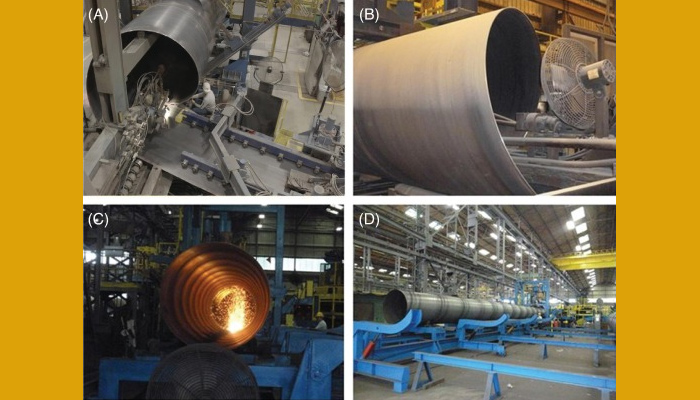
Understanding Large Diameter Spiral Welded Steel Pipe Manufacturing Process
Introduction: The Importance of Manufacturing Quality in Large Diameter Spiral Welded Steel Pipe
Large diameter spiral welded steel pipes play a critical role in modern infrastructure and industrial development. They are widely used in applications such as:
- Municipal water transmission systems
- Drainage and sewage networks
- Oil and gas transportation
- Industrial pipelines
- Mining operations
- Hydraulic engineering projects
Because these pipelines often operate under high pressure, harsh environmental conditions, and long-term service requirements, the manufacturing process directly determines their performance, reliability, and service life.
A high-quality large diameter spiral welded steel pipe is not simply produced by welding steel strips together. It requires advanced forming technology, precise welding processes, strict quality inspection, and professional surface protection.
Understanding the manufacturing process helps engineers, contractors, and buyers evaluate product quality and select reliable suppliers for large-scale pipeline projects.
What Is Large Diameter Spiral Welded Steel Pipe?
Large diameter spiral welded steel pipe is a type of welded steel pipe manufactured by continuously forming steel coils into a cylindrical shape and welding the spiral seam along the pipe body.
Unlike seamless steel pipes, which are produced from solid steel billets, spiral welded pipes are made from steel strips or coils.
The basic manufacturing concept includes:
- Steel coil preparation
- Spiral forming
- Welding of spiral seams
- Pipe cutting
- Inspection and testing
- Surface treatment and coating
This production method allows manufacturers to produce pipes with:
- Large diameters
- Long lengths
- Customized wall thicknesses
- Various steel grades
These characteristics make spiral welded steel pipes highly suitable for large-scale pipeline systems.
1. Raw Material Selection and Inspection
High-Quality Steel Coils Are the Foundation
The first stage of manufacturing begins with selecting suitable steel coils.
The quality of raw materials directly affects:
- Pipe strength
- Welding performance
- Corrosion resistance
- Long-term durability
Before production, manufacturers conduct strict inspections of steel coils.
Key inspection items include:
Chemical Composition Analysis
This ensures that the steel meets required standards and contains appropriate levels of:
- Carbon
- Manganese
- Silicon
- Other alloying elements
Mechanical Property Testing
Testing includes:
- Tensile strength
- Yield strength
- Elongation
- Impact toughness
These properties determine whether the pipe can withstand operating conditions.
Surface Quality Inspection
Steel coils are checked for:
- Cracks
- Surface defects
- Rust
- Deformation
Only qualified materials can enter the production process.
2. Steel Coil Uncoiling and Preparation
After inspection, steel coils are transported to the production line.
The preparation process includes:
Coil Uncoiling
The steel coil is gradually opened and flattened using specialized equipment.
This process ensures:
- Smooth steel strip feeding
- Stable forming performance
- Reduced production defects
Edge Treatment
The edges of the steel strip are processed to improve welding quality.
Proper edge preparation helps achieve:
- Better welding penetration
- Stronger weld joints
- More stable pipe performance
3. Spiral Forming Process
Creating the Pipe Shape
The spiral forming process is the core step of manufacturing large diameter spiral welded steel pipe.
During this stage, the flat steel strip passes through forming rollers and gradually changes into a cylindrical pipe shape.
Unlike straight seam welded pipes, the pipe is formed at an angle, creating a spiral structure.
The forming process requires precise control of:
- Pipe diameter
- Forming angle
- Roundness
- Steel strip alignment
Advantages of Spiral Forming Technology
The spiral forming method provides several benefits:
Flexible Diameter Production
Manufacturers can produce different pipe diameters by adjusting:
- Steel strip width
- Forming parameters
- Production settings
Better Material Utilization
The process allows efficient use of steel coils, reducing material waste.
Suitable for Large Diameter Pipes
Spiral forming is particularly advantageous for producing:
- Large water transmission pipes
- Industrial pipelines
- Infrastructure steel pipes
4. Spiral Seam Welding Process
Submerged Arc Welding Technology
After forming, the spiral seam must be permanently joined through welding.
The most commonly used method for large diameter spiral welded steel pipe is:
Submerged Arc Welding (SAW)
This advanced welding technology provides:
- High welding strength
- Deep penetration
- Stable weld quality
- High production efficiency
Internal and External Welding
Professional manufacturers usually perform both:
Internal Welding
Provides structural support and improves joint strength.
External Welding
Ensures complete sealing and enhances overall durability.
The combination of internal and external welding creates a strong and reliable pipe structure.
5. Pipe Cutting and Dimension Control
After welding, the continuous pipe is cut into required lengths.
Typical customization includes:
- Standard pipe lengths
- Project-specific dimensions
- Special connection requirements
During this stage, manufacturers carefully control:
- Pipe length
- Diameter accuracy
- Wall thickness
- End shape
Accurate dimensions are essential because they affect:
- Pipeline installation efficiency
- Connection quality
- System performance
6. Non-Destructive Testing and Quality Inspection
Quality inspection is one of the most important stages in large diameter spiral welded steel pipe manufacturing.
Professional manufacturers use multiple inspection methods.
Weld Seam Inspection
The welding seam is carefully examined using:
Ultrasonic Testing (UT)
Used to detect internal welding defects.
X-Ray Inspection
Used to identify hidden weld problems.
Visual Inspection
Checks surface appearance and welding quality.
These methods help ensure that pipes can safely handle operational pressure.
Dimensional Inspection
Manufacturers measure:
- Outer diameter
- Wall thickness
- Pipe length
- Roundness
- Straightness
Accurate dimensions ensure compatibility during installation.
Hydrostatic Testing
Hydrostatic testing verifies whether the pipe can withstand pressure conditions.
During testing, pipes are filled with water and exposed to controlled pressure.
This confirms:
- Leak resistance
- Structural integrity
- Pressure capability
7. Surface Treatment and Anti-Corrosion Coating
Protecting Pipes From Environmental Damage
Large diameter spiral welded steel pipes are often used underground or in outdoor environments.
Without proper protection, steel pipes may suffer from corrosion.
Therefore, surface treatment is an essential manufacturing step.
Common Anti-Corrosion Solutions
3PE Coating
Three-layer polyethylene coating is one of the most popular solutions for underground pipelines.
Advantages include:
- Excellent corrosion resistance
- Strong mechanical protection
- Long service life
Common applications:
- Water pipelines
- Oil and gas pipelines
- Underground infrastructure
Epoxy Coating
Epoxy coatings provide:
- Smooth internal surfaces
- Chemical resistance
- Improved flow efficiency
They are widely used in:
- Industrial pipelines
- Wastewater systems
- Chemical environments
8. Final Inspection and Product Approval
Before shipment, finished pipes undergo final inspection.
Manufacturers verify:
- Product specifications
- Surface quality
- Coating condition
- Test results
- Documentation
Professional suppliers provide quality documents such as:
- Material certificates
- Inspection reports
- Test records
These documents help customers confirm product reliability.
Key Factors Affecting Manufacturing Quality
The quality of large diameter spiral welded steel pipe depends on several factors.
1. Manufacturing Equipment
Advanced production lines improve:
- Accuracy
- Efficiency
- Consistency
2. Welding Technology
High-quality welding determines:
- Pipe strength
- Pressure resistance
- Service life
3. Quality Control System
A complete inspection system reduces:
- Manufacturing defects
- Installation problems
- Operational risks
4. Experienced Technical Team
Skilled engineers and operators ensure:
- Stable production
- Proper process control
- Effective problem solving
Applications of Large Diameter Spiral Welded Steel Pipe
Because of its excellent performance, large diameter spiral welded steel pipe is widely used in:
Municipal Water Supply
Applications:
- Main transmission pipelines
- Water treatment facilities
- Urban distribution systems
Drainage and Sewage Systems
Applications:
- Stormwater pipelines
- Wastewater transportation
- Flood control projects
Industrial Projects
Applications:
- Power plants
- Steel factories
- Chemical facilities
- Mining operations
Hydraulic Engineering
Applications:
- Water diversion projects
- Reservoir connections
- Hydropower systems
Conclusion: Manufacturing Process Determines Pipe Performance
The manufacturing process of large diameter spiral welded steel pipe involves multiple critical stages, from raw material selection and spiral forming to welding, inspection, and corrosion protection.
Each step directly affects:
- Structural strength
- Pipeline safety
- Operating efficiency
- Service life
With advanced manufacturing technology and strict quality control, spiral welded steel pipes provide a reliable and economical solution for modern infrastructure and industrial pipeline projects.
For engineers, contractors, and project owners, understanding the manufacturing process helps ensure better product selection and long-term project success.
Choosing an experienced large diameter spiral welded steel pipe manufacturer is essential for achieving high-quality, durable, and cost-effective pipeline systems.
