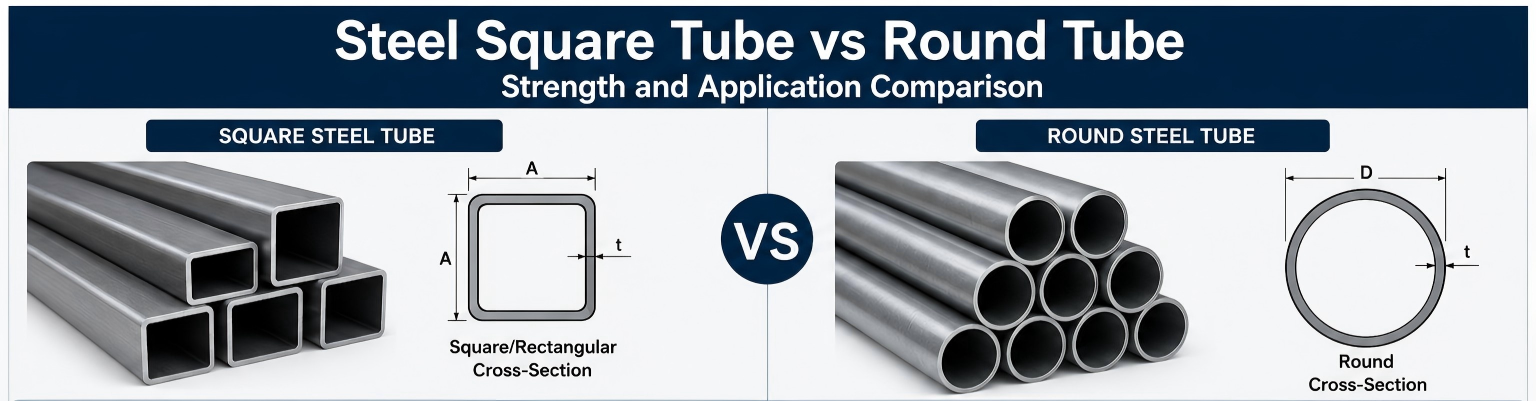
Steel Square Tube vs Round Tube: Strength and Application Comparison
Introduction
Steel tubes are among the most widely used structural materials in construction, manufacturing, infrastructure, and industrial applications. Among the various types available, steel square tubes and round steel tubes are the two most common options.
When selecting materials for a project, engineers, contractors, and buyers often ask:
Steel Square Tube vs Round Tube: Which is stronger and which one is better for my application?
The answer depends on the specific requirements of the project. While both types offer excellent strength and durability, their structural characteristics make them suitable for different applications.
In this article, we will compare square steel tubes and round steel tubes in terms of strength, load-bearing capacity, fabrication, cost, and practical applications to help you make the right decision.
What Is a Steel Square Tube?
A steel square tube is a hollow structural section (HSS) with a square or rectangular cross-section. It is typically manufactured through hot rolling, cold forming, or welding processes.
Key characteristics include:
- Flat surfaces on all four sides
- Easy connection and installation
- Excellent bending resistance
- Efficient use of space
Common sizes include:
- 20 × 20 mm
- 40 × 40 mm
- 50 × 50 mm
- 100 × 100 mm
- 200 × 200 mm
Square steel tubes are widely used in:
- Building frameworks
- Structural steel projects
- Warehouse racking systems
- Machinery bases
- Fencing and guardrail systems
What Is a Round Steel Tube?
A round steel tube is a hollow steel section with a circular cross-section. It is one of the most versatile and widely used steel products across numerous industries.
Key characteristics include:
- Uniform stress distribution
- Excellent torsional strength
- Efficient fluid transportation
- Reduced wind resistance
Common sizes include:
- 25 mm OD
- 50 mm OD
- 76 mm OD
- 114 mm OD
- 168 mm OD
Typical applications include:
- Pipeline systems
- Bridge structures
- Automotive components
- Bicycle frames
- Oil and gas transportation
Steel Square Tube vs Round Tube: Strength Comparison
Many people assume that square tubes are stronger simply because of their shape. However, strength must be evaluated based on the type of load and stress involved.
1. Bending Strength
When comparing steel tubes of the same material and weight, square tubes generally offer superior bending resistance.
This is because more material is distributed farther from the neutral axis, resulting in a higher moment of inertia.
Benefits include:
- Greater bending resistance
- Reduced deflection
- Better performance as beams and frames
For this reason, square tubes are commonly used in:
- Structural frames
- Equipment supports
- Storage racks
- Building beams
Winner: Square Tube
Bending Strength: Square Tube > Round Tube
2. Torsional Strength
Torsional strength refers to a tube’s ability to resist twisting forces.
Round tubes have a significant advantage because their circular geometry distributes torsional stress evenly around the entire cross-section.
In contrast, square tubes tend to develop stress concentrations at the corners.
Advantages of round tubes include:
- Better resistance to twisting
- Improved fatigue performance
- Longer service life under cyclic loading
Applications such as drive shafts, bicycle frames, and mechanical components often rely on round tubes for this reason.
Winner: Round Tube
Torsional Strength: Round Tube > Square Tube
3. Compression Strength
Under axial compression loads, round tubes generally perform slightly better.
The circular shape allows forces to be distributed evenly throughout the structure, reducing the risk of localized buckling.
As a result, round tubes are frequently used in:
- Bridge columns
- Structural supports
- Towers
- Heavy-load applications
Winner: Round Tube
Compression Strength: Round Tube > Square Tube
4. Impact Resistance
Round tubes naturally disperse impact forces more effectively than square tubes.
When subjected to sudden impacts:
- Stress spreads evenly around the circumference
- Localized stress concentration is minimized
Square tube corners can become weak points under severe impact loads.
For applications involving vehicle structures or transportation equipment, round tubes are often preferred.
Winner: Round Tube
Impact Resistance: Round Tube > Square Tube
Fabrication and Processing Comparison
Welding Performance
Square tubes offer a clear advantage when it comes to welding and assembly.
Their flat surfaces provide:
- Larger contact areas
- Easier alignment
- Faster installation
As a result, square tubes are widely favored in structural steel fabrication.
Cutting and Machining
Square tubes are easier to process because they:
- Remain stable during cutting
- Are easier to clamp and position
- Improve automation efficiency
Round tubes require specialized fixtures to prevent rolling during machining, which can increase production complexity.
For large-scale manufacturing projects, square tubes often help reduce fabrication costs.
Space Utilization
One significant advantage of square tubes is their efficient use of space.
For example, a 100 × 100 mm square tube provides a larger usable internal area for:
- Electrical conduits
- Equipment frames
- Modular structures
Round tubes leave unused space near the edges due to their circular geometry.
Therefore, square tubes are often preferred in applications where space efficiency matters.
Aerodynamic Performance
Round tubes excel in aerodynamic environments.
Because they have no corners, they generate less drag and experience lower wind loads.
This makes round tubes ideal for:
- Light poles
- Communication towers
- Wind energy structures
- Stadium frameworks
In regions with strong winds, round tubes frequently outperform square tubes.
Cost Comparison
Material prices vary depending on market conditions, but in general:
Material Cost
The raw material cost difference between square and round tubes is relatively small.
Fabrication Cost
Square tubes often result in lower overall fabrication expenses due to:
- Easier cutting
- Simpler welding
- Faster installation
For large structural projects, these savings can significantly reduce total project costs.
Application Comparison
When to Choose Steel Square Tubes
Square tubes are typically the better choice for:
- Building frames
- Structural steel fabrication
- Warehouse shelving systems
- Equipment supports
- Fencing systems
- Modular construction
Main advantages:
- Superior bending strength
- Easy fabrication and assembly
- Lower processing costs
When to Choose Round Steel Tubes
Round tubes are ideal for:
- Fluid transportation systems
- Bridge columns
- Bicycle frames
- Automotive components
- Oil and gas pipelines
- Wind energy projects
Main advantages:
- Excellent torsional strength
- Better compression performance
- Lower wind resistance
Square Tube vs Round Tube: Quick Comparison Table
| Performance Factor | Square Tube | Round Tube |
|---|---|---|
| Bending Strength | ★★★★★ | ★★★★☆ |
| Torsional Strength | ★★★☆☆ | ★★★★★ |
| Compression Strength | ★★★★☆ | ★★★★★ |
| Welding Convenience | ★★★★★ | ★★★☆☆ |
| Processing Efficiency | ★★★★★ | ★★★☆☆ |
| Aerodynamic Performance | ★★★☆☆ | ★★★★★ |
| Space Utilization | ★★★★★ | ★★★☆☆ |
| Fluid Transportation | ★☆☆☆☆ | ★★★★★ |
| Structural Frameworks | ★★★★★ | ★★★★☆ |
| Pipeline Applications | ★☆☆☆☆ | ★★★★★ |
Conclusion
In the debate of Steel Square Tube vs Round Tube, there is no universal winner.
If your project requires:
- High bending strength
- Easy welding and installation
- Lower fabrication costs
Then steel square tubes are usually the better choice.
If your project prioritizes:
- Torsional strength
- Compression resistance
- Fluid transportation efficiency
- Aerodynamic performance
Then round steel tubes are likely the superior solution.
In many engineering projects, both square and round tubes are used together to maximize structural performance and cost efficiency. Understanding the unique advantages of each type will help you select the most suitable material, improve safety, and achieve long-term reliability.