
Scaffolding Systems – The Core Support System for Construction Projects
Scaffolding systems are a crucial component of construction projects, providing workers with safe and stable high-altitude work platforms and serving as vital infrastructure for ensuring project quality and construction efficiency. The scaffold frame, as the core load-bearing structure of the system, connects the ground foundation to the work platform, integrates various rods and components, and bears and transmits construction loads. Scientific selection, standardized erection, and regular maintenance are of great significance for ensuring construction safety and improving project efficiency.
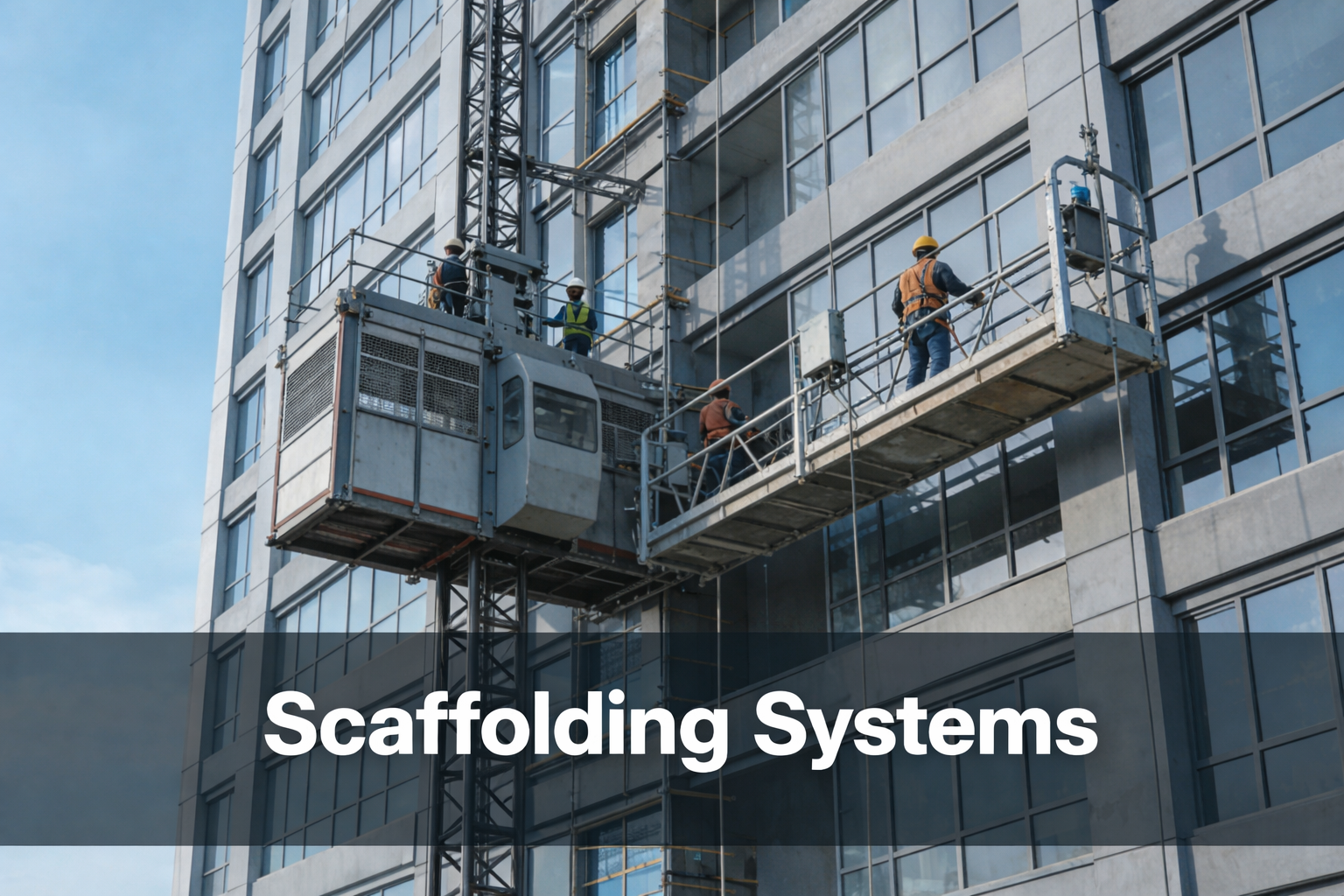
Scaffolding System
1.Definition and Main Functions of Scaffolding Systems
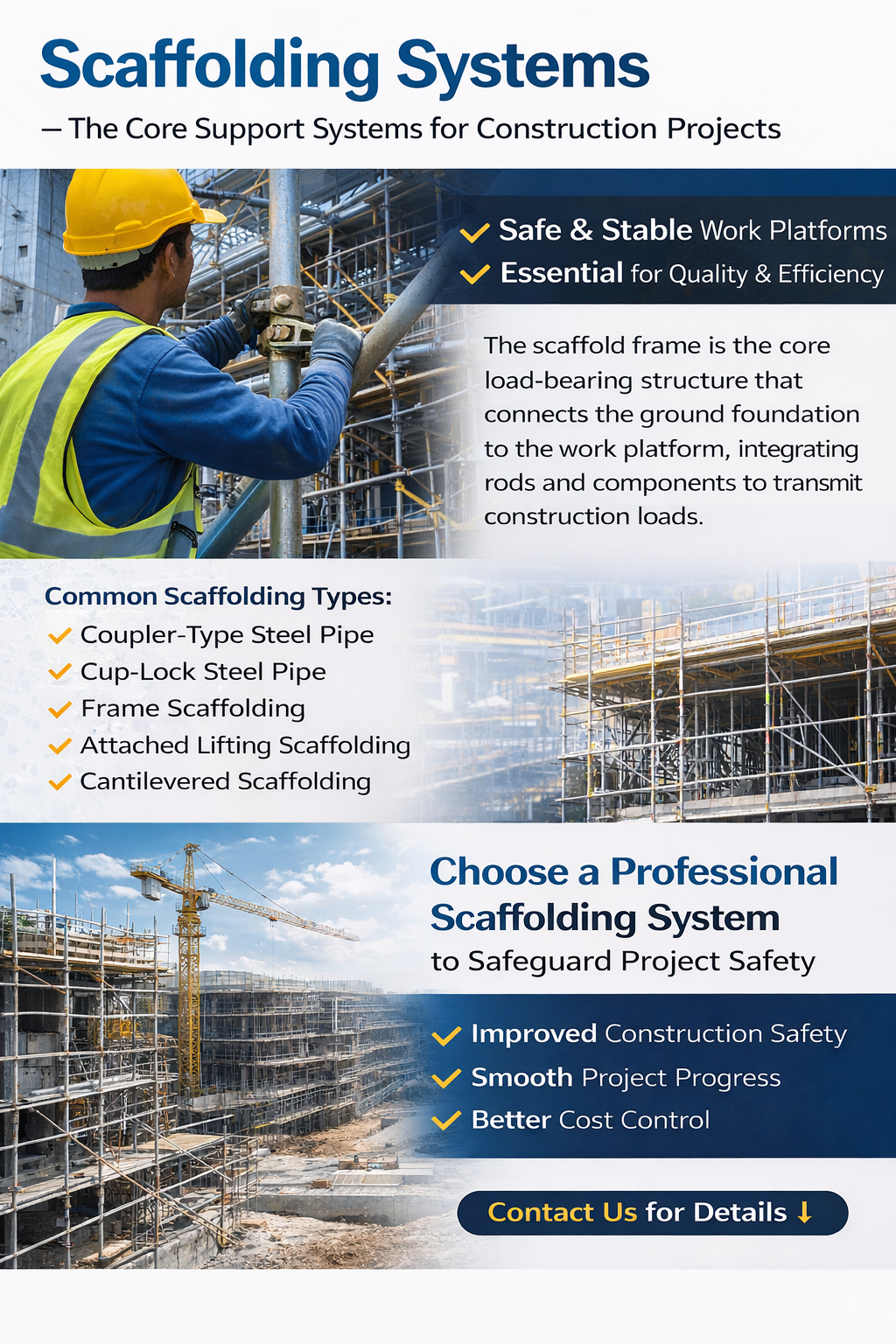
Common Scaffolding Types
A.Coupler-type Steel Pipe Scaffolding
Composed of steel pipes and couplers, it offers flexible erection and strong applicability, widely used in various construction projects.
B.Cup-lock Steel Pipe Scaffolding
Utilizes a modular structural design, ensuring strong connections and convenient assembly and disassembly, significantly improving construction efficiency.
C.Frame Scaffolding
Offers good overall stability and a high degree of structural standardization, commonly used in large-area construction areas such as factories and stadiums.
D.Attached Lifting Scaffolding
Can be raised and lowered synchronously with the main building structure, suitable for exterior wall construction of high-rise and super high-rise buildings.
E.Cantilevered Scaffolding:
Fixed to the main structure via embedded parts, suitable for special construction sites where ground-mounted scaffolding cannot be erected.
2.Uses and Importance of Scaffolding Systems
Core Functions
Scaffolding systems provide a reliable working platform for construction personnel, equipment, and materials, maintain the stability of the construction structure, and the scaffold itself is the key carrier for transmitting various loads.
Environmental Adaptability
The scaffolding structure can effectively resist the influence of external forces such as construction loads and wind loads, ensuring operational safety in complex construction environments.
3.Common Forms of Scaffolding Systems
Type |
Main Features |
Applicable Scenarios |
Ground-Mounted Scaffolding |
High load-bearing capacity, high overall stability |
Low-rise buildings, projects with good foundation conditions |
Cantilevered Scaffolding |
Does not occupy ground space |
High-rise buildings and podium connection parts |
Attached Lifting Scaffolding |
Automatic lifting, saving labor and materials |
High-rise exterior wall construction |
4.Core Components of Scaffolding Systems
Scaffolding Frame
Frame Classification and Characteristics
Type |
Main Features |
Coupled Steel Pipe Frame |
Materials readily available, flexible erection; requires regular inspection to prevent couplers from loosening |
Bowl-lock Steel Pipe Frame |
Sturdy nodes, high standardization, high turnover efficiency |
Aluminum Alloy Frame |
Lightweight, corrosion-resistant, suitable for medium and light-duty construction |
Main Component Types
A.Uprights
Uprights are vertical load-bearing components, bearing all vertical loads of the frame. Standard specification steel pipes should be used, and connection strength should be ensured when butt-jointing or lap-jointing. A base and pad must be installed at the bottom to prevent uneven settlement.
B.Horizontal Bars
Horizontal bars include longitudinal and transverse bars, connected to the uprights via couplers to form a horizontal frame structure. Spacing should meet the requirements of the construction plan and satisfy the scaffolding board laying standards.
C.Scaffolding Boards
Scaffolding boards are the main working surface for construction workers. Common types include wooden boards, steel boards, and bamboo boards. They should be fully laid and fixed, with no protruding boards, and gaps must meet specifications.
Steel scaffolding boards: High strength, long service life, suitable for heavy-duty operations.
Bamboo scaffolding boards: Lightweight, low cost, suitable for light-duty operations.
D.Wall Ties
Wall ties are used to connect the scaffolding to the main structure and are crucial components for preventing scaffolding collapse. Rigid connections should be used, with spacing and positions set according to specifications. Arbitrary removal is strictly prohibited. If removal is necessary, temporary reinforcement measures must be taken and the scaffolding restored promptly.
E.Scissor Bracing
Scissor bracing is arranged in a crisscross pattern on the outside of the scaffolding to enhance lateral displacement resistance and overall stability. Scaffolding should be continuously installed and securely connected to the uprights and horizontal bars, with angles controlled between 45° and 60°. Special attention should be paid to reinforcement at corners and ends.
F.Component Connections
Connecting components are a crucial foundation for ensuring the stable operation of scaffolding.
Couplers: Including right-angle couplers, swivel couplers, and butt couplers, they should meet quality standards and achieve the specified tightening torque.
Bowl-lock joints: Possessing self-locking function, ensuring a secure connection and efficient assembly/disassembly.
Bolt connections: Used for assembling portal scaffolding; require regular inspection for rust prevention and loosening prevention.
Scaffolding System
